


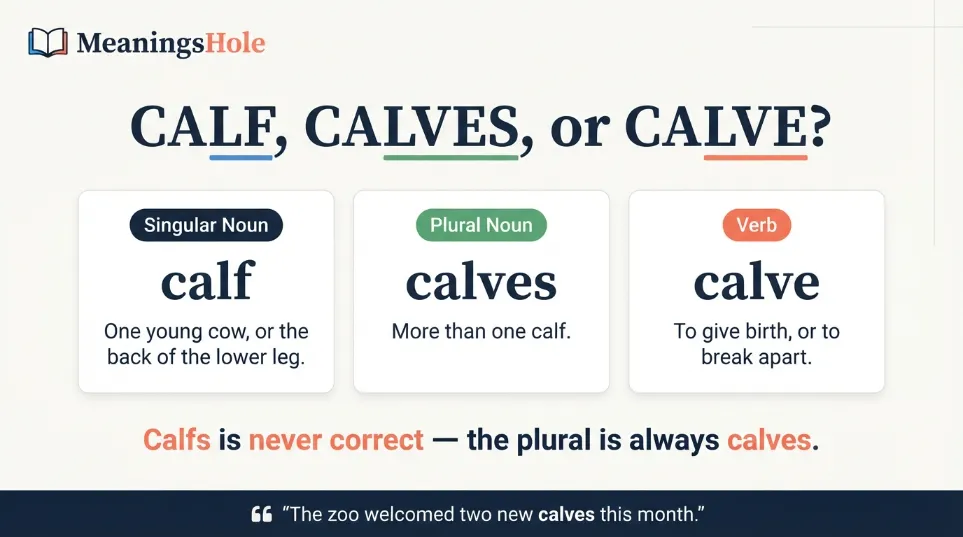
Quick Answer: Calves is the correct plural form of the noun calf. Calve is a different word entirely, used as a verb meaning to give birth or to break apart. Example: The farmer counted twelve calves in the field.
My neighbor raises cattle on a small farm nearby. Last spring, she posted a sign that read, “Three new calfs born this week!” A visitor gently pointed out the mix-up, and she laughed about it for days. She told me later that she always second-guessed herself with this word, unsure whether it was calfs, calves, or something else entirely.
That mix-up is more common than people think. Many English nouns don’t just add an “s” for the plural form, and calf is one of them. On top of that, there’s a completely separate word, calve, that looks almost identical but means something else altogether.
If calf or calve has ever left you second-guessing a sentence, this guide will clear it up. We’ll walk through the rule, the reasoning, and plenty of real examples, so the confusion disappears for good.
Calf or Calve: Quick Answer
Calves is the correct plural of calf.
Calve is a separate word, used as a verb.
Calfs is incorrect and should be avoided.
Examples
- The zoo welcomed two new calves this month.
- The cow is expected to calve any day now.
Incorrect Example
- The zoo welcomed two new calfs this month.
What Does “Calf” Mean?
Everything starts with the noun calf. It’s a word with more than one meaning, depending on the context. Most often, it refers to a young cow, though it can also describe the young of other large animals, like elephants or whales.
Calf also has a second, unrelated meaning. It names the muscular part of the leg, just below the knee and above the ankle.
Examples
- The calf followed its mother across the pasture.
- She stretched her calf before the morning run.
- The elephant calf stayed close to the herd.
When you’re talking about more than one, the spelling changes. Calf becomes calves, and that shift is exactly where most writers slip.
What Does “Calve” Mean?
Here’s where things get interesting. Calve isn’t the plural of calf at all. It’s a completely different word, and it happens to be a verb.
Calve means:
- To give birth, usually used for cows
- To break off and separate, often used for glaciers or icebergs
Examples
- The cow is due to calve within the next few days.
- Massive chunks of ice calve from the glacier each summer.
Notice how different this is from calves. One is a plural noun. The other is an action word entirely.
Why Is “Calves” the Correct Plural?
English has a specific pattern for nouns ending in f or fe. It isn’t random, and it isn’t just a style choice some writers follow. Many of these words change their ending when they become plural.
The f gets replaced with v. Then es gets added at the end. This shift keeps the word flowing naturally, and it applies to a whole family of similar nouns, not just calf.
The Pattern
- calf → calves
- leaf → leaves
- knife → knives
This is a consistent grammar rule, not a random exception.
The Incorrect Pattern
- calf → calfs ❌
Writing calfs breaks this basic spelling rule completely.
Calf vs Calves vs Calve: Side-by-Side Comparison

| Word | Part of Speech | Meaning |
| Calf | Noun (singular) | One young cow, or the back of the lower leg |
| Calves | Noun (plural) | More than one calf |
| Calve | Verb | To give birth, or to break apart |
Key Takeaway
Use calves for plural nouns, and calve only as a verb.
The Grammar Rule, Explained Simply
Let’s slow down and look closer at why this happens. Once you understand the mechanics, the confusion tends to disappear for good.
Rule for Nouns Ending in F or FE
Many nouns that end in f or fe follow this same shift.
- Singular ends in f or fe → change to v, then add es
Step-by-Step: Turning Calf Into Calves
Step 1: Look at the final letter of calf. It’s f.
Step 2: Because it ends in f, the swap rule applies.
Step 3: Remove the f.
Step 4: Add ves in its place.
Step 5: You land on calves. That’s the finished word.
Nouns That Follow the Same Pattern
| Singular | Plural |
| Calf | Calves |
| Leaf | Leaves |
| Knife | Knives |
| Wife | Wives |
| Half | Halves |
Nouns That Break the Pattern
Not every f-ending word follows this rule.
| Singular | Plural |
| Roof | Roofs |
| Chief | Chiefs |
| Belief | Beliefs |
This split matters. English keeps a few exceptions, so it helps to double-check unfamiliar words.
Where Does the Word “Calf” Come From?
Calf has old roots stretching back to Old English, where a similar word described a young animal. Over centuries, it kept that core meaning while picking up a second one, describing part of the human leg, likely because of a visual resemblance between the two.
Calve, the verb, grew from the same root family. It described the act of a cow giving birth to its young. Later, that same word got borrowed to describe glaciers shedding large chunks of ice, since the imagery felt similar.
Why Do People Confuse Calf, Calves, and Calve?
This mix-up happens for a few clear reasons, and honestly, it makes sense once you break it down.
Most Nouns Just Add “S”
Think about cats, dogs, and books.
People naturally assume every plural works this way.
So calf becomes calfs in their mental shortcut.
The Words Look and Sound Alike
Calves and calve share almost the same letters.
That similarity makes it easy to swap them by mistake.
The F-to-V Rule Rarely Gets Taught Directly
Many learners never sit through a lesson on this specific pattern.
Without it, guessing becomes the default approach.
How These Words Show Up in Real Life
These words aren’t confined to grammar textbooks. They show up constantly, especially around farms, nature, and fitness.
On a Farm
- The farmer expects the cow to calve in early spring.
- Several calves grazed near the old barn.
In Nature Documentaries
- Massive slabs of ice calve from the glacier’s edge.
- A pod of whale calves swam beside their mothers.
At the Gym
- She felt a sharp pull in her calf during the sprint.
- His calves ached after the long hike uphill.
These Words in Everyday Writing
Emails
- The vet visits tomorrow to check on the calves.
- Please note the farm expects a cow to calve soon.
News Headlines
- Scientists study why glaciers calve faster each year.
- Local dairy farm welcomes ten new calves this spring.
Social Media Posts
- Just watched an iceberg calve into the sea!
- Meet our newest calves at the petting zoo.
Formal Reports
- The herd’s calves were weighed and recorded weekly.
- Researchers tracked when each cow began to calve.
Every Form of “Calf” and “Calve”
Knowing every form sharpens your grammar across the board.
| Word Form | Example |
| Singular Noun | calf |
| Plural Noun | calves |
| Base Verb | calve |
| Past Tense Verb | calved |
| Present Participle | calving |
Example Sentences
- The calf wobbled on its legs for the first time.
- Three calves rested beneath the old oak tree.
- The cow will likely calve before sunrise.
- The glacier calved a massive iceberg last winter.
- Farmers stay alert during calving season.
Common Mistakes People Make

Mistake 1: Adding Only an “S” to Calf
- ❌ The farm has six calfs this year.
- ✅ The farm has six calves this year.
Mistake 2: Using “Calve” Instead of “Calves”
- ❌ We saw three baby calve in the pasture.
- ✅ We saw three baby calves in the pasture.
Mistake 3: Using “Calves” Instead of “Calve”
- ❌ The cow is expected to calves next week.
- ✅ The cow is expected to calve next week.
Calf vs Calves vs Calve: Which One Fits?
This trips up even confident, experienced writers sometimes.
| Word | Used For |
| Calf | One young cow, or the back of the leg |
| Calves | More than one calf |
| Calve | The action of giving birth or breaking apart |
Examples
- One calf stood near the fence.
- Two calves grazed beside their mothers.
- The cow will calve sometime next week.
Similar Words That Follow the Same Rule
This pattern reaches well beyond the word calf alone.
| Singular | Plural |
| Leaf | Leaves |
| Knife | Knives |
| Wife | Wives |
| Half | Halves |
| Loaf | Loaves |
Every one of these swaps f for v before adding es, just like calf.
Easy Ways to Remember Calf, Calves, and Calve
Memory Trick 1
If a noun ends in f, think v for plural.
Calf → calves. Leaf → leaves.
Memory Trick 2
Remember that calve ends the same way verbs like give and leave do.
That “e” hints it’s an action word, not a plural noun.
Memory Trick 3
Picture one calf, then picture a whole herd of calves.
The image helps the plural spelling stick in memory.
Also read: Forest or Forrest: Meaning, Difference, Spelling Rules, Examples, and Correct Usage
British English vs American English
Here’s some reassuring news. There’s no split at all.
Calves works identically in both versions of English.
| Region | Correct Plural |
| American English | calves |
| British English | calves |
| Canadian English | calves |
| Australian English | calves |
Calfs stays incorrect everywhere in standard English writing.
Why Correct Spelling Actually Matters
A single misspelled word can leave a bigger impression than most people expect. Readers often form quick judgments within the first few lines, sometimes without even realizing they’re doing it.
In Professional Writing
A small slip can quietly chip away at your credibility.
- ❌ The ranch reported twenty new calfs this year.
- ✅ The ranch reported twenty new calves this year.
In Academic Writing
Spelling accuracy often shapes how research papers get graded.
In Digital Communication
Clean, correct spelling builds reader trust much faster.
Calf, Calves, and Calve in Spoken English
Spoken conversations rarely expose this mistake at all.
- The vet checked on the calves this morning.
- The cow is expected to calve soon.
The error mostly appears in writing, mainly because calves and calve sound fairly close when spoken quickly.
What the Usage Data Shows
Search trends and dictionaries consistently point to one answer.
Calves is the accepted, standard plural across every major source.
Calfs shows up almost entirely as a spelling mistake.
Farmers, vets, and professional writers all lean toward calves without exception.
Common Phrases Using These Words

Calf Muscle
- He pulled his calf muscle during the race.
Baby Calves
- The baby calves stayed close to their mothers.
Calving Season
- Calving season keeps the whole farm busy each spring.
Iceberg Calving
- Scientists study iceberg calving to track climate change.
More Real-Life Example Sentences
- The rancher bottle-fed the orphaned calf each morning.
- Six calves huddled together during the storm.
- The cow finally began to calve after midnight.
- Her calves were sore after the long bike ride.
- The glacier calved a chunk the size of a building.
- The zoo announced two new elephant calves.
- The dairy farm tracks every cow expected to calve.
- His calves felt tight after the steep trail run.
Practice Exercise 1: Fill in the Blank
Choose calf, calves, or calve for each sentence.
- The farm welcomed three new ______ this week. (Answer: calves)
- She stretched her sore ______ after the run. (Answer: calf)
- The cow is expected to ______ any day now. (Answer: calve)
Practice Exercise 2: Fix the Sentence
Rewrite each sentence correctly.
- The barn has five new calfs. (Answer: The barn has five new calves.)
- We watched the glacier calves into the ocean. (Answer: We watched the glacier calve into the ocean.)
- Both of her calve were sore after the hike. (Answer: Both of her calves were sore after the hike.)
A Deeper Look at the Grammar Rule
Why Does F Change to V?
English often swaps a final f for v before adding certain endings. This habit keeps pronunciation smooth, since “fs” can feel awkward to say compared to “ves.”
Compare the Patterns
| Incorrect | Correct |
| calfs | calves |
| leafs | leaves |
| knifes | knives |
This pattern threads through a noticeable portion of English nouns.
Also Read: Families or Familys: Meaning, Difference, Grammar Rules, Examples, and Correct Usage
Calf or Calve in Formal Writing
Formal writing leaves almost no room for guessing on this point.
Agricultural Reports
- The report tracked forty calves born this season.
Scientific Writing
- Researchers documented when each cow began to calve.
Journalism
- The article explained why glaciers calve more in warmer months.
Using calfs in any formal document tends to look careless and unpolished.
Words Related to Calf and Calve
| Word | Meaning |
| Calved | Past tense of calve |
| Calving | The act of giving birth, or its ongoing process |
| Heifer | A young female cow that hasn’t calved yet |
| Herd | A group of cattle, including calves |
These related words all circle back to farming and animal life.
Frequently Asked Questions
Is “calfs” a real word?
No. It’s not accepted in standard English grammar. The correct plural is always calves.
Is “calve” the plural of “calf”?
No. Calve is a verb, not a plural noun. The correct plural is calves.
What does “calve” mean exactly?
It means to give birth, usually for cows, or to break apart, often used for glaciers.
Is “calves” used in British English?
Yes. It’s correct across British and American English alike.
What is the past tense of calve?
The past tense is calved.
Why do people mix up calves and calve?
The words look and sound similar, even though one is a noun and the other is a verb.
Does “calf” always mean a baby cow?
No. It can also describe the back of the lower leg.
Final Thoughts
The debate over calf or calve really comes down to understanding two different words. Calves is the correct plural noun for more than one calf, while calve is a separate verb meaning to give birth or break apart.
That same f-to-v pattern also governs everyday words like leaf, knife, and half. So mastering it once doesn’t just fix one word. It clears up an entire category of common spelling slips, and that makes the small effort well worth it.
Whether you’re writing about farm life, fitness, or nature, this tiny distinction adds up over time. Correct spelling makes your writing look sharper, more careful, and more trustworthy.
Remember the shortcut: more than one calf means calves, while the action of giving birth means calve. Practice it a few times, and it will start feeling completely automatic.
Read more Topics on Meanings Hole
