


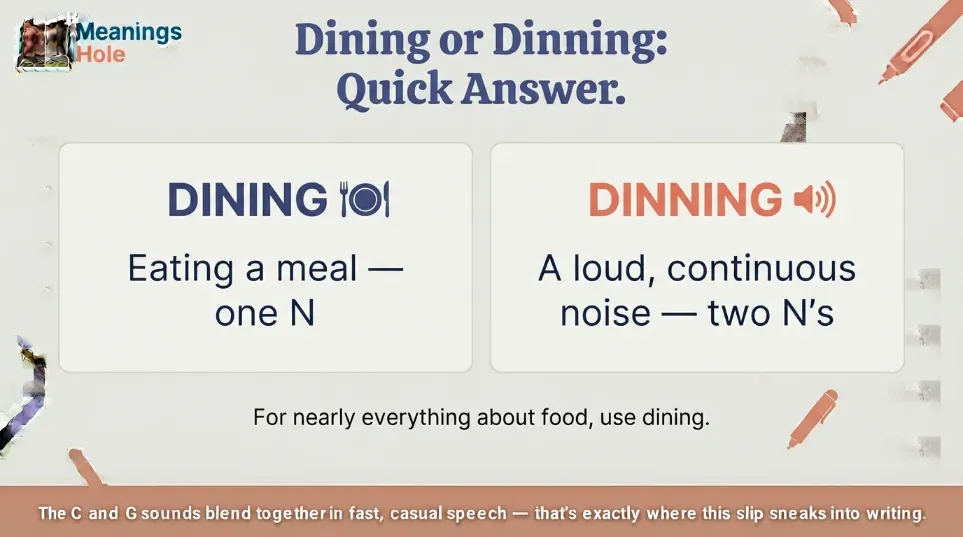
Quick Answer: Dining relates to eating a meal, usually in a formal or social setting. Dinning is a real but far less common word, describing a loud, continuous noise. Example: They enjoyed dining by candlelight while music was dinning faintly from another room.
A restaurant sign, a furniture catalog, and a poem about a thunderstorm might all use words from this same family, yet only one of them is actually describing food. Swap a single letter, and the whole meaning shifts from a quiet dinner table to a headache-inducing racket.
Most people only ever need one of these words, which is exactly why the other one catches people off guard when it shows up. Knowing both, and knowing when each applies, clears up a mix-up that trips up even careful writers.
If dining or dinning has ever left you second-guessing a menu, an invitation, or a sentence, here’s the full breakdown, with the reasoning and plenty of examples along the way.
Dining or Dinning: Quick Answer
Dining relates to eating a meal.
Dinning relates to a loud, continuous noise.
For nearly everything involving food or restaurants, use dining.
Examples
- They spent the evening dining at a cozy Italian restaurant.
- The construction noise kept dinning in her ears all afternoon.
Incorrect Example (When Meaning Food)
- They spent the evening dinning at a cozy Italian restaurant.
What Does “Dining” Mean?
Dining describes the act of eating a meal, especially in a formal, social, or restaurant setting. It’s the present participle of the verb dine, used constantly in menus, invitations, and everyday conversation about meals.
Examples
- The couple enjoyed dining at their favorite waterfront restaurant.
- The hotel offers elegant dining options for guests.
- They spent the evening dining and catching up with old friends.
Whenever you’re describing the act of eating, especially something a bit more formal than a quick snack, dining is the correct word.
What Does “Dinning” Mean?
Dinning is a real word, though far less common than dining. It’s the present participle of the verb din, meaning to make a loud, continuous, often unpleasant noise. This word shows up mostly in literary or descriptive writing about sound.
Examples
- The construction equipment kept dinning outside her window.
- Thunder was dinning across the valley throughout the night.
- The stadium crowd’s roar kept dinning in his ears for hours.
Notice how different this is from dining. One describes a meal. The other describes an ongoing, often overwhelming sound.
Why Are They Spelled Differently?
These two words come from completely separate roots, even though they look almost identical once -ing gets added. Dine already ends in a silent e, so adding -ing simply drops that e, creating dining.
Din, however, ends in a single consonant following a single, stressed vowel. That combination triggers English’s consonant-doubling rule, so din becomes dinning when adding -ing, doubling the final n.
Quick Way to Tell Them Apart
- Talking about a meal or restaurant? Use dining.
- Talking about a loud, continuous noise? Use dinning.
Dining vs Dinning: Side-by-Side Comparison

| Word | Root Verb | Meaning |
| Dining | Dine | Eating a meal, especially formally |
| Dinning | Din | Making a loud, continuous noise |
Key Takeaway
Match the word to its root verb: eating means dine → dining, while loud noise means din → dinning.
The Spelling Rule, Explained Simply
Since these two words come from different base verbs, the real skill is understanding why each one adds -ing differently.
Step-by-Step: Why “Dine” Becomes “Dining”
Step 1: Start with the base verb, dine.
Step 2: Notice it ends in a silent e.
Step 3: Drop that e before adding -ing.
Step 4: You land on dining, with a single n.
Step-by-Step: Why “Din” Becomes “Dinning”
Step 1: Start with the base verb, din.
Step 2: Notice it ends in a single consonant, n, after a single, stressed vowel.
Step 3: Because of that pattern, double the final consonant before adding -ing.
Step 4: You land on dinning, with a double n.
Comparing Similar Verb Pairs
| Base Verb | Ends In | “-ing” Form |
| Dine | Silent e | Dining |
| Din | Single consonant, stressed vowel | Dinning |
| Bake | Silent e | Baking |
| Run | Single consonant, stressed vowel | Running |
Where Do These Words Come From?
Dine traces back to Old French, connected to a word describing the act of taking a meal, particularly the main meal of the day. That root eventually shaped the modern sense of dining as a somewhat formal or social eating experience.
Din, meanwhile, comes from an entirely separate Old English root, describing a loud, harsh noise or clamor. That meaning has stayed remarkably consistent for centuries, still describing overwhelming or continuous sound today, from thunder to construction equipment to crowded stadiums.
Why Do People Confuse Dining and Dinning?
This mix-up happens for a few clear reasons, and honestly, it makes sense once you break it down.
The Words Look Nearly Identical
Both words share the same letters, aside from that single doubled n.
A quick glance can easily blend the two together.
“Dinning” Is Rarely Used in Everyday Writing
Most people encounter dine and dining constantly, but rarely see din or dinning at all.
That unfamiliarity makes the correct doubled spelling feel unusual or wrong, even when it’s accurate.
Autocorrect May Not Recognize “Dinning”
Since it’s a less common word, some spellcheck tools might flag it unnecessarily, adding to the confusion.
How These Words Show Up in Real Life
Dining shows up constantly across restaurants, hospitality, and everyday meals. Dinning stays mostly within descriptive or literary writing about sound.
In Restaurants and Hospitality
- The resort offers fine dining with ocean views.
- Guests enjoyed a relaxing dining experience by the pool.
In Descriptive or Literary Writing
- The factory machines kept dinning throughout the night shift.
- Waves were dinning against the rocks during the storm.
In Everyday Conversation
- We’re dining out tonight to celebrate her promotion.
- The traffic noise kept dinning outside our apartment for hours.
These Words in Everyday Writing
Emails
- Please confirm your dining preferences for the upcoming event.
News Headlines
- New dining district opens downtown with a dozen restaurants.
Social Media Posts
- Loved dining at this rooftop restaurant last night! 🍽️
Formal Reports
- The survey measured guest satisfaction with the hotel’s dining services.
Related Words and Forms
Knowing related forms sharpens your understanding of each word.
| Word | Type | Example |
| Dine | Verb | They dine at that restaurant every anniversary. |
| Dining | Present participle/noun | The dining room seats twelve guests. |
| Din | Noun/verb | The din of the crowd grew louder. |
| Dinning | Present participle | The alarm kept dinning throughout the building. |
Example Sentences
- They dined at a quiet countryside inn.
- The dining hall was decorated for the holidays.
- The din from the construction site was unbearable.
- Church bells kept dinning across the town square.
Also Read: Bodies vs Bodys: Meaning, Difference & Correct Spelling
Common Mistakes People Make

Mistake 1: Using “Dinning” for Meals
- ❌ We’re dinning at the new steakhouse tonight.
- ✅ We’re dining at the new steakhouse tonight.
Mistake 2: Using “Dining” for Loud Noise
- ❌ The alarm kept dining throughout the building.
- ✅ The alarm kept dinning throughout the building.
Mistake 3: Misspelling “Dining Room” With a Double N
- ❌ The dinning room table seats eight comfortably.
- ✅ The dining room table seats eight comfortably.
Dining vs Dinning: Which One Fits?
This trips up even careful writers sometimes, mostly due to how rarely dinning appears.
| Word | Used For |
| Dining | Eating a meal, restaurants, hospitality |
| Dinning | A loud, continuous, often unpleasant noise |
Examples
- The family enjoyed dining together every Sunday.
- Thunder kept dinning across the mountains all night.
- The restaurant’s dining room overlooks the harbor.
- The machinery’s dinning made conversation nearly impossible.
Similar Word Pairs Worth Knowing
This kind of silent-e versus doubled-consonant confusion shows up elsewhere too.
| Silent-E Verb | Doubling Verb |
| Dine → Dining | Din → Dinning |
| Hope → Hoping | Hop → Hopping |
| Tape → Taping | Tap → Tapping |
Comparing pairs like these trains your eye to notice which spelling rule applies before adding -ing.
Easy Ways to Remember Dining and Dinning
Memory Trick 1
Dining has one n, just like the single, calm act of sitting down to eat.
Memory Trick 2
Dinning has two n‘s, echoing the doubled, overwhelming quality of a loud noise.
Memory Trick 3
If you can swap in “eating,” it’s dining. If you can swap in “loud noise,” it’s dinning.
British English vs American English
Here’s some reassuring news. There’s no meaningful split.
Both words carry the same meaning and spelling in either version of English.
| Region | Dining Meaning | Dinning Meaning |
| American English | eating a meal | loud, continuous noise |
| British English | eating a meal | loud, continuous noise |
| Canadian English | eating a meal | loud, continuous noise |
| Australian English | eating a meal | loud, continuous noise |
There’s no regional shortcut that changes either word’s meaning or spelling.
Why Correct Spelling Actually Matters

A single swapped letter can leave a bigger impression than most people expect, especially on a restaurant sign or a formal invitation.
In Professional Writing
Using the wrong word can genuinely confuse the reader about what’s actually happening.
- ❌ Join us for an evening of fine dinning.
- ✅ Join us for an evening of fine dining.
In Hospitality and Marketing
Precise word choice matters, since restaurants and hotels rely on this word constantly.
In Digital Communication
Clean, correct word choice builds reader trust much faster.
Dining and Dinning in Spoken English
Spoken conversations can genuinely blur this difference, since the words sound extremely close, differing only slightly in emphasis.
- We’re dining out this weekend.
- The construction noise kept dinning all morning.
Listening closely to context usually clears up which word is actually meant.
What the Usage Data Shows
Dictionaries and style guides consistently confirm this distinction.
Dining appears constantly across restaurant, hospitality, and everyday meal-related writing.
Dinning appears far less often, mostly within literary or descriptive writing about sound.
Editors and professional writers keep these two carefully separate.
Common Phrases Using These Words
Fine Dining
- The city added several new fine dining restaurants this year.
Dining Room
- The dining room table was set for a holiday feast.
Constant Din
- The constant din of the city never fully faded at night.
Dinning in Her Ears
- The alarm kept dinning in her ears long after it stopped.
More Real-Life Example Sentences
- The couple enjoyed a quiet dining experience overlooking the lake.
- The factory’s machinery kept dinning throughout the entire shift.
- Their dining room was decorated beautifully for the holidays.
- Thunder kept dinning across the valley during the storm.
- The hotel offers both casual and fine dining options.
- The crowd’s cheers kept dinning long after the game ended.
- They’re dining with old friends at their favorite bistro tonight.
- The construction site’s dinning made it hard to concentrate.
Practice Exercise 1: Fill in the Blank
Choose dining or dinning for each sentence.
- We’re ______ at a new restaurant tonight. (Answer: dining)
- The alarm kept ______ throughout the building. (Answer: dinning)
- Their ______ room overlooks the garden. (Answer: dining)
Practice Exercise 2: Fix the Sentence
Rewrite each sentence correctly.
- We’re dinning at the new Italian place tonight. (Answer: We’re dining at the new Italian place tonight.)
- The construction noise kept dining outside all morning. (Answer: The construction noise kept dinning outside all morning.)
- Their dinning room table seats ten guests. (Answer: Their dining room table seats ten guests.)
A Deeper Look at the Words
Why Do They Look So Similar Despite Different Meanings?
Dining and dinning happen to collide visually purely because of how English adds -ing to short verbs. Dine, with its silent e, drops that letter, while din, ending in a stressed single consonant, doubles it. The rules are consistent, but the results land right next to each other on the page.
Compare the Patterns
| Word | Root Verb | Rule Applied |
| Dining | Dine | Drop the silent e |
| Dinning | Din | Double the final consonant |
Recognizing which rule applies to each root word makes the spelling difference much clearer.
Dinning or Dining in Formal Writing
Formal writing leaves almost no room for guessing on this point.
Hospitality Writing
- The resort’s dining options include three award-winning restaurants.
Literary and Descriptive Writing
- The relentless dinning of rain against the roof kept her awake.
Business Writing
- The report reviewed customer satisfaction across all dining venues.
Mixing up dining and dinning in a formal document can create real confusion for readers.
Words Related to Dining and Dinning
| Word | Meaning |
| Dine | To eat a meal, especially formally |
| Dinner | The main meal of the day |
| Din | A loud, continuous, often harsh noise |
| Clamor | A loud, confused noise, similar to din |
These related words split cleanly into two separate families, one about eating and one about sound.
Also Read: Discard vs Disgard: Meaning, Difference & Correct Spelling
Frequently Asked Questions
Are “dining” and “dinning” the same word?
No. Dining relates to eating a meal, while dinning relates to a loud, continuous noise.
How do I know which one to use?
Check the context. If it’s about food or restaurants, use dining. If it’s about noise, use dinning.
Is “dinning” a common word?
It’s far less common than dining, appearing mostly in literary or descriptive writing.
Is this distinction the same in British English?
Yes. It’s identical across British and American English.
Why does “dining room” only have one “n”?
Because it comes from dine, which drops its silent e before adding -ing, rather than doubling a consonant.
Can “dinning” ever describe pleasant sounds?
It typically describes noise that’s loud, continuous, and often unwelcome, rather than pleasant sounds.
Does autocorrect ever flag “dinning” as a mistake?
Sometimes, since it’s less common, though it remains a legitimate word.
Final Thoughts
The debate over dining or dinning really comes down to recognizing two unrelated words that happen to look almost identical. Dining connects to eating a meal, while dinning connects to a loud, ongoing noise, and the spelling difference comes from two completely different -ing rules.
Since context makes the meaning fairly clear most of the time, checking whether you’re describing food or sound will almost always point you toward the right word.
Whether you’re writing a restaurant review, a storm scene, or a dinner invitation, this small distinction adds up over time. Correct word choice makes your writing look sharper, clearer, and more precise.
Remember the shortcut: one n for the quiet act of eating, two n‘s for the overwhelming sound of noise. Practice it a few times, and it will start feeling completely automatic.
Read more Topics on Meanings Hole
