


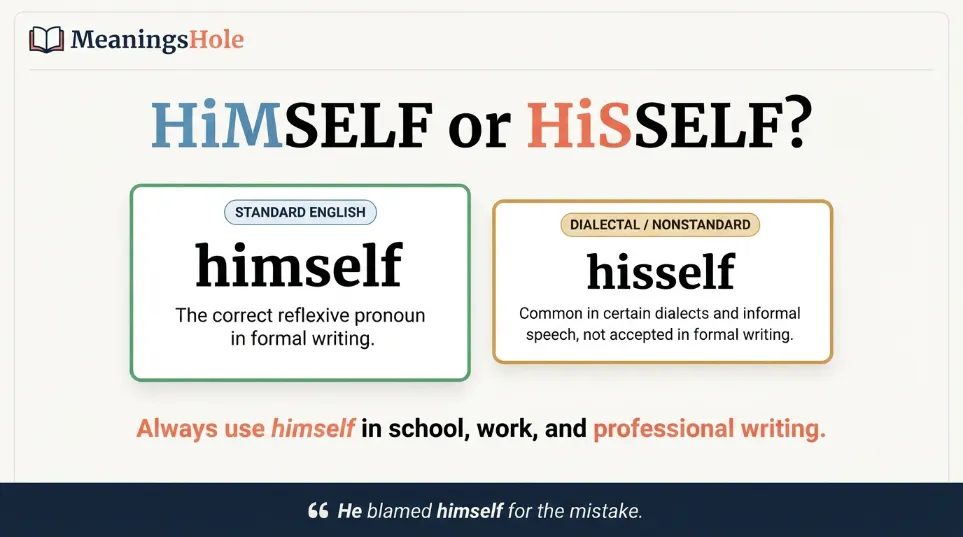
Quick Answer: Himself is the correct reflexive pronoun in standard English. Hisself is a nonstandard form, common in certain dialects and informal speech, but not accepted in formal writing. Example: He blamed himself for the mistake.
My grandfather grew up in a small rural town, and he always said, “He did it hisself.” I remember correcting my homework once, writing “hisself” without thinking twice, because that’s simply how I heard it spoken at home. My teacher circled it in red and wrote one word next to it: himself.
At first, I felt a little embarrassed, since the word felt completely natural to me. Later, I learned that hisself isn’t just a random mistake. It actually follows a logical pattern, one that simply never became part of standard English grammar.
If himself or hisself has ever made you pause, this guide will clear it up for good. We’ll walk through the meaning, the reasoning, and plenty of real examples, so you always know which one to reach for.
Himself or Hisself: Quick Answer
Himself is the correct, standard reflexive pronoun.
Hisself is nonstandard and should be avoided in formal writing.
Use himself in school, work, and professional settings.
Examples
- He taught himself to play guitar.
- She hurt herself while hiking last week.
Incorrect Example
- He taught hisself to play guitar.
What Does “Himself” Mean?
Himself is a reflexive pronoun, used when the subject and object of a sentence refer to the same male person. It shows that someone is doing something to or for themselves, rather than to another person.
Examples
- He blames himself for the missed flight.
- The boy dressed himself for school this morning.
- He finished the project entirely by himself.
Reflexive pronouns like himself appear constantly in everyday English, describing actions that circle back to the person performing them.
What Does “Hisself” Mean?
Hisself attempts to do the exact same job as himself. It shows up in certain regional dialects and informal speech patterns, most notably in some varieties of Southern American English and African American Vernacular English.
Examples (Dialectal, Not Standard)
- He did it all by hisself.
- He hurt hisself while chopping wood.
While these sentences make complete sense in casual conversation, hisself is not recognized in standard grammar textbooks, dictionaries as a formal entry, or professional writing.
Why Is “Himself” Correct Instead of “Hisself”?
This one isn’t about a spelling rule, like adding “s” or swapping letters. It’s about how English built its reflexive pronoun system centuries ago, and that system simply didn’t settle on the pattern hisself follows.
Most reflexive pronouns combine a possessive word with self or selves. But himself breaks that pattern slightly, using the object form him instead of the possessive form his. That inconsistency is exactly where hisself comes from, as an attempt to make the pattern more regular.
The Actual Pattern in Standard English
| Pronoun Type | Reflexive Form |
| I | myself |
| You | yourself |
| He | himself |
| She | herself |
| It | itself |
| We | ourselves |
| They | themselves |
Notice myself, yourself, and herself all use possessive forms (my, your, her). Himself, however, breaks that pattern by using him, not his.
Why “Hisself” Feels Logical
- his + self → hisself (following the possessive pattern)
This logic makes sense on paper. It just never became the accepted standard.
Himself vs Hisself: Side-by-Side Comparison

| Word | Correct or Incorrect | Usage |
| Himself | Correct | Standard reflexive pronoun |
| Hisself | Nonstandard | Used in dialects, not formal writing |
Key Takeaway
Always choose himself in school, work, and professional writing.
The Grammar Rule, Explained Simply
Let’s slow down and look closer at how reflexive pronouns actually form in standard English.
Rule for Reflexive Pronouns
Most reflexive pronouns follow one of two patterns.
- Possessive pronoun + self (myself, yourself, herself)
- Object pronoun + self (himself, itself)
Step-by-Step: Why Himself Uses “Him,” Not “His”
Step 1: Start with the subject, he.
Step 2: Look at its object form. That’s him, not his.
Step 3: English historically attaches self to that object form here.
Step 4: You land on himself, the accepted standard.
Step 5: Hisself would instead attach self to the possessive his, which never became standard.
Reflexive Pronouns Built From Object Forms
| Pronoun | Reflexive Form |
| Him | Himself |
| It | Itself |
Reflexive Pronouns Built From Possessive Forms
| Pronoun | Reflexive Form |
| My | Myself |
| Your | Yourself |
| Her | Herself |
| Our | Ourselves |
Where Does the Word “Himself” Come From?
Himself traces back to Old English, where reflexive meaning was often expressed differently than it is today. Over time, English speakers began attaching self to existing pronoun forms to create emphasis or reflect an action back onto the subject.
Him already existed as the object form of he, so himself grew naturally from that combination. Hisself, by contrast, likely developed later as speakers tried to make the system more consistent, since most other reflexive pronouns did rely on possessive forms. That version, however, never gained acceptance in formal, standardized English.
Why Do People Say “Hisself” Instead?
This usage happens for a few clear reasons, and it isn’t simply a random mistake.
The Possessive Pattern Feels More Consistent
My becomes myself. Her becomes herself.
So his becoming hisself feels like it should follow too.
Regional and Cultural Dialects Preserve It
Certain dialects have used hisself for generations.
Within those communities, it functions as completely normal speech.
It’s Rarely Explained in Grammar Lessons
Most grammar classes teach the standard forms only.
Few explain why himself breaks from the expected pattern.
How These Words Show Up in Real Life
Himself appears constantly across formal and everyday English. Hisself appears mostly in casual, regional, or dialectal speech.
In Standard Writing
- He congratulated himself on the promotion.
- The boy tied his shoes himself for the first time.
In Casual, Dialectal Speech
- He fixed it hisself, didn’t need no help.
- He always says he raised hisself.
In Storytelling and Dialogue
- “He built that whole barn hisself,” she said.
- Writers sometimes use hisself in dialogue to reflect a character’s voice.
These Words in Everyday Writing
Emails
- He completed the report himself before the deadline.
News Headlines
- Local man builds his own home almost entirely himself.
Social Media Posts
- Proud of him, he fixed the car all by himself!
Formal Reports
- The employee independently resolved the issue himself.
Every Form of Reflexive Pronouns
Knowing every form sharpens your grammar across the board.
| Subject | Standard Reflexive |
| I | myself |
| You (singular) | yourself |
| He | himself |
| She | herself |
| It | itself |
| We | ourselves |
| You (plural) | yourselves |
| They | themselves |
Example Sentences
- I taught myself how to cook.
- You should be proud of yourself.
- He surprised himself with the results.
- She treated herself to a nice dinner.
- They organized the entire event themselves.
Common Mistakes People Make

Mistake 1: Using “Hisself” in Formal Writing
- ❌ He completed the assignment hisself.
- ✅ He completed the assignment himself.
Mistake 2: Assuming All Reflexives Use Possessives
- ❌ It hurted itself on the fence. (also incorrect tense)
- ✅ It hurt itself on the fence.
Mistake 3: Mixing Up “Theirself” and “Themselves”
- ❌ They finished the project theirself.
- ✅ They finished the project themselves.
Himself vs Hisself: Which One Fits?
This trips up even confident writers sometimes, especially in casual speech.
| Word | Setting |
| Himself | Formal writing, school, work, standard English |
| Hisself | Informal speech, certain dialects only |
Examples
- He drove himself to the airport.
- He said he raised hisself since he was young. (dialectal speech, not formal writing)
- She encouraged him to believe in himself.
Similar Nonstandard Pronoun Forms
This pattern of nonstandard reflexive pronouns shows up elsewhere too.
| Standard Form | Nonstandard Form |
| Themselves | Theirself / Theirselves |
| Himself | Hisself |
Both nonstandard versions follow the same logic, attaching self to a possessive pronoun instead of an object pronoun.
Easy Ways to Remember Himself
Memory Trick 1
Picture him plus self. Not his plus self.
Memory Trick 2
Compare it to itself. Both use the object form, not the possessive.
Memory Trick 3
If you’re writing something formal, always default to himself.
British English vs American English
Here’s some reassuring news. There’s no meaningful split.
Himself stays correct in every major English dialect worldwide.
| Region | Standard Form |
| American English | himself |
| British English | himself |
| Canadian English | himself |
| Australian English | himself |
Hisself appears in regional dialects across several English-speaking countries, but never as the accepted formal standard.
Also Read: Lily or Lilly: Meaning, Difference & Correct Spelling
Why Correct Usage Actually Matters

A single word choice can leave a bigger impression than most people expect. Readers and listeners often form quick judgments, sometimes without even realizing they’re doing it.
In Professional Writing
Using hisself can distract readers from your actual message.
- ❌ He organized the entire event hisself.
- ✅ He organized the entire event himself.
In Academic Writing
Standard grammar usage often shapes how essays get graded.
In Everyday Communication
Understanding both forms helps you recognize dialects respectfully, without confusing them with errors.
Himself and Hisself in Spoken English
Spoken English reveals a real difference here, unlike some sound-alike word pairs.
- He fixed it himself. (standard)
- He fixed it hisself. (dialectal)
Both are clearly understood in conversation, but only himself fits standard written English.
What the Usage Data Shows
Dictionaries and style guides consistently point to one standard.
Himself appears as the accepted form across every major English dictionary.
Hisself appears labeled as dialectal, nonstandard, or informal.
Teachers, editors, and professional writers rely on himself for all formal contexts.
Common Phrases Using “Himself”
By Himself
- He finished the marathon entirely by himself.
Proud of Himself
- He felt proud of himself after the presentation.
Talks to Himself
- He sometimes talks to himself while working.
Keeps to Himself
- The new neighbor mostly keeps to himself.
More Real-Life Example Sentences
- He surprised himself with how well he performed.
- The child learned to tie his shoes himself.
- He blamed himself for missing the appointment.
- He treated himself to a well-earned vacation.
- He introduced himself to the new coworkers.
- He challenged himself to run a full marathon.
- He often laughs at jokes he tells himself.
- He reminded himself to stay patient during traffic.
Practice Exercise 1: Fill in the Blank
Choose himself or hisself for formal writing.
- He fixed the leaky faucet ______. (Answer: himself)
- He pushed ______ to finish the race. (Answer: himself)
- He proudly built the shed ______. (Answer: himself)
Practice Exercise 2: Fix the Sentence
Rewrite each sentence in standard English.
- He painted the fence hisself. (Answer: He painted the fence himself.)
- He said he taught hisself to swim. (Answer: He said he taught himself to swim.)
- He blamed hisself for the delay. (Answer: He blamed himself for the delay.)
A Deeper Look at the Grammar Rule
Why Doesn’t English Follow One Simple Pattern?
English reflexive pronouns actually blend two older patterns together, object-based and possessive-based. That blend created a small inconsistency, and himself landed on the object-based side of that split, unlike myself or herself.
Compare the Patterns
| Pronoun Base | Pattern Type | Reflexive Form |
| Him | Object-based | Himself |
| Her | Possessive-based | Herself |
| It | Object-based | Itself |
| My | Possessive-based | Myself |
This mixed history explains exactly why hisself feels logical, even though it never became standard.
Himself or Hisself in Formal Writing
Formal writing leaves almost no room for using the nonstandard form.
Business Writing
- He completed the audit himself before the deadline.
Academic Writing
- The student conducted the entire experiment himself.
Journalism
- The mayor addressed the concerns himself at the meeting.
Using hisself in any formal document will typically be flagged as an error.
Words Related to Himself
| Word | Meaning |
| Herself | Reflexive pronoun for a female subject |
| Itself | Reflexive pronoun for an object or animal |
| Themselves | Reflexive pronoun for plural subjects |
| Oneself | General reflexive pronoun, used broadly |
These related words all serve the same grammatical purpose across different subjects.
Also read: Grammar or Grammer: Meaning, Difference & Correct Spelling
Frequently Asked Questions
Is “hisself” a real word?
It exists in certain dialects, but it’s not part of standard English grammar.
Is “hisself” grammatically wrong?
In formal writing, yes. In informal, dialectal speech, it follows its own consistent internal logic.
Why does “himself” use “him” instead of “his”?
Because English historically built that reflexive form from the object pronoun, not the possessive one.
Is “hisself” used in British English?
It appears in some regional British dialects too, though it’s still considered nonstandard overall.
What’s the standard reflexive pronoun for “he”?
The standard form is himself.
Should writers ever use “hisself” in fiction?
Yes, often in dialogue, to reflect a character’s authentic regional voice.
Is “theirself” similarly nonstandard?
Yes. Like hisself, it follows the possessive pattern but isn’t accepted in standard English.
Final Thoughts
The debate over himself or hisself really comes down to understanding how English built its reflexive pronouns. Himself follows the accepted, standard pattern, using the object form him. Hisself follows a more consistent-feeling possessive pattern, but it simply never became the formal standard.
That same possessive-versus-object split shows up in other nonstandard forms too, like theirself instead of themselves. Recognizing this pattern helps you understand dialects respectfully, without mistaking them for careless errors.
Whether you’re writing an essay, a business email, or a story with dialogue, knowing this distinction adds up over time. Correct usage makes your formal writing look sharper and more polished.
Remember the shortcut: formal writing always calls for himself, while hisself belongs to informal, dialectal speech. Practice it a few times, and the difference will start feeling completely automatic.
Read more Topics on Meanings Hole
