


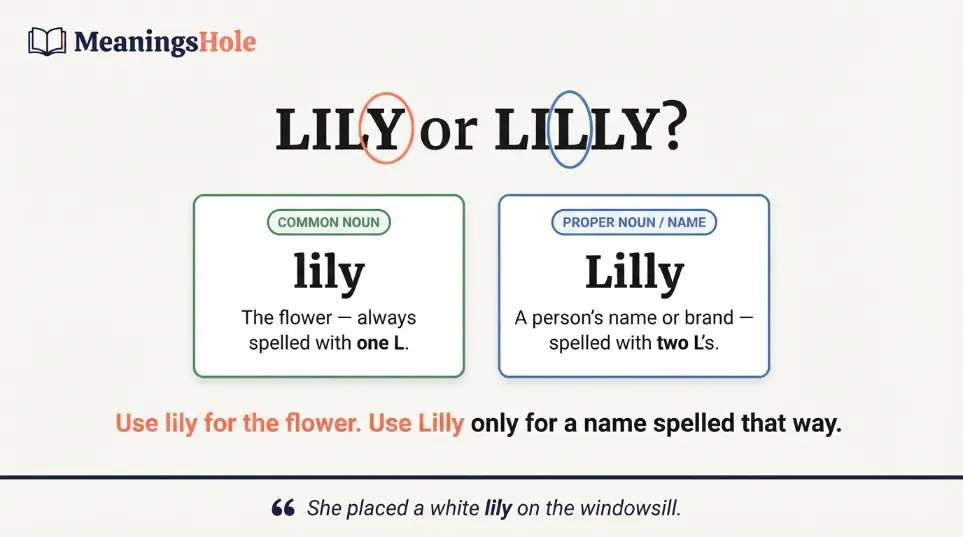
Quick answer: Lily is the correct spelling for the flower and the common noun. Lilly is a variant spelling, mostly used as a proper name or brand name, not as the everyday word for the plant. Example: She placed a white lily on the windowsill.
My neighbor named her daughter Lilly, spelled with two L’s. A few weeks later, she wrote a caption online about the flowers blooming in her garden, calling them “lillies.” A friend gently pointed out that the flower itself is usually spelled lily, with just one L. She laughed and said she genuinely thought both spellings were interchangeable.
That mix-up happens a lot, and honestly, it makes sense. Names don’t always follow the same rules as everyday words. Someone can be named Lilly, while the flower blooming in their yard is still spelled lily. Two different situations, two different accepted spellings.
If lily or lilly has ever left you unsure which one to type, this guide will clear it up for good. We’ll walk through the meaning, the reasoning, and plenty of real examples, so you always know which spelling fits.
Lily or Lilly: Quick Answer
Lily is the correct spelling for the flower.
Lilly is mainly used as a personal name or brand name.
For the plant itself, always use lily.
Examples
- The lily bloomed early this spring.
- Her name is Lilly, spelled with two L’s.
Incorrect Example
- The lilly bloomed early this spring.
What Does “Lily” Mean?
Lily refers to a family of flowering plants known for their large, often fragrant blossoms. It’s also used more broadly to describe anything shaped like or associated with this flower, like a “lily pad” floating on a pond.
Examples
- The garden was filled with white lilies.
- A single lily sat in a glass vase.
- Lily pads covered the surface of the pond.
Whenever you’re writing about the plant, lily is the spelling dictionaries and style guides consistently use.
What Does “Lilly” Mean?
Lilly isn’t really a separate word with its own definition. Instead, it functions almost entirely as a proper noun, most often a person’s first name or part of a brand name. It doesn’t appear in dictionaries as an accepted spelling for the flower itself.
Examples
- Lilly graduated from college last spring.
- The Eli Lilly company develops pharmaceutical products.
- My cousin’s daughter is named Lilly.
Notice how different this feels from lily. One describes a flower. The other identifies a specific person, company, or brand.
Also Read: Accidently or Accidentally: Meaning, Difference & Correct Spelling
Why Are They Spelled Differently?
This distinction isn’t really about grammar rules, like verb endings or plural forms. It’s about the difference between a common noun and a proper noun. Lily, the flower, follows standard dictionary spelling. Lilly, the name, follows whatever spelling a family, company, or individual chooses for that particular name.
Names in English don’t always match dictionary spelling exactly. Parents can spell a name however they’d like, and that choice becomes the correct spelling for that specific person, even if it differs from the everyday word it’s based on.
Quick Way to Tell Them Apart
- Talking about the flower or plant? Use lily.
- Talking about a specific person’s name or a brand? Use Lilly, if that’s how they spell it.
Lily vs Lilly: Side-by-Side Comparison

| Word | Part of Speech | Meaning |
| Lily | Common noun | A flowering plant, or anything shaped like one |
| Lilly | Proper noun | A personal name or brand name |
Key Takeaway
Use lily for the flower. Use Lilly only when referring to a name spelled that way.
The Usage Rule, Explained Simply
Since this isn’t governed by a spelling rule like pluralization or verb conjugation, the real skill is recognizing whether you’re describing a plant or referring to a specific name.
Step-by-Step: Choosing the Right Spelling
Step 1: Ask if you’re describing the flower or plant itself.
Step 2: If yes, use lily, the standard dictionary spelling.
Step 3: If you’re referring to a specific person’s name, check how they spell it.
Step 4: Many people spell their name Lilly, with two L’s, so always confirm before writing it.
Step 5: For brand names, like Eli Lilly, use the company’s official spelling.
Where Each Spelling Typically Appears
| Context | Likely Spelling |
| Botanical writing | Lily |
| Gardening articles | Lily |
| Personal names | Lilly (varies by individual) |
| Brand and company names | Depends on the brand |
Where Does the Word “Lily” Come From?
Lily traces back through Old English and Latin, ultimately connecting to an ancient word for the flower that appeared across several early languages. The flower itself has held symbolic meaning for centuries, often representing purity, renewal, or elegance in art and literature.
As names became more personalized over time, some parents began spelling the name Lilly, with two L’s, likely influenced by how the double-letter pattern appears in other popular names. That stylistic choice eventually became common enough to feel like its own accepted variant, especially for names rather than the flower.
Why Do People Confuse Lily and Lilly?
This mix-up happens for a few clear reasons, and honestly, it makes sense once you break it down.
They Sound Completely Identical
Say lily and lilly out loud, back to back.
There’s no audible difference between the two spellings.
Names Often Get Treated Like Regular Words
People sometimes assume a name’s spelling should match the dictionary word it’s based on.
But names frequently take their own creative path.
Autocorrect Doesn’t Always Catch It
Since Lilly is a common name, many spellcheck tools accept it without flagging anything.
That makes it easy to accidentally use it for the flower too.
How These Words Show Up in Real Life
Lily shows up constantly in gardens, poetry, and everyday nature writing. Lilly shows up mainly in names, from people to businesses.
In Gardening
- The lilies need full sun to bloom properly.
- She planted a row of tiger lilies along the fence.
In Personal Names
- Lilly started her new job this week.
- Grandma always calls her granddaughter “little Lilly.”
In Business and Branding
- Eli Lilly and Company develops important medications.
- The boutique is named after the owner, Lilly.
These Words in Everyday Writing
Emails
- The bouquet includes roses, tulips, and white lilies.
News Headlines
- Local flower show highlights rare lily varieties this year.
Social Media Posts
- Meet our newest addition, baby Lilly! 🌸
- The lilies in my garden are finally blooming.
Formal Writing
- The study examined pollination patterns in wild lilies.
- Lilly was appointed to the board last quarter.
Related Words and Forms
Knowing related forms sharpens your understanding of each spelling.
| Word | Meaning |
| Lily | The flower or plant |
| Lilies | Plural form of the flower |
| Lily pad | A floating leaf of a water lily |
| Lily-white | An expression describing something very pale or pure |
Example Sentences
- The pond was dotted with lily pads.
- Her dress was described as lily-white.
- The florist arranged a dozen fresh lilies.
Common Mistakes People Make

Mistake 1: Using “Lilly” for the Flower
- ❌ The garden was full of blooming lillies.
- ✅ The garden was full of blooming lilies.
Mistake 2: Assuming Every Name Uses “Lily”
- ❌ Her name is spelled Lily, but everyone calls her Lilly.
- ✅ Confirm the actual spelling the person uses for their own name.
Mistake 3: Misspelling the Plural
- ❌ The florist arranged several lilys for the wedding.
- ✅ The florist arranged several lilies for the wedding.
Lily vs Lilly: Which One Fits?
This trips up even careful writers sometimes, especially with names involved.
| Word | Used For |
| Lily | The flower, or anything shaped like it |
| Lilly | A specific person’s name or brand, if spelled that way |
Examples
- The lily bloomed beautifully this spring.
- My coworker Lilly just got promoted.
- The pond’s lily pads attracted several frogs.
- Lilly’s bakery just opened downtown.
Similar Common Word and Name Pairs
This kind of common-word versus proper-name split shows up elsewhere too.
| Common Word | Related Name Variant |
| Grace | Grace (name, same spelling) |
| Daisy | Daisy (name, same spelling) |
| Rose | Rose (name, same spelling) |
| Lily | Lilly (name, alternate spelling) |
Most flower-based names keep the same spelling as the flower. Lilly stands out as one of the more common exceptions.
Easy Ways to Remember Lily and Lilly
Memory Trick 1
One L for the flower. Picture a single, simple lily stem.
Memory Trick 2
Two L‘s often show up in names, like Lilly, Billy, or Milly.
Memory Trick 3
When in doubt about a name’s spelling, always double-check with the person directly.
British English vs American English

Here’s some reassuring news. There’s no meaningful split.
Lily stays the standard spelling for the flower in every major English-speaking region.
| Region | Flower Spelling | Name Spelling |
| American English | lily | Lily or Lilly (varies) |
| British English | lily | Lily or Lilly (varies) |
| Canadian English | lily | Lily or Lilly (varies) |
| Australian English | lily | Lily or Lilly (varies) |
Name spellings simply come down to personal or family choice, regardless of region.
Why Correct Spelling Actually Matters
A single letter can leave a bigger impression than most people expect, especially when it comes to someone’s name.
In Professional Writing
Misspelling a flower’s name can look careless in botanical or gardening content.
- ❌ The bouquet featured fresh lillies and roses.
- ✅ The bouquet featured fresh lilies and roses.
With Personal Names
Misspelling someone’s actual name, whether Lily or Lilly, can feel disrespectful, even if unintentional.
In Branding
Companies like Eli Lilly rely on consistent, correct spelling across all official materials.
Lily and Lilly in Spoken English
Spoken conversations never reveal this difference at all, since both spellings sound identical.
- The lily in the vase smells wonderful.
- Lilly just started her new job this week.
That’s exactly why double-checking matters most in writing, not speech.
What the Usage Data Shows
Dictionaries and style guides consistently confirm this distinction.
Lily appears as the standard spelling for the flower across every major dictionary.
Lilly appears primarily in name records, birth certificates, and brand registrations.
Botanists, florists, and professional writers rely on lily for the plant itself.
Common Phrases Using These Words
Lily of the Valley
- Lily of the valley produces small, bell-shaped blooms.
Gild the Lily
- Adding more decorations would just gild the lily.
Water Lily
- The pond was covered in blooming water lilies.
Lily-Livered
- The old expression “lily-livered” means cowardly.
More Real-Life Example Sentences
- The florist recommended lilies for the anniversary bouquet.
- Lilly volunteered to organize the charity event.
- Water lilies floated peacefully across the calm pond.
- The company, Eli Lilly, focuses on medical research.
- Her garden’s lilies bloom every early summer.
- Lilly’s little sister just started kindergarten.
- The painting featured a single white lily in a vase.
- Lilly moved to a new city last year.
Practice Exercise 1: Fill in the Blank
Choose lily or Lilly for each sentence.
- The ______ in the garden bloomed beautifully. (Answer: lily)
- ______ just celebrated her birthday. (Answer: Lilly, assuming that’s her name’s spelling)
- The pond was covered in ______ pads. (Answer: lily)
Practice Exercise 2: Fix the Sentence
Rewrite each sentence with the correct spelling.
- The bouquet had fresh lillies inside. (Answer: The bouquet had fresh lilies inside.)
- My neighbor’s name is spelled Lily, with two L’s. (Answer: only correct if that matches her actual name spelling; otherwise check directly.)
- The lilly pad floated across the pond. (Answer: The lily pad floated across the pond.)
A Deeper Look at the Spelling
Why Does One Spelling Belong to Names Instead?
Names in English often diverge from dictionary words over time, shaped by family tradition, personal preference, or trends. Lilly, with its extra L, likely gained popularity as a stylistic name choice, separate from the flower’s standardized spelling.
Compare the Patterns
| Word | Category | Correct Spelling |
| Lily | Flower | lily |
| Lilly | Personal name | Lilly (if that’s the chosen spelling) |
Recognizing which category you’re writing about makes the choice much easier.
Lily or Lilly in Formal Writing
Formal writing calls for extra care, especially when both categories might appear together.
Botanical Writing
- Researchers documented several rare lily species.
Business Writing
- Eli Lilly and Company released its annual report.
Journalism
- The article profiled Lilly, a local small business owner.
Mixing up lily and Lilly in a formal document can create real confusion for readers.
Words Related to Lily
| Word | Meaning |
| Lilies | Plural form of the flower |
| Lily pad | Floating leaf of a water lily |
| Lily-white | Very pale or pure, often used figuratively |
| Tiger lily | A specific, brightly colored lily variety |
These related words all stem from the flower’s common spelling.
Also Read: Labeller or Labeler: Meaning, Difference & Correct Spelling
Frequently Asked Questions
Is “lilly” ever correct for the flower?
No. The standard spelling for the flower is always lily.
Can “Lilly” be a correct spelling for a name?
Yes, if that’s how the individual or family chooses to spell it.
Why do some people spell the name with two L’s?
It’s largely a stylistic preference, similar to other names with doubled letters.
Is this distinction the same in British English?
Yes. British and American English both use lily for the flower.
What is the plural of “lily”?
The plural is lilies, following the consonant-plus-y spelling pattern.
Does Eli Lilly the company use two L’s?
Yes, the pharmaceutical company spells its name Lilly, with two L’s.
Should I always double-check someone’s name spelling?
Yes, especially with names like this one that have multiple accepted variants.
Final Thoughts
The debate over lily or lilly really comes down to recognizing the difference between a common noun and a proper noun. Lily stays the standard, correct spelling for the flower, appearing consistently across dictionaries and botanical writing. Lilly, on the other hand, mostly belongs to personal names and brand names, where spelling choices can vary.
Since there’s no strict grammar rule connecting the two, context becomes your best guide. Always use lily for the plant, and double-check spelling whenever you’re writing someone’s actual name.
Whether you’re writing about a garden, a friend, or a well-known company, this small distinction adds up over time. Correct spelling makes your writing look sharper, more careful, and more respectful.
Remember the shortcut: one L for the flower, two L’s often for the name. Practice it a few times, and it will start feeling completely automatic.
Read more Topics on Meanings Hole
