


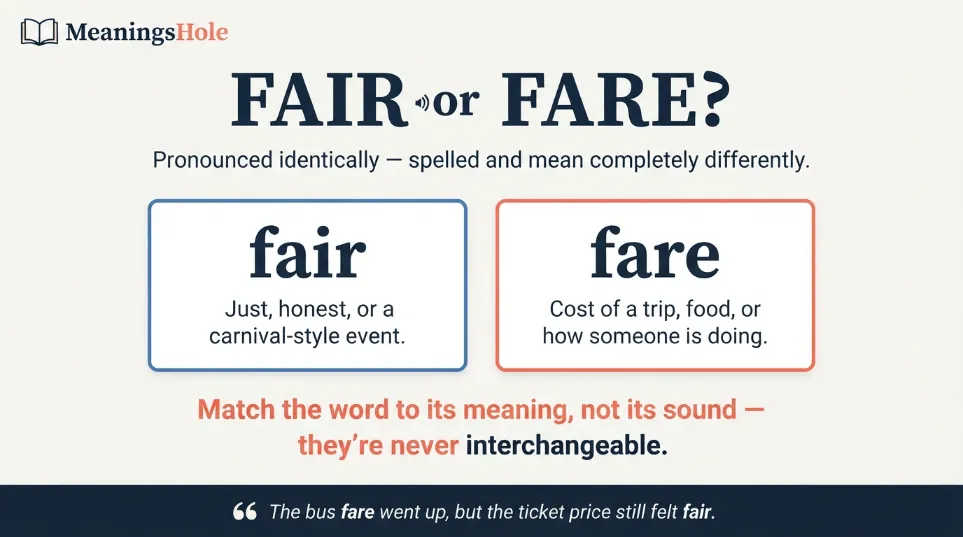
Quick answer: Fair usually means just, honest, or an event like a carnival. Fare usually means the cost of a trip, or how well someone is doing. Example: The bus fare went up, but the ticket price still felt fair.
My uncle once texted our family group chat, “The taxi fair was way too expensive tonight.” My cousin replied with a laughing emoji and one word: “Fare.” He read it back and groaned. He told me he always mixes these two up, even though he knows the difference in his head.
He’s definitely not alone. Fair and fare sound exactly the same when spoken out loud. That’s what makes them homophones, words that share a sound but carry completely different meanings and spellings. The moment you write them down, though, the difference matters a lot.
If fair or fare has ever left you pausing mid-sentence, this guide will clear it up for good. We’ll walk through the meanings, the reasoning, and plenty of real examples, so you never have to guess again.
Fair or Fare: Quick Answer
Fair relates to fairness, or a carnival-style event.
Fare relates to travel cost, food, or how someone is doing.
They sound identical but mean completely different things.
Examples
- The judge made a fair decision.
- The train fare increased this month.
Incorrect Example
- The train fair increased this month.
What Does “Fair” Mean?
Fair carries a few different meanings, depending on how it’s used. Most commonly, it describes something honest, equal, or free from bias. It can also describe weather, skin tone, or a local event with rides and games.
Examples
- The referee made a fair call.
- We visited the county fair last weekend.
- The forecast predicts fair weather tomorrow.
Because fair covers so much ground, context always decides which meaning fits.
What Does “Fare” Mean?
Fare is a different word entirely, even though it sounds identical. As a noun, it usually refers to the price paid for a trip, like a bus, train, or taxi ride. It can also describe food served somewhere.
As a verb, fare describes how someone is doing or progressing through a situation.
Examples
- The airfare dropped right before the holidays.
- The restaurant serves simple, home-style fare.
- She fared well during her first job interview.
Notice how different this feels from fair. One is about honesty or an event. The other is about cost, food, or progress.
Why Are They Spelled Differently?
English is full of homophones, and fair and fare are a classic example. They developed from separate word histories, even though they eventually landed on nearly identical pronunciation. That shared sound is simply a coincidence of how English evolved over time.
There’s no spelling rule connecting them, the way there is with plurals or verb endings. Instead, the only real trick is learning each word’s meaning and reaching for the right one based on context.
Quick Way to Tell Them Apart
- Talking about honesty, justice, or a carnival? Use fair.
- Talking about travel cost, food, or how something’s going? Use fare.
Fair vs Fare: Side-by-Side Comparison

| Word | Part of Speech | Meaning |
| Fair | Adjective / Noun | Just and honest, or a carnival-style event |
| Fare | Noun / Verb | Cost of travel or food, or to progress through something |
Key Takeaway
Match the word to its meaning, not its sound. They’re pronounced the same but never interchangeable.
The Usage Rule, Explained Simply
Since there’s no spelling shortcut here, the real skill is context recognition. Once you train your eye to notice the surrounding words, choosing correctly becomes second nature.
Step-by-Step: Choosing the Right Word
Step 1: Read the sentence and find the subject being described.
Step 2: Ask if it relates to honesty, equality, weather, or an event.
Step 3: If yes, the word is fair.
Step 4: If the sentence involves travel cost, food, or how someone is doing, it’s fare.
Step 5: Double-check by swapping in a synonym, like “just” for fair, or “ticket price” for fare.
Fair Used as Different Parts of Speech
| Usage | Example |
| Adjective | a fair trade |
| Noun (event) | the state fair |
| Adverb | play fair |
Fare Used as Different Parts of Speech
| Usage | Example |
| Noun (cost) | the cab fare |
| Noun (food) | traditional fare |
| Verb | how she fared today |
Where Do These Words Come From?
Fair, meaning just or honest, traces back to Old English, where it originally described something beautiful or pleasing. Over time, that meaning shifted toward honesty and balance, while a separate branch of the word came to describe seasonal markets and gatherings.
Fare has its own separate history. It comes from an Old English word meaning “to travel” or “to journey.” That root explains why it still connects to transportation costs today, and why the verb form describes how someone is progressing along their path.
Why Do People Confuse Fair and Fare?
This mix-up happens for a few clear reasons, and honestly, it makes sense once you break it down.
They Sound Completely Identical
Say fair and fare out loud, back to back.
There’s truly no audible difference between them.
English Has Many Homophone Traps
Words like their/there/they’re create the same kind of confusion.
Once you notice the pattern, it gets easier to catch.
Spellcheck Doesn’t Always Catch It
Both words are spelled correctly on their own.
So autocorrect often misses the mistake entirely.
How These Words Show Up in Real Life
These words aren’t confined to grammar textbooks. They show up constantly, especially around travel, events, and everyday judgment calls.
While Traveling
- The airline raised its fares for summer flights.
- She checked the fare before booking her ticket.
At Local Events
- The town fair opens this weekend.
- Rides at the fair cost extra tickets.
In Everyday Decisions
- He tried to be fair when splitting the bill.
- The manager wanted a fair outcome for everyone.
These Words in Everyday Writing
Emails
- Please confirm the flight fare before we book.
- We want to keep this process fair for everyone.
News Headlines
- City raises bus fares starting next month.
- Officials debate what counts as a fair wage.
Social Media Posts
- Just paid way too much for my Uber fare!
- Had so much fun at the fair this weekend.
Formal Reports
- The survey measured public opinion on transit fares.
- The committee reviewed fair hiring practices company-wide.
Every Form and Related Word
Knowing related forms sharpens your understanding of each word.
| Word | Type | Example |
| Fair | Adjective | a fair judge |
| Fairness | Noun | fighting for fairness |
| Fairly | Adverb | treated fairly |
| Fare | Noun | the subway fare |
| Fared | Past tense verb | she fared better than expected |
| Faring | Present participle | how are you faring? |
Example Sentences
- The contest felt fair to every contestant.
- The county fair runs through the weekend.
- The cab fare surprised her with how low it was.
- He fared poorly during the first round.
Common Mistakes People Make

Mistake 1: Using “Fair” for Travel Cost
- ❌ The bus fair went up again this year.
- ✅ The bus fare went up again this year.
Mistake 2: Using “Fare” for Honesty
- ❌ That referee’s call wasn’t very fare.
- ✅ That referee’s call wasn’t very fair.
Mistake 3: Mixing Up the Event Meaning
- ❌ We’re heading to the county fare this weekend.
- ✅ We’re heading to the county fair this weekend.
Fair vs Fare: Which One Fits?
This trips up even confident, experienced writers sometimes.
| Word | Used For |
| Fair | Honesty, equality, weather, or a carnival event |
| Fare | Travel cost, food, or how something is progressing |
Examples
- The trial felt fair to both sides.
- The taxi fare depends on distance traveled.
- The weekend fair drew a huge crowd.
- The team fared well during the tournament.
Similar Homophone Pairs Worth Knowing
This kind of sound-alike confusion shows up elsewhere too.
| Word Pair | Quick Difference |
| Their / There / They’re | Possession, location, contraction |
| Its / It’s | Possession, contraction |
| Your / You’re | Possession, contraction |
| Bare / Bear | Uncovered, or the animal |
Comparing pairs like these trains your eye to slow down and check meaning.
Easy Ways to Remember Fair and Fare
Memory Trick 1
Fair rhymes with share. Think of sharing something equally.
Memory Trick 2
Fare has an “a” like “airfare.” Picture a plane ticket.
Memory Trick 3
If you can swap in “ticket price,” it’s fare. If you can swap in “just” or “carnival,” it’s fair.
British English vs American English
Here’s some reassuring news. There’s no split at all.
Both fair and fare work identically in either version of English.
| Region | Fair Meaning | Fare Meaning |
| American English | just, event | travel cost, food |
| British English | just, event | travel cost, food |
| Canadian English | just, event | travel cost, food |
| Australian English | just, event | travel cost, food |
There’s no regional shortcut that changes either spelling or meaning.
Why Correct Spelling Actually Matters

A single swapped word can leave a bigger impression than most people expect. Readers often form quick judgments within the first few lines, sometimes without even realizing they’re doing it.
In Professional Writing
A small slip can quietly chip away at your credibility.
- ❌ Please review the updated transit fair schedule.
- ✅ Please review the updated transit fare schedule.
In Academic Writing
Word choice accuracy often shapes how essays get graded.
In Digital Communication
Clean, correct word choice builds reader trust much faster.
Also Read: Losses or Loses? Meaning, Difference & Correct Usage
Fair and Fare in Spoken English
Spoken conversations never expose this mistake at all, since both words sound identical.
- The judge made a fair decision.
- The fare increased right before the holidays.
That’s exactly why the confusion mostly shows up in writing, texting, and email.
What the Usage Data Shows
Search trends and dictionaries consistently confirm this distinction.
Fair stays correct for honesty, equality, and events.
Fare stays correct for travel cost, food, and progress.
Editors, journalists, and professional writers keep these two firmly separate.
Common Phrases Using These Words
Fair Play
- The coach always insisted on fair play.
Fair Share
- Everyone contributed their fair share to the project.
Bus Fare
- She scrambled to find exact bus fare.
Fare Well
- We hope you fare well on your new journey.
More Real-Life Example Sentences
- The negotiation ended with a fair compromise.
- Airfares tend to spike during holiday weeks.
- The state fair featured rides, games, and food stalls.
- He fared surprisingly well on the difficult exam.
- The judges promised a fair scoring process.
- Train fares vary depending on the time of day.
- Fair weather is expected throughout the weekend.
- The restaurant offers simple, comforting fare.
Practice Exercise 1: Fill in the Blank
Choose fair or fare for each sentence.
- The subway ______ increased last month. (Answer: fare)
- She tried to keep the game ______. (Answer: fair)
- He ______ better than expected on the test. (Answer: fared)
Practice Exercise 2: Fix the Sentence
Rewrite each sentence correctly.
- The taxi fair cost more than expected. (Answer: The taxi fare cost more than expected.)
- That wasn’t a fare way to treat him. (Answer: That wasn’t a fair way to treat him.)
- We’re going to the county fare this weekend. (Answer: We’re going to the county fair this weekend.)
A Deeper Look at the Words
Why Do They Sound the Same but Mean Different Things?
Fair and fare are true homophones, meaning their pronunciation matches even though their origins and spellings differ. English holds many pairs like this, often because two separate old words evolved toward the same modern sound.
Compare the Patterns
| Word | Category | Example |
| Fair | Adjective/Noun | a fair trial |
| Fare | Noun/Verb | the train fare |
Recognizing the category each word belongs to makes the choice much easier.
Also Read: Congratulations or Congradulations: Meaning, Difference and Correct Usage
Fair or Fare in Formal Writing
Formal writing leaves almost no room for guessing on this point.
Business Reports
- The company reviewed its fare pricing structure.
Legal Writing
- The contract outlined fair terms for both parties.
Journalism
- The article compared airfare trends across airlines.
Mixing up fair and fare in a formal document tends to look careless and unpolished.
Words Related to Fair and Fare
| Word | Meaning |
| Fairness | The quality of being just |
| Unfair | Not just or equal |
| Welfare | Well-being, often tied to support systems |
| Warfare | Conflict or combat between groups |
Interestingly, welfare and warfare both contain the word fare, tracing back to that same root meaning of faring, or getting along.
Frequently Asked Questions
Are “fair” and “fare” the same word?
No. They’re homophones, sounding alike but carrying completely different meanings.
How do I know which one to use?
Check the context. Honesty, weather, or an event means fair. Travel cost or food means fare.
Is “fare” only used for transportation?
Mostly, but it can also describe food, as in “traditional fare,” or progress, as in “how she fared.”
Is this distinction the same in British English?
Yes. It’s identical across British and American English.
What is the past tense of “fare” as a verb?
The past tense is fared.
Why do spellcheckers miss this mistake?
Both words are spelled correctly on their own, so spellcheck can’t tell which meaning you intended.
Does “fair” ever relate to skin or hair color?
Yes. Fair can describe light skin or hair tone as well.
Final Thoughts
The debate over fair or fare really comes down to recognizing two unrelated words that happen to sound alike. Fair connects to honesty, equality, weather, and carnivals, while fare connects to travel cost, food, and personal progress.
Since there’s no spelling rule to lean on, context becomes your best tool. Reading the sentence carefully and checking the meaning behind it will almost always lead you to the right choice.
Whether you’re writing about a bus ride, a local event, or a fair decision, this small distinction adds up over time. Correct word choice makes your writing look sharper, clearer, and more trustworthy.
Remember the shortcut: honesty and events mean fair, while cost and progress mean fare. Practice it a few times, and it will start feeling completely automatic.
Read more Topics on Meanings Hole
