


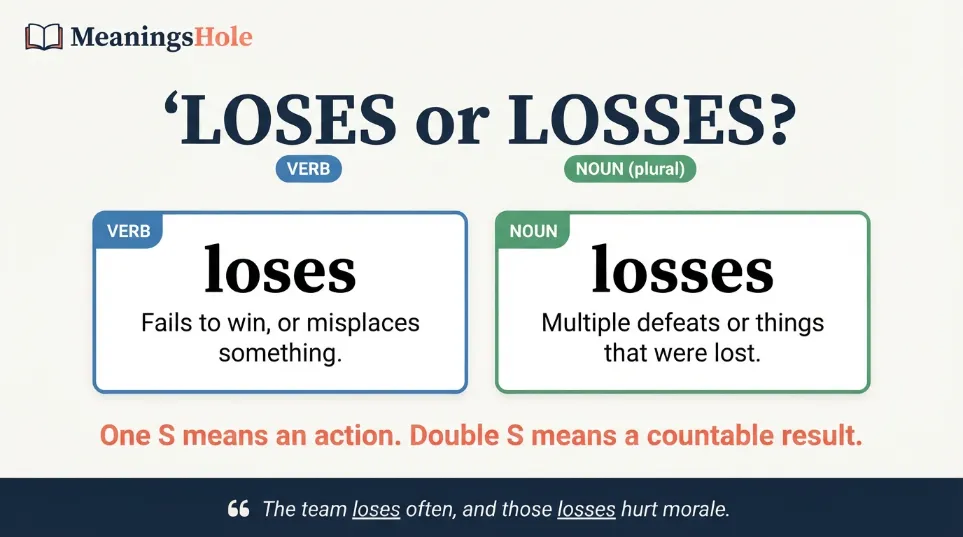
Quick answer: Loses is a verb, meaning someone fails to win or misplaces something. Losses is a plural noun, meaning multiple defeats or things that were lost. Example: The team loses often, and those losses hurt morale.
A friend of mine runs a small fantasy football group. Last season, he texted everyone, “Our team loses this week were rough.” Someone replied, “You mean losses, right?” He paused, reread his message, and laughed at himself. He told me he always mixed these two up, no matter how many times he double-checked.
He’s far from alone. Loses and losses look almost identical on the page, and they even sound close when spoken quickly. But one is an action word, and the other is a countable noun. Mixing them up is an easy trap to fall into.
If losses or loses has ever tripped you up mid-sentence, this guide will clear it up for good. We’ll walk through the rule, the reasoning, and plenty of real examples, so you never have to pause and guess again.
Losses or Loses: Quick Answer
Loses is a verb.
Losses is a plural noun.
Use loses for an action. Use losses for countable defeats or missing items.
Examples
- He loses his keys almost every week.
- The team suffered three losses this season.
Incorrect Example
- The team suffered three loses this season.
What Does “Loses” Mean?
Everything starts with the base verb lose. It describes failing to win, misplacing something, or no longer having something you once had. It’s a word we reach for constantly, in sports, in daily routines, and in everyday setbacks.
Once the subject becomes he, she, or it, the spelling shifts slightly. Lose becomes loses, and that small change is exactly where confusion tends to creep in.
Examples
- He loses his patience during long meetings.
- She loses track of time while reading.
- The app loses connection in poor weather.
What Does “Losses” Mean?
Here’s where a different word enters the picture. Losses isn’t a form of the verb at all. It’s the plural of the noun loss, and a loss describes something that has gone away, been defeated, or failed to succeed.
Losses means:
- Multiple defeats, as in sports or competitions
- Multiple instances of something being taken away or gone
- Financial setbacks, when money is involved
Examples
- The company reported heavy losses last quarter.
- Injuries led to several tough losses this season.
- The family experienced significant losses in the flood.
Notice how different this feels from loses. One is an action someone does. The other is a countable result or outcome.
Why Are They Spelled Differently?
English separates these two words because they come from different grammatical roles, even though they share the same root idea. It isn’t random, and it isn’t a style choice some writers follow. The spelling reflects the job each word is doing in a sentence.
Loses follows the standard verb pattern for he, she, or it. You simply drop the silent e in lose, then add es.
Losses follows the standard plural pattern for nouns ending in s. You add es directly onto loss, doubling that final s consonant along the way.
The Pattern
- lose → loses (verb)
- loss → losses (noun, plural)
This is a consistent grammar distinction, not a coincidence.
The Incorrect Pattern
- loss → loses ❌ (when trying to describe multiple defeats)
Writing loses when you mean the plural noun breaks this basic distinction completely.
Loses vs Losses: Side-by-Side Comparison

| Word | Part of Speech | Meaning |
| Loses | Verb (third-person singular) | Fails to win, or misplaces something |
| Losses | Noun (plural) | Multiple defeats or things that were lost |
Key Takeaway
Use loses for actions, and losses for countable outcomes or results.
The Grammar Rule, Explained Simply
Let’s slow down and look closer at each word separately. Once you understand the mechanics behind both, the confusion tends to disappear for good.
Rule for the Verb “Lose”
Lose ends in a silent e. For he, she, or it, drop that e and add es.
Step-by-Step: Turning Lose Into Loses
Step 1: Start with the base verb lose.
Step 2: Remove the silent e at the end.
Step 3: Add es in its place.
Step 4: You land on loses. That’s the finished verb.
Rule for the Noun “Loss”
Loss already ends in a consonant, s. For plural nouns ending in s, x, ch, or sh, you simply add es.
Step-by-Step: Turning Loss Into Losses
Step 1: Start with the base noun loss.
Step 2: Notice it already ends in s.
Step 3: Add es directly to the end.
Step 4: You land on losses. That’s the finished plural.
Similar Verbs Ending in Silent E
| Base Verb | Third-Person Form |
| Lose | Loses |
| Close | Closes |
| Choose | Chooses |
Similar Nouns Ending in S
| Singular | Plural |
| Loss | Losses |
| Class | Classes |
| Boss | Bosses |
Where Does the Word “Lose” Come From?
Lose traces back to Old English, where an early form of the word described letting something slip away or perish. Over centuries, its meaning broadened to cover competitions, possessions, and even emotional experiences, like losing touch with someone.
Loss, the noun, grew from that same root family. It captured the result of losing something, whether that was a game, an object, or something far more personal. That shared history is exactly why the two words feel connected, even though they now serve different grammatical roles.
Why Do People Confuse Loses and Losses?
This mix-up happens for a few clear reasons, and honestly, it makes sense once you break it down.
The Words Look Nearly Identical
Both start with los and both end close to the same sound.
A quick glance can easily blur the two together.
The Words Sound Alike When Spoken
Say loses and losses out loud, back to back.
The difference is subtle, especially in fast conversation.
Verb and Noun Roles Rarely Get Explained Together
Many learners study verbs and nouns separately.
That separation makes it harder to compare related words directly.
How These Words Show Up in Real Life
These words aren’t confined to grammar textbooks. They show up constantly, especially in sports, business, and everyday conversation.
In Sports
- The team rarely loses at home games.
- Their recent losses have worried the fans.
In Business
- The startup loses money during its first year.
- Investors reviewed the company’s quarterly losses.
In Daily Life
- He always loses his umbrella on rainy days.
- Her small losses added up over the month.
These Words in Everyday Writing
Emails
- The department loses productivity during long meetings.
- Please review the losses listed in this report.
News Headlines
- Local team loses third straight game this season.
- Farmers report heavy losses after the storm.
Social Media Posts
- My phone loses battery way too fast lately.
- Sharing my small wins after some big losses this year.
Formal Reports
- The firm loses market share each passing quarter.
- Analysts tracked significant losses across the sector.
Every Form of “Lose” and “Loss”
Knowing every form sharpens your grammar across the board.
| Word Form | Example |
| Base Verb | lose |
| Third-Person Singular | loses |
| Past Tense | lost |
| Past Participle | lost |
| Present Participle | losing |
| Singular Noun | loss |
| Plural Noun | losses |
Example Sentences
- I lose my train of thought sometimes.
- She loses focus during long lectures.
- They lost the match in the final minute.
- We are losing daylight fast this evening.
- The company reported one major loss last year.
- The company reported several losses over five years.
Common Mistakes People Make

Mistake 1: Using “Loses” for Plural Defeats
- ❌ The team had three loses this month.
- ✅ The team had three losses this month.
Mistake 2: Using “Losses” as a Verb
- ❌ He losses his keys constantly.
- ✅ He loses his keys constantly.
Mistake 3: Confusing “Lose” and “Loose”
- ❌ Don’t loose your temper during the game.
- ✅ Don’t lose your temper during the game.
Loses vs Losses: Which One Fits?
This trips up even confident, experienced writers sometimes.
| Word | Used For |
| Loses | An action someone or something performs |
| Losses | Multiple defeats, setbacks, or missing items |
Examples
- He loses focus by the afternoon.
- The gym reported member losses this year.
- She loses patience with slow traffic.
- Their recent losses stung the whole team.
Similar Word Pairs Worth Knowing
This pattern of verb versus plural noun shows up elsewhere too.
| Verb Form | Plural Noun Form |
| Chooses | Choices |
| Wins | Wins |
| Fails | Failures |
| Misses | Misses |
While not every pair matches exactly, comparing verbs and nouns side by side helps train your eye for the difference.
Easy Ways to Remember Loses and Losses
Memory Trick 1
One s means action. Loses is something someone does.
Memory Trick 2
Double s means a group. Losses describes multiple results.
Memory Trick 3
Picture a scoreboard. One loss becomes many losses over a season, while a player simply loses a single game.
Also read: Feet or Foot: Meaning, Difference, Grammar Rules, Examples, and Correct Usage
British English vs American English
Here’s some reassuring news. There’s no split at all.
Both loses and losses work identically in either version of English.
| Region | Verb Form | Plural Noun Form |
| American English | loses | losses |
| British English | loses | losses |
| Canadian English | loses | losses |
| Australian English | loses | losses |
There’s no regional shortcut that changes either spelling.
Why Correct Spelling Actually Matters

A single misused word can leave a bigger impression than most people expect. Readers often form quick judgments within the first few lines, sometimes without even realizing they’re doing it.
In Professional Writing
A small slip can quietly chip away at your credibility.
- ❌ The report highlighted three major loses.
- ✅ The report highlighted three major losses.
In Academic Writing
Grammar accuracy often shapes how essays and papers are graded.
In Digital Communication
Clean, correct spelling builds reader trust much faster.
Loses and Losses in Spoken English
Spoken conversations rarely expose this mistake at all.
- He loses his train of thought sometimes.
- Their losses this season have been tough.
The error mostly appears in writing, mainly because loses and losses sound quite close when spoken quickly.
What the Usage Data Shows
Search trends and dictionaries consistently point to one answer.
Loses stays correct as the verb form across every major source.
Losses stays correct as the plural noun form.
Sports writers, business analysts, and editors all rely on this exact distinction.
Common Phrases Using These Words
Loses Sleep
- She loses sleep worrying about deadlines.
Cut Your Losses
- Sometimes it’s smarter to cut your losses early.
Loses Track
- He loses track of time while gaming.
Weigh the Losses
- Investors weigh the losses against future gains.
More Real-Life Example Sentences
- The library loses several umbrellas each week.
- Our team suffered two tough losses in a row.
- She loses her voice after long lectures.
- The farm reported crop losses after the drought.
- He loses interest quickly in slow movies.
- The shop tallied its losses at year’s end.
- The phone loses signal inside the building.
- Their losses this quarter surprised investors.
Also Read: Congratulations or Congradulations: Meaning, Difference and Correct Usage
Practice Exercise 1: Fill in the Blank
Choose loses or losses for each sentence.
- He ______ his glasses almost every day. (Answer: loses)
- The company reported major ______ this year. (Answer: losses)
- The team rarely ______ on home turf. (Answer: loses)
Practice Exercise 2: Fix the Sentence
Rewrite each sentence correctly.
- The store reported small loses last month. (Answer: The store reported small losses last month.)
- She losses her patience during traffic. (Answer: She loses her patience during traffic.)
- Our team had three loses this season. (Answer: Our team had three losses this season.)
A Deeper Look at the Grammar Rule
Why Does One Word Get a Single S and the Other Double?
Lose already ends in a silent e, so adding es for the verb form only needs one s. Loss, however, already ends in s, so its plural adds another s before es, creating the double letter.
Compare the Patterns
| Word | Type | Correct Form |
| Lose | Verb, base | lose |
| Lose | Verb, third-person | loses |
| Loss | Noun, singular | loss |
| Loss | Noun, plural | losses |
This distinction threads through a noticeable number of English word pairs.
Loses or Losses in Formal Writing
Formal writing leaves almost no room for guessing on this point.
Business Reports
- The firm reported unexpected losses in the third quarter.
Sports Journalism
- The coach explained why the team loses close games.
Academic Writing
- The study measured economic losses after the policy shift.
Mixing up loses and losses in a formal document tends to look careless and unpolished.
Words Related to Lose and Loss
| Word | Meaning |
| Lost | Past tense of lose |
| Losing | Currently failing to win or hold onto something |
| Loser | Someone who loses, often informal |
| Lossless | Describing something with no reduction in quality |
These related words all circle back to the same core idea of things slipping away.
Frequently Asked Questions
Is “loses” the plural of “loss”?
No. Loses is a verb. The plural noun is losses.
When should I use “losses” instead of “loses”?
Use losses when counting multiple defeats or missing items, not as an action.
What’s the difference between “lose” and “loose”?
Lose means to fail to win or misplace something. Loose describes something not tight or secure.
Is “loses” used the same way in British English?
Yes. It’s correct across British and American English alike.
What is the past tense of lose?
The past tense is lost.
Why do people mix up loses and losses?
The words look and sound similar, even though one is a verb and the other is a plural noun.
Can “losses” ever be a verb?
No. Losses always functions as a plural noun.
Final Thoughts
The debate over losses or loses really comes down to understanding two different word types. Loses describes an action, something a person or thing does, while losses describes countable results, like defeats or setbacks.
That same verb-versus-noun pattern shows up across plenty of other English word pairs too. So mastering this distinction once doesn’t just fix one mix-up. It sharpens how you read and write similar words going forward.
Whether you’re writing about sports, business, or everyday mishaps, this small distinction adds up over time. Correct usage makes your writing look sharper, clearer, and more trustworthy.
Remember the shortcut: one s means someone loses something right now, while double s means multiple losses have already happened. Practice it a few times, and it will start feeling completely automatic.
Read more Topics on Meanings Hole
