


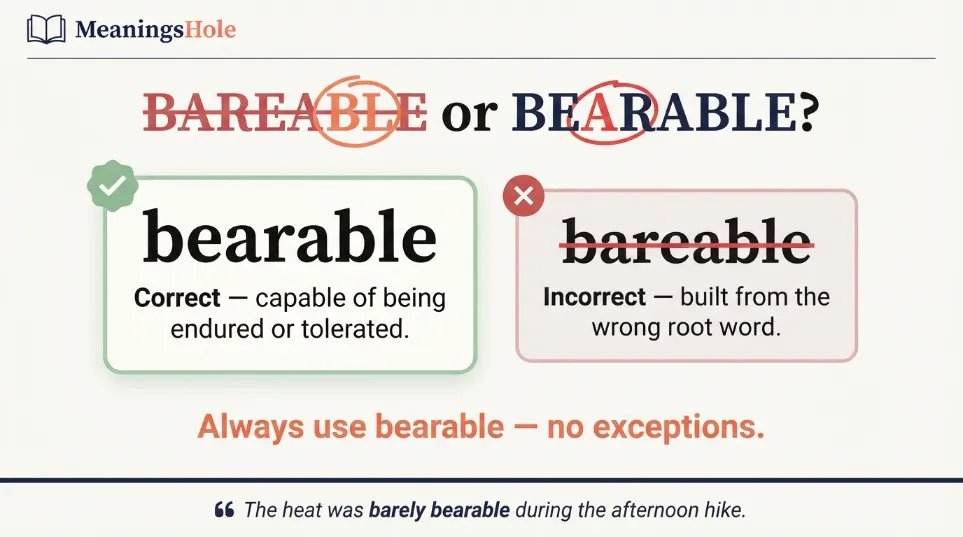
Quick Answer: Bearable is the correct spelling. Bareable is a common misspelling with no accepted meaning in standard English. Example: The heat was barely bearable during the afternoon hike.
A friend of mine complained online about a long flight delay, writing, “The wait was barely bareable.” A commenter gently pointed out the mix-up, and she laughed, realizing she had confused it with the word “bare.” She told me she always second-guesses this word, unsure whether it connects to “bare” or something else entirely.
That confusion makes more sense than it might seem. Bearable doesn’t come from “bare” at all. It actually comes from the verb “bear,” meaning to endure or tolerate something difficult. That small distinction is exactly where the spelling mix-up begins.
If bareable or bearable has ever made you pause before typing, this guide will clear it up for good. We’ll walk through the correct spelling, the reasoning behind it, and plenty of real examples, so you never have to second-guess it again.
Bareable or Bearable: Quick Answer
Bearable is the correct spelling.
Bareable is incorrect in standard English.
Always use bearable, no matter the context.
Examples
- The pain became more bearable after medication.
- She found the long meeting barely bearable.
Incorrect Example
- The pain became more bareable after medication.
What Does “Bearable” Mean?
Bearable describes something that can be endured or tolerated, even if it’s difficult or unpleasant. It’s the adjective form of the verb bear, meaning to withstand or put up with something.
Examples
- The heat was bearable near the shade.
- His workload felt more bearable with help from a coworker.
- The pain was barely bearable by the end of the day.
Whenever you’re describing something tolerable, even under difficult circumstances, bearable is the correct word.
Is “Bareable” a Real Word?
No. Bareable is simply a spelling mistake. It has no separate meaning and doesn’t appear as an accepted entry in standard dictionaries. This particular error happens because the misspelling looks like it connects to bare, meaning uncovered or exposed, even though the two words share no real relationship.
Incorrect Examples
- ❌ The noise level was barely bareable.
- ❌ She made the situation more bareable for everyone.
Corrected Versions
- ✅ The noise level was barely bearable.
- ✅ She made the situation more bearable for everyone.
Why Is “Bearable” Spelled With an “Ea” Instead of an “Are”?
English spelling here comes directly from the verb bear, meaning to carry, endure, or withstand something. Adding the suffix -able creates bearable, meaning capable of being endured. The word bare, describing something uncovered, comes from a completely different root and has no connection to enduring hardship at all.
The Pattern
- bear + able → bearable
- bare + able → bareable ❌ (incorrect, since “bare” isn’t the correct root)
There’s no swap rule here, like changing a letter mid-word. It’s simply a matter of remembering the correct base verb.
Words Built the Same Way as “Bearable”
| Base Verb | Correct “-able” Form |
| Bear | Bearable |
| Wear | Wearable |
| Break | Breakable |
| Read | Readable |
Bareable vs Bearable: Side-by-Side Comparison

| Word | Correct or Incorrect | Meaning |
| Bearable | Correct | Capable of being endured or tolerated |
| Bareable | Incorrect | No accepted meaning |
Key Takeaway
There’s no situation where bareable is the right choice. Always write bearable.
The Spelling Rule, Explained Simply
Since this comes down to choosing the correct root verb, the real skill here is separating bear from bare in your mind.
Step-by-Step: Locking In the Correct Spelling
Step 1: Identify the root verb, bear, meaning to endure or carry.
Step 2: Notice it’s spelled with ea, not are.
Step 3: Add the suffix -able directly onto the end.
Step 4: You land on bearable, the correctly built word.
Step 5: Double-check by testing the meaning: does the sentence describe enduring something difficult?
Comparing “Bear” and “Bare”
| Word | Meaning | Example |
| Bear | To endure or carry | She could barely bear the pain. |
| Bare | Uncovered or exposed | He walked outside with bare feet. |
Recognizing these as two separate words with different meanings prevents the mix-up entirely.
Where Does the Word “Bearable” Come From?
Bear, meaning to carry or endure, traces back to Old English, connected to very old Germanic roots describing the act of carrying weight, whether physical or emotional. Over time, that meaning expanded to include enduring hardship or discomfort, not just carrying literal objects.
Adding the suffix -able, which generally means “capable of,” created bearable, describing something that can be endured or tolerated. Bare, by contrast, developed along an entirely separate path, also rooted in Old English, but describing something stripped of covering or decoration.
Why Do People Misspell “Bearable” as “Bareable”?
This mistake happens for a few clear reasons, and it’s more common than most people realize.
The Words Sound Very Similar
Say bear and bare out loud, back to back.
They’re true homophones, sounding completely identical in speech.
“Bare” Feels Like the More Familiar Word
Many people encounter “bare” more often in everyday contexts, like “bare feet” or “bare minimum.”
That familiarity can nudge the spelling in the wrong direction.
Autocorrect Doesn’t Always Catch It
Since “bareable” isn’t a recognized word, some spellcheck tools flag it immediately, but others occasionally miss it.
How “Bearable” Shows Up in Real Life
This word appears constantly across everyday conversation, health, and emotional experiences.
In Daily Life
- The commute felt more bearable with good music.
- The cold weather was barely bearable without a coat.
In Health and Wellness
- The therapy made her symptoms more bearable.
- Pain medication helped make recovery bearable.
In Emotional Situations
- Talking to a friend made the loss more bearable.
- The support group made grief feel slightly more bearable.
“Bearable” in Everyday Writing
Emails
- Thankfully, the delayed flight was made bearable by free snacks.
News Headlines
- Extreme heat becomes barely bearable across the region.
Social Media Posts
- Coffee is the only thing making Mondays bearable lately. ☕
Formal Reports
- Researchers studied factors that made chronic pain more bearable.
Related Words Built From “Bear”
Knowing related forms sharpens your understanding of the word family.
| Word | Meaning |
| Bear | To endure, carry, or tolerate |
| Bearable | Capable of being endured |
| Unbearable | Impossible to endure |
| Bearing | The manner in which someone carries themselves |
Example Sentences
- She could hardly bear the disappointment.
- The heat felt completely unbearable by noon.
- He walked with a confident bearing.
Common Mistakes People Make

Mistake 1: Confusing “Bear” With “Bare”
- ❌ The pain was barely bareable by evening.
- ✅ The pain was barely bearable by evening.
Mistake 2: Misspelling the Negative Form
- ❌ The noise was completely unbareable.
- ✅ The noise was completely unbearable.
Mistake 3: Mixing Up Related Verb Forms
- ❌ She could barely bare the weight of the boxes.
- ✅ She could barely bear the weight of the boxes.
Bearable vs Other Commonly Confused Word Pairs
This kind of homophone-based confusion shows up elsewhere too.
| Correct | Common Confusion |
| Bearable | Bareable |
| Wearable | Wareable |
| Stationary | Stationery |
| Complement | Compliment |
Comparing these side by side can help train your eye for similar sound-alike traps.
Easy Ways to Remember “Bearable”
Memory Trick 1
Think of the phrase “bear the weight,” connecting directly to enduring something heavy or difficult.
Memory Trick 2
Remember: bare describes something uncovered, like “bare skin,” while bear describes enduring something.
Memory Trick 3
Pair it with wearable, since both follow the same base-verb-plus--able pattern.
British English vs American English
Here’s some reassuring news. There’s no split at all.
Bearable is spelled identically in every major English-speaking region.
| Region | Correct Spelling |
| American English | bearable |
| British English | bearable |
| Canadian English | bearable |
| Australian English | bearable |
Bareable stays incorrect everywhere in standard English.
Also read: Many or Meny: Meaning, Difference, Grammar Rules, Examples, and Correct Usage
Why Correct Spelling Actually Matters
A single misspelled word can leave a bigger impression than most people expect.
In Professional Writing
Misspelling this word can quietly chip away at your credibility.
- ❌ The workload became more bareable after delegating tasks.
- ✅ The workload became more bearable after delegating tasks.
In Academic Writing
Spelling accuracy often shapes how essays and reports get graded.
In Digital Communication
Clean, correct spelling helps build trust with readers quickly.
“Bearable” in Spoken English
Spoken conversations never reveal this mistake at all, since bear and bare sound completely identical.
- The heat was barely bearable by afternoon.
- She made the situation feel more bearable.
That’s exactly why the confusion mostly shows up in writing, not speech.
What the Usage Data Shows
Dictionaries and style guides consistently confirm one spelling.
Bearable appears as the only accepted spelling across every major English dictionary.
Bareable shows up almost entirely as a spelling mistake.
Editors, writers, and professionals rely exclusively on bearable.
Common Phrases Using “Bearable”
Barely Bearable
- The traffic today was barely bearable.
Make It Bearable
- Good friends make hard days feel bearable.
Bearable Pain
- The doctor said the discomfort should stay bearable.
Somewhat Bearable
- The long lecture felt somewhat bearable with snacks nearby.
More Real-Life Example Sentences
- The humidity made the hike barely bearable.
- Her positive attitude made the setback more bearable.
- The medication kept his symptoms bearable throughout the day.
- The long drive felt bearable thanks to good company.
- She found the criticism easier to bear with support from friends.
- The noise from construction was hardly bearable this morning.
- With proper gear, the cold hike felt surprisingly bearable.
- His calm presence made the stressful meeting more bearable.
Practice Exercise 1: Fill in the Blank
Choose the correct spelling for each sentence.
- The heat was barely ______ without air conditioning. (Answer: bearable)
- Her support made the loss more ______. (Answer: bearable)
- The pain became ______ after resting. (Answer: bearable)
Practice Exercise 2: Fix the Sentence
Rewrite each sentence with the correct spelling.
- The noise was hardly bareable during the concert. (Answer: The noise was hardly bearable during the concert.)
- Good music made the drive more bareable. (Answer: Good music made the drive more bearable.)
- The heat felt completely unbareable by noon. (Answer: The heat felt completely unbearable by noon.)
A Deeper Look at the Spelling

Why Do “Bear” and “Bare” Get Confused So Easily?
Bear and bare are true homophones, meaning they sound identical despite having completely different meanings and origins. English contains many such pairs, and without a clear spelling anchor, it’s easy for the brain to grab the more familiar-looking word, even when it’s incorrect for the context.
Compare the Patterns
| Word | Meaning | Correct Related Form |
| Bear | To endure | Bearable |
| Bare | Uncovered | (No such word as “bareable”) |
Recognizing these as entirely separate words helps prevent the common mix-up.
Bareable or Bearable in Formal Writing
Formal writing leaves absolutely no room for the incorrect spelling.
Business Writing
- The revised schedule made the workload more bearable.
Academic Writing
- The study measured how support systems make stress more bearable.
Journalism
- The article described how community aid made hardship more bearable.
Using bareable in any formal document will almost always be flagged as an error.
Words Related to Bearable
| Word | Meaning |
| Bear | To endure, carry, or tolerate |
| Unbearable | Impossible to endure |
| Endurable | Capable of being endured, a close synonym |
| Tolerable | Able to be tolerated or accepted |
These related words all connect to the idea of enduring something difficult.
Also Read: Congratulations or Congradulations: Meaning, Difference and Correct Usage
Frequently Asked Questions
Is “bareable” ever an acceptable spelling?
No. It’s not accepted anywhere in standard English.
Why do people confuse “bearable” with “bare”?
Because “bear” and “bare” are true homophones, sounding identical despite unrelated meanings.
Is “bearable” spelled the same worldwide?
Yes. It’s identical across British and American English.
What’s an easy way to remember the spelling?
Connect it to the phrase “bear the weight,” since both relate to enduring something.
What’s the opposite of “bearable”?
The opposite is unbearable, meaning impossible to endure.
Why is this word misspelled so often?
The homophone confusion with “bare,” plus that word’s greater everyday familiarity, both contribute.
Does autocorrect usually catch this mistake?
Often, yes, though some tools may occasionally miss less common misspellings like this one.
Final Thoughts
The debate over bareable or bearable really comes down to one simple fact. Bearable is always correct, and bareable has no accepted meaning in standard English at all.
This mistake usually happens because of confusion with the homophone bare, even though the two words share no real connection. Once you separate these two ideas in your mind, the correct spelling becomes much easier to lock in.
Whether you’re describing pain, weather, or a stressful day, getting this word right adds up over time. Correct spelling makes your writing look sharper, more careful, and more credible.
Remember the shortcut: connect bearable to the verb bear, meaning to endure, not to the word bare, meaning uncovered. Practice it a few times, and it will start feeling completely automatic.
Read more Topics on Meanings Hole
