


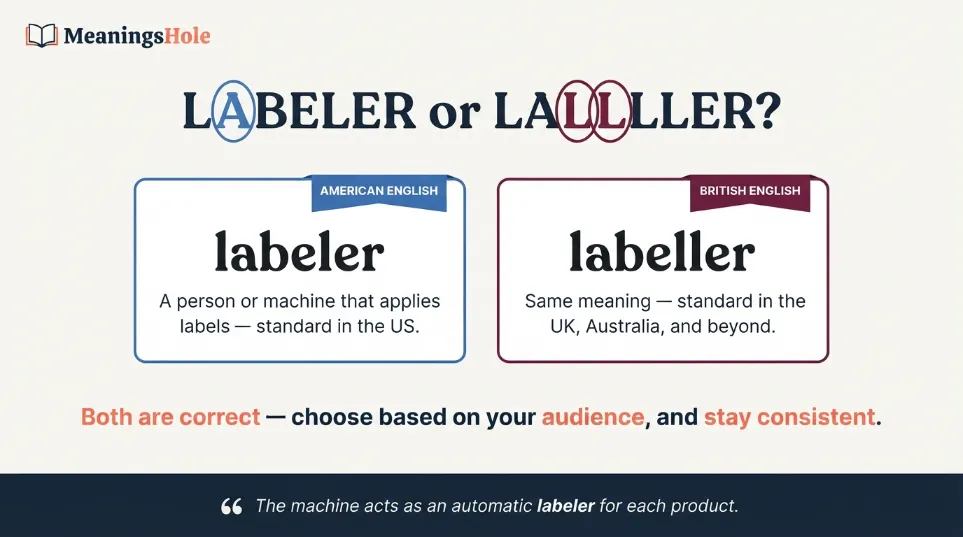
Quick Answer: Labeler is the standard spelling in American English. Labeller is the standard spelling in British English. Both are correct, depending on where you're writing. Example: The machine acts as an automatic labeler for each product.
A friend of mine designs packaging equipment, and her company sells to clients worldwide. She once sent two versions of the same product manual, one spelled “labeler” and the other “labeller.” A new employee flagged it as an error, thinking someone had made a typo. She explained that both spellings were intentional, matching different regional audiences.
That mix-up happens more often than people expect. The word looks almost identical either way, just one letter apart. But that single extra L isn’t a mistake at all. It follows a specific regional spelling pattern that shows up across many similar words.
If labeller or labeler has ever left you unsure which spelling to use, this guide will clear it up for good. We’ll walk through the meaning, the reasoning, and plenty of real examples, so you always know which version fits.
Labeller or Labeler: Quick Answer
Labeler is standard in American English.
Labeller is standard in British English.
Both spellings are correct, depending on your audience.
Examples
- The label maker doubles as a handheld labeler. (American)
- The label maker doubles as a handheld labeller. (British)
Consistency Matters
- Mixing both spellings within the same document looks inconsistent.
What Does “Labeler” Mean?
Labeler refers to a person or machine that applies labels to items. It comes from the verb label, describing the action of attaching a tag, name, or description to something.
Examples
- The factory installed a new automatic labeler.
- She works as a labeler on the packaging line.
- The software acts as a labeler for uploaded images.
This spelling, with one L before the ending, is the standard form used throughout the United States.
What Does “Labeller” Mean?
Labeller carries the exact same meaning as labeler. The only difference lies in the spelling, specifically, whether the final consonant doubles before the ending is added. This version, with two L‘s, is the standard form used throughout the United Kingdom, Australia, and several other English-speaking countries.
Examples
- The factory installed a new automatic labeller.
- She works as a labeller on the packaging line.
- The software acts as a labeller for uploaded images.
Notice the sentences carry identical meaning. Only the regional spelling convention changes.
Why Do These Two Spellings Exist?
This split isn’t about one version being right and the other wrong. It comes down to a broader pattern involving how British and American English handle consonant doubling before certain endings, like -er, -ed, or -ing.
British English generally doubles a final L before adding these endings, even when the last syllable isn’t stressed. American English usually skips that doubling in the same situation.
The Pattern
- label + er → labeler (American)
- label + er → labeller (British)
This isn’t a spelling mistake pattern. It’s a genuine regional variation, accepted on both sides.
Labeler vs Labeller: Side-by-Side Comparison

| Word | Region | Meaning |
| Labeler | American English (standard) | A person or machine that applies labels |
| Labeller | British English (standard) | A person or machine that applies labels |
Key Takeaway
Choose the spelling that matches your audience, and stay consistent throughout your writing.
The Spelling Pattern, Explained Simply
Since this isn’t a right-or-wrong situation, the real skill is recognizing which regional rule applies to your writing.
Step-by-Step: Understanding the Doubling Rule
Step 1: Start with the base verb, label.
Step 2: Notice the final syllable, -bel, isn’t strongly stressed when spoken.
Step 3: In British English, that final L still gets doubled before adding -er.
Step 4: In American English, the final L typically stays single.
Step 5: Apply the same logic when adding -ed or -ing to similar words.
Other Words Following This Same Pattern
| American English | British English |
| Traveler | Traveller |
| Canceled | Cancelled |
| Modeling | Modelling |
| Signaled | Signalled |
Where Does the Word “Label” Come From?
Label traces back to Old French, originally describing a narrow strip or band, often attached to identify or decorate something. It later entered English with a similar meaning, evolving into today’s sense of a tag or descriptive marker attached to an object.
The -er ending simply describes someone or something performing an action, in this case, the act of labeling. The doubling difference emerged much later, as British and American spelling conventions gradually diverged during the eighteenth and nineteenth centuries.
Why Do People Get Confused Between the Two?
This mix-up happens for a few clear reasons, and it’s more understandable than most people realize.
The Doubling Rule Feels Inconsistent
English doubles some final consonants and not others, depending on stress patterns.
That inconsistency makes it hard to predict without checking directly.
Global Content Blurs Regional Lines
Product manuals, websites, and articles mix American and British spelling constantly.
That exposure makes both versions feel equally familiar over time.
Spellcheck Tools Often Default to One Region
Many writing tools assume American English by default.
That can quietly flag a perfectly valid British spelling as incorrect.
How These Words Show Up in Real Life
Both spellings appear constantly across manufacturing, retail, and everyday product writing, depending on the audience.
In American Manufacturing
- The warehouse upgraded to a faster automatic labeler.
- She trained new staff to operate the labeler safely.
In British Manufacturing
- The warehouse upgraded to a faster automatic labeller.
- She trained new staff to operate the labeller safely.
In Retail and Packaging
- The store uses a handheld labeler for price tags. (American)
- The store uses a handheld labeller for price tags. (British)
These Words in Everyday Writing
Emails
- Please order a replacement labeler for the packaging line. (American)
- Please order a replacement labeller for the packaging line. (British)
Product Listings
- This compact labeler prints custom tags in seconds. (American)
- This compact labeller prints custom tags in seconds. (British)
Social Media Posts
- Just upgraded my craft room with a new labeler! (American)
- Just upgraded my craft room with a new labeller! (British)
Formal Reports
- The audit reviewed labeler efficiency across three shifts. (American)
- The audit reviewed labeller efficiency across three shifts. (British)
Related Words and Forms
Knowing related forms sharpens your understanding of the entire word family.
| Word | Meaning |
| Label | A tag or marker attached to something |
| Labeled / Labelled | Past tense of the verb, marked with a label |
| Labeling / Labelling | The ongoing act of applying labels |
| Mislabel | To attach an incorrect label |
Example Sentences
- She labeled every box before the move. (American)
- She labelled every box before the move. (British)
- The product was mislabeled at the factory.
- Labeling ingredients clearly helps consumers with allergies.
Common Mistakes People Make

Mistake 1: Mixing Both Spellings in One Document
- ❌ We ordered a new labeller, but the labeler arrived broken.
- ✅ We ordered a new labeller, but the labeller arrived broken.
Mistake 2: Assuming One Spelling Is Simply Wrong
- ❌ “Labeller” is a misspelling of “labeler.”
- ✅ Both spellings are correct, depending on regional convention.
Mistake 3: Applying the Doubling Rule Inconsistently
- ❌ Using “labelled” but “labeler” in the same American document.
- ✅ Staying consistent with either all-American or all-British forms.
Labeler vs Labeller: Which One Fits?
This trips up even experienced writers, especially on international teams.
| Word | Used For |
| Labeler | American English audiences and style guides |
| Labeller | British, Australian, and similar style guides |
Examples
- The US-based factory relies on a high-speed labeler.
- The UK-based factory relies on a high-speed labeller.
- Both terms describe identical machines and processes.
Similar American vs British Word Pairs
This kind of consonant-doubling pattern shows up across many related words.
| American English | British English |
| Traveler | Traveller |
| Modeler | Modeller |
| Canceling | Cancelling |
| Fueled | Fuelled |
Recognizing this broader pattern makes the labeler pair much easier to remember.
Easy Ways to Remember Labeler and Labeller
Memory Trick 1
One L for the US, matching the shorter, simplified American spelling style.
Memory Trick 2
Two L‘s for the UK, matching the doubling seen in “traveller” and “cancelled.”
Memory Trick 3
When unsure, check how your document already spells similar words, like “traveled” or “travelled,” for consistency.
British English vs American English
This is really the heart of the entire distinction.
| Region | Standard Spelling |
| American English | labeler |
| British English | labeller |
| Canadian English | labeller (commonly, though both appear) |
| Australian English | labeller |
Canadian English often leans toward British doubling conventions, so checking local style guides remains helpful there.
Why Correct Spelling Actually Matters
Choosing the right regional spelling can leave a stronger impression than most people expect.
In Professional Writing
Using the wrong regional spelling can feel slightly off to your target audience.
- If writing for a British client, “labeller” signals attention to detail.
- If writing for an American client, “labeler” does the same.
In Product Documentation
Manuals and packaging often need to match the spelling conventions of their target market.
In Digital Communication
Matching your audience’s expected spelling builds trust and feels more natural to readers.
Also Read: Therefor or Therefore: Meaning, Difference & Correct Usage
Labeler and Labeller in Spoken English
Spoken conversations rarely reveal this difference at all, since both words sound nearly identical.
- The factory just installed a new labeler.
- The factory just installed a new labeller.
The distinction matters almost entirely in writing, not speech.
What the Usage Data Shows
Dictionaries and style guides consistently confirm both spellings as valid.
Labeler dominates in American manufacturing, retail, and software contexts.
Labeller dominates in British, Australian, and many international contexts.
Editors typically choose one spelling and apply it consistently throughout a single piece of writing.
Common Phrases Using These Words
Automatic Labeler / Labeller
- The line runs faster with a new automatic labeler. (American)
Handheld Labeler / Labeller
- She keeps a handheld labeller in her craft supplies. (British)
Industrial Labeler / Labeller
- The plant upgraded to an industrial labeler last year. (American)
Product Labeler / Labeller
- The startup built custom software as a product labeller. (British)
More Real-Life Example Sentences

- The bakery uses a small labeler for pricing pastries. (American)
- The bakery uses a small labeller for pricing pastries. (British)
- Their startup develops AI-powered data labelers. (American)
- Their startup develops AI-powered data labellers. (British)
- The warehouse manager ordered two new labelers. (American)
- The warehouse manager ordered two new labellers. (British)
- She works part-time as a freelance data labeler. (American)
- She works part-time as a freelance data labeller. (British)
Practice Exercise 1: Fill in the Blank
Choose the correct spelling based on the region noted.
- (American) The plant installed a new automatic ______. (Answer: labeler)
- (British) The plant installed a new automatic ______. (Answer: labeller)
- (American) She works as a freelance data ______. (Answer: labeler)
Practice Exercise 2: Identify the Region
Read each sentence and identify which English convention it follows.
- “The factory upgraded its labelling equipment this year.” (Answer: British English)
- “The factory upgraded its labeling equipment this year.” (Answer: American English)
- “She trained new staff on the automatic labeller.” (Answer: British English)
A Deeper Look at the Spelling Split
Why Does British English Double the “L” Here?
British spelling conventions historically double a final consonant before adding a suffix, even when the preceding syllable isn’t strongly stressed, as with label. American English, following simplifications popularized in the nineteenth century, generally skips that doubling unless the stress clearly falls on the final syllable.
Compare the Patterns
| Base Word | American Form | British Form |
| Label | Labeler | Labeller |
| Travel | Traveler | Traveller |
| Cancel | Canceled | Cancelled |
This historical split explains why so many related words follow the exact same dual-spelling pattern.
Labeller or Labeler in Formal Writing
Formal writing calls for extra attention to regional consistency.
American Business Writing
- The report recommended upgrading the facility’s labeler system.
British Business Writing
- The report recommended upgrading the facility’s labeller system.
International Publications
- Some global publications choose one spelling and apply it universally, regardless of the writer’s background.
Mixing spellings within a single formal document tends to look inconsistent and unpolished.
Words Related to Labeler and Labeller
| Word | Meaning |
| Label | A tag or descriptive marker |
| Labeling / Labelling | The act of applying labels |
| Relabel | To label something again, often correctly |
| Unlabeled / Unlabelled | Not marked with a label at all |
These related words all connect to the same underlying idea, identifying or describing something clearly.
Also read: Optimisation or Optimization: Meaning, Difference & Correct Spelling
Frequently Asked Questions
Is “labeller” a misspelling of “labeler”?
No. Both are correct, standard spellings, depending on regional English conventions.
Which spelling should I use for a global audience?
Check your company or platform’s style guide; many default to American spelling for international content.
Why does British English double the final “L” here?
It follows a broader British spelling pattern of doubling final consonants before certain endings, even in unstressed syllables.
Is Canadian English closer to American or British spelling?
It often leans toward British doubling conventions, though usage can vary by publication.
Does this same rule apply to “labeled” and “labelled”?
Yes, the same American-versus-British doubling pattern applies to that pair as well.
Should I switch spellings depending on who I’m emailing?
Yes, adapting to your recipient’s regional convention is considered good etiquette.
Is it ever acceptable to mix both spellings in one document?
No. Consistency throughout a single piece of writing is always recommended.
Final Thoughts
The debate over labeller or labeler really comes down to regional spelling convention, not right versus wrong. Labeler fits American English audiences, while labeller fits British, Australian, and many international audiences.
This same consonant-doubling pattern extends across many related words, like traveler/traveller and canceled/cancelled. Recognizing that broader pattern makes choosing the right spelling much easier going forward.
Whether you’re writing a product manual, a business report, or a quick email to an international client, matching your audience’s spelling convention adds up over time. Consistent, correctly matched spelling makes your writing look polished, professional, and audience-aware.
Remember the shortcut: one L for American English, two L‘s for British English. Practice it a few times, and choosing the right version will start feeling completely automatic.
Read more Topics on Meanings Hole
