


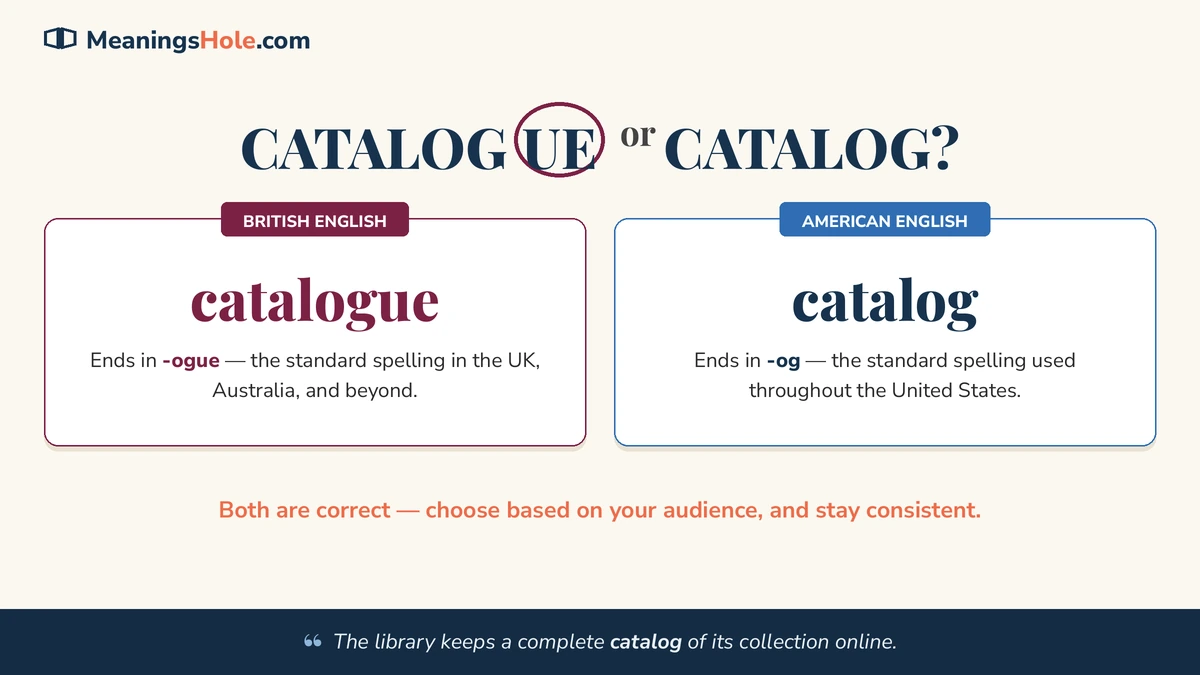
Quick Answer: Catalog is the standard spelling in American English. Catalogue is the standard spelling in British English. Both are correct, depending on where you're writing. Example: The library keeps a complete catalog of its collection online.
Walk into a library, and one of the first things you might notice is the search screen where visitors type in a title or an author. In some countries, the sign above it says “Catalog.” In others, it says “Catalogue.” The screen works the same way, the books sit on the same shelves, and nobody inside is confused.
That’s the quiet nature of this pair. Neither spelling is a typo, and neither one is outdated. They are two accepted versions of the same word, shaped by the spelling habits of different regions.
If catalogue or catalog has ever made you pause before typing, here’s a clear breakdown of how the two versions work, along with plenty of examples to help you choose with confidence.
Catalogue or Catalog: Quick Answer
Catalog is standard in American English.
Catalogue is standard in British English.
Both spellings are correct, depending on your audience.
Examples
- The museum published a catalog of its new exhibit. (American)
- The museum published a catalogue of its new exhibit. (British)
Consistency Matters
- Mixing both spellings within the same document looks inconsistent.
What Does “Catalog” Mean?
Catalog describes a complete list of items, such as products, books, artworks, or courses, usually arranged in an organized way. It can also work as a verb, meaning to list or record items in an organized system.
Examples
- The company mailed its spring catalog to customers.
- Librarians catalog every new book that arrives.
- The university’s course catalog lists all available classes.
This spelling, ending in -og, is the standard form used throughout the United States.
What Does “Catalogue” Mean?
Catalogue carries the exact same meaning as catalog. The only difference lies in the spelling. The ending -ogue is the standard form in the United Kingdom, Australia, and several other English-speaking countries.
Examples
- The company mailed its spring catalogue to customers.
- Librarians catalogue every new book that arrives.
- The university’s course catalogue lists all available classes.
Notice the sentences carry identical meaning. Only the regional spelling convention changes.
Why Do These Two Spellings Exist?
This split isn’t about one version being right and the other wrong. It comes from a broader pattern in English spelling. Many words borrowed from Greek and French ended in -ogue, and American English later shortened several of them to -og.
British English largely kept the longer -ogue form, closer to the older spelling. American spelling reform in the early 1800s, led by writers like Noah Webster, pushed toward simpler forms, so catalog became standard in the United States.
The Pattern
- catalog → American English
- catalogue → British English
This isn’t a spelling mistake pattern. It’s a genuine regional variation, accepted on both sides.
Catalog vs Catalogue: Side-by-Side Comparison
| Word | Region | Meaning |
| Catalog | American English (standard) | A complete, organized list of items |
| Catalogue | British English (standard) | A complete, organized list of items |
Key Takeaway
Choose the spelling that matches your audience, and stay consistent throughout your writing.
The Spelling Pattern, Explained Simply
Since this isn’t a right-or-wrong situation, the real skill is recognizing which regional convention applies to your writing.
Step-by-Step: Choosing the Right Spelling
Step 1: Identify your primary audience or publication style guide.
Step 2: If writing for an American audience, use catalog.
Step 3: If writing for a British, Australian, or similar audience, use catalogue.
Step 4: Check whether your company or platform has an official style guide.
Step 5: Stay consistent throughout the entire document, never mixing both spellings.
Other Words Following This Same Pattern
| American English | British English |
| Catalog | Catalogue |
| Dialog | Dialogue |
| Analog | Analogue |
| Prolog | Prologue |
(Note: American English still uses “dialogue” in many contexts, especially for conversation in books and plays, so this pair is less strict than “catalog/catalogue.”)
Where Does the Word “Catalogue” Come From?
Catalogue traces back to Greek, from a word meaning “a list” or “a register,” which passed through Latin and French into English. The Greek root combined parts meaning “down” and “to count” or “to speak,” capturing the idea of listing something item by item.
The longer -ogue ending came along with that French influence. Later, American English shortened it to -og, while British English kept the longer form. That’s why both spellings feel natural today.
Why Do People Get Confused Between the Two?
This mix-up happens for a few clear reasons, and it makes sense once you break it down.
Global Content Blurs Regional Lines
Websites, apps, and stores reach readers in many countries at once.
That constant exposure makes both spellings feel equally familiar.
Computer Terms Use the Shorter Form
Technology often uses short forms like catalog and dialog.
That can make the shorter spelling look like the “default” to some writers.
Spellcheck Tools Often Default to One Region
Many writing tools are set to American English.
That can quietly “correct” a perfectly valid British spelling.
How These Words Show Up in Real Life
Both spellings appear constantly across retail, libraries, museums, and music.
In Retail and Shopping
- The furniture catalog arrives in the mail each spring. (American)
- The furniture catalogue arrives in the post each spring. (British)
In Libraries and Archives
- Staff update the library catalog every week. (American)
- Staff update the library catalogue every week. (British)
In Music and Entertainment
- The band’s back catalog includes ten albums. (American)
- The band’s back catalogue includes ten albums. (British)
These Words in Everyday Writing
Emails
- Please find our latest product catalog attached. (American)
- Please find our latest product catalogue attached. (British)
News Headlines
- Museum releases a digital catalog of rare paintings. (American)
- Museum releases a digital catalogue of rare paintings. (British)
Social Media Posts
- Just got the new spring catalog, so many good ideas! (American)
- Just got the new spring catalogue, so many good ideas! (British)
Formal Reports
- The report includes a catalog of all equipment on site. (American)
- The report includes a catalogue of all equipment on site. (British)
Related Words and Forms
Knowing related forms sharpens your understanding of the whole word family.
| Word | Meaning |
| Catalog / Catalogue | A complete, organized list of items |
| Cataloged / Catalogued | Past tense of the verb |
| Cataloging / Cataloguing | Present participle of the verb |
| Cataloger / Cataloguer | A person who creates a catalog |
Example Sentences
- She cataloged every painting in the collection. (American)
- She catalogued every painting in the collection. (British)
- The librarian is cataloging new arrivals. (American)
- The librarian is cataloguing new arrivals. (British)
Note how the verb forms follow the same regional split as the noun. Be careful with the doubled letters: American English uses cataloged, while British English uses catalogued.
Common Mistakes People Make

Mistake 1: Mixing Both Spellings in One Document
- ❌ We mailed the catalog, and the catalogue arrived late.
- ✅ We mailed the catalog, and the catalog arrived late.
Mistake 2: Assuming One Spelling Is Simply Wrong
- ❌ “Catalogue” is a misspelling of “catalog.”
- ✅ Both spellings are correct, depending on regional convention.
Mistake 3: Mixing Noun and Verb Forms Across Regions
- ❌ The librarian catalogued every book in the American collection.
- ✅ The librarian cataloged every book in the American collection.
Also Read: Cacoon or Cocoon: Why Cocoon Is the Correct Spelling
Catalog vs Catalogue: Which One Fits?
This trips up even experienced writers, especially on international teams.
| Word | Used For |
| Catalog | American English audiences and style guides |
| Catalogue | British, Australian, and similar style guides |
Examples
- The US-based store printed a new catalog for fall.
- The UK-based store printed a new catalogue for autumn.
- Both terms describe an identical organized list.
Similar American vs British Word Pairs
This kind of -og versus -ogue pattern shows up across a few related words.
| American English | British English |
| Catalog | Catalogue |
| Analog | Analogue |
| Prolog | Prologue |
| Monolog | Monologue |
Recognizing this broader pattern makes the catalog pair much easier to remember.
Easy Ways to Remember Catalog and Catalogue
Memory Trick 1
Catalog is shorter, like the simpler, trimmed spelling many American words use.
Memory Trick 2
Catalogue keeps the extra ue, like the longer, older spelling in British English.
Memory Trick 3
When unsure, check how your document spells similar words, like analog or analogue, for consistency.
British English vs American English
This is really the heart of the entire distinction.
| Region | Standard Spelling |
| American English | catalog |
| British English | catalogue |
| Canadian English | catalogue (commonly, though both appear) |
| Australian English | catalogue |
Canadian English often leans toward British spelling for this word, so checking local style guides remains helpful there.
Why Correct Spelling Actually Matters
Choosing the right regional spelling can leave a stronger impression than most people expect.
In Professional Writing
Using the wrong regional spelling can feel slightly off to your target audience.
- If writing for a British client, “catalogue” signals attention to detail.
- If writing for an American client, “catalog” does the same.
In Retail and Publishing
Printed catalogs and websites often match the spelling habits of their target market.
In Digital Communication
Matching your audience’s expected spelling builds trust and feels more natural to readers.
Catalog and Catalogue in Spoken English
Spoken conversations never reveal this difference at all, since both spellings sound identical.
- Check the catalog for the item number.
- Check the catalogue for the item number.
The distinction matters only in writing.
What the Usage Data Shows
Dictionaries and style guides consistently confirm both spellings as valid.
Catalog dominates in American retail, libraries, and technology writing.
Catalogue dominates in British, Australian, and many international contexts.
Editors typically choose one spelling and apply it consistently throughout a single piece of writing.
Common Phrases Using These Words
Back Catalog
- The label re-released the artist’s back catalog. (American)
Product Catalogue
- Customers can browse the full product catalogue online. (British)
Course Catalog
- The course catalog lists every class for the semester. (American)
Online Catalogue
- The library’s online catalogue is searchable by title. (British)
More Real-Life Example Sentences
- The shop prints a holiday catalog every November. (American)
- The shop prints a holiday catalogue every November. (British)
- She flipped through the seed catalog for planting ideas. (American)
- She flipped through the seed catalogue for planting ideas. (British)
- The museum cataloged thousands of artifacts last year. (American)
- The museum catalogued thousands of artefacts last year. (British)
- The archive’s catalog is available to researchers. (American)
- The archive’s catalogue is available to researchers. (British)
Practice Exercise 1: Fill in the Blank
Choose the correct spelling based on the region noted.
- (American) The store mailed a new ______ to customers. (Answer: catalog)
- (British) The store posted a new ______ to customers. (Answer: catalogue)
- (American) The librarian ______ every new book. (Answer: cataloged)
Practice Exercise 2: Identify the Region
Read each sentence and identify which English convention it follows.
- “The library updated its online catalogue this week.” (Answer: British English)
- “The library updated its online catalog this week.” (Answer: American English)
- “She catalogued the collection by date.” (Answer: British English)
A Deeper Look at the Spelling Split

Why Did American English Shorten Some “-Ogue” Words?
American spelling reform in the early 1800s, associated with lexicographer Noah Webster, favored simpler, shorter spellings. Several -ogue words became -og in American English, while British English largely kept the longer forms. Later, computing and technology also helped popularize the short forms worldwide.
Compare the Patterns
| Ending Type | American Example | British Example |
| -og / -ogue | Catalog | Catalogue |
| -og / -ogue | Analog | Analogue |
This historical split explains why several related words follow the same dual-spelling pattern.
Catalogue or Catalog in Formal Writing
Formal writing calls for extra attention to regional consistency.
American Business Writing
- The company distributes a product catalog each quarter.
British Business Writing
- The company distributes a product catalogue each quarter.
International Publications
- Some global publications choose one spelling and apply it universally, regardless of the writer’s background.
Mixing spellings within a single formal document tends to look inconsistent and unpolished.
Words Related to Catalog and Catalogue
| Word | Meaning |
| Inventory | A complete list of goods or items in stock |
| Directory | A list of names, addresses, or details |
| Index | An alphabetical list of topics and where to find them |
| Register | An official list or record |
These related words all connect to organized lists of items or information.
Also Read: Layed or Laid: The Only Correct Past Tense, Explained
Frequently Asked Questions
Is “catalogue” a misspelling of “catalog”?
No. Both are correct, standard spellings, depending on regional English conventions. You can read the Merriam-Webster entry for catalog for more.
Which spelling should I use for a global audience?
Check your company or platform’s style guide. Many international businesses default to the spelling used by their main market.
Why does British English keep the longer ending?
British spelling stayed closer to the older French form, while American spelling later shortened it.
Is this distinction the same in Canadian English?
Canadian English often leans toward catalogue, though both forms appear.
Is this the same in British English?
Yes, catalogue is the standard British spelling.
Do the verb forms follow the same split?
Yes. American English uses cataloged and cataloging. British English uses catalogued and cataloguing.
Is it ever acceptable to mix both spellings in one document?
No. Consistency throughout a single piece of writing is always recommended.
Final Thoughts
The debate over catalogue or catalog really comes down to regional spelling convention, not right versus wrong. Catalog fits American English audiences, while catalogue fits British, Australian, and many international audiences.
This same shorter-versus-longer pattern shows up in other words, like analog/analogue and prolog/prologue. Recognizing that broader pattern makes choosing the right spelling much easier going forward.
Whether you’re writing a product list, a library notice, or a museum guide, matching your audience’s spelling convention adds up over time. Consistent, correctly matched spelling makes your writing look polished, professional, and audience-aware.
Remember the shortcut: catalog for American English, catalogue for British English. Practice it a few times, and choosing the right version will start feeling completely automatic.
Read more Topics on Meanings Hole
