


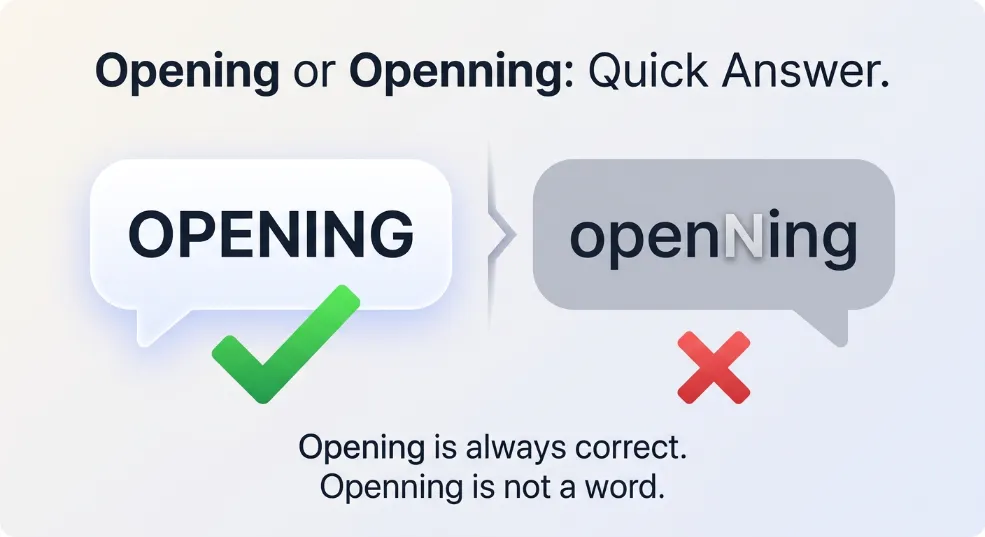
Quick Answer: Opening is the correct spelling. Openning is a common misspelling with no accepted meaning in standard English. Example: The store's grand opening starts at nine tomorrow.
A friend of mine designed invitations for her bakery’s launch, and the first draft read, “Join us for our grand openning!” A coworker noticed it during proofreading, right before the batch went to print. She was relieved someone caught it in time, since two hundred invitations were about to go out with that extra letter.
That kind of mistake happens more often than you’d expect, especially with -ing words. Many similar verbs double their final consonant before adding this ending, like running or beginning. That pattern feels so familiar that it’s easy to accidentally apply it here too, even though opening doesn’t follow the same rule.
If opening or openning has ever made you pause before typing, this guide will clear it up for good. We’ll walk through the correct spelling, the reasoning behind it, and plenty of real examples, so you never have to second-guess it again.
Opening or Openning: Quick Answer
Opening is the correct spelling.
Openning is incorrect in standard English.
Always use opening, no matter the context.
Examples
- The museum’s new opening hours start next week.
- She practiced her speech for the store opening.
Incorrect Example
- The museum’s new openning hours start next week.
What Does “Opening” Mean?
Opening can function as a noun, adjective, or verb form, depending on the sentence. As a noun, it describes an act of becoming open, an available position, or a gap or space. As a verb form, it’s the present participle of open, describing the action currently happening.
Examples
- The job opening attracted many qualified applicants.
- There’s a small opening in the fence.
- She is opening the store early today.
Whenever you’re describing this concept, whether as a noun or an ongoing action, opening is the correct spelling.
Is “Openning” a Real Word?
No. Openning is simply a spelling mistake. It has no separate meaning and doesn’t appear as an accepted entry in standard dictionaries. This particular error usually comes from applying a doubling rule that doesn’t actually belong to this word.
Incorrect Examples
- ❌ The store’s grand openning is this Saturday.
- ❌ There’s a small openning between the boards.
Corrected Versions
- ✅ The store’s grand opening is this Saturday.
- ✅ There’s a small opening between the boards.
Why Doesn’t “Opening” Double the Final Consonant?
English does have a real rule about doubling a final consonant before adding -ing, but it only applies under specific conditions. Specifically, doubling happens when a short word ends in a single consonant, following a single vowel, and the stress falls on that final syllable.
Open ends in n, following a single vowel, but the stress falls on the first syllable, OH-pen, not the second. Because the stress lands elsewhere, the consonant doesn’t double.
The Pattern
- open + ing → opening (no doubling, stress falls on first syllable)
- run + ing → running (doubling applies, stress falls on the only syllable)
Words That Follow the Same Non-Doubling Pattern as “Opening”
| Base Word | Correct “-ing” Form |
| Open | Opening |
| Happen | Happening |
| Listen | Listening |
| Visit | Visiting |
Opening vs Openning: Side-by-Side Comparison

| Word | Correct or Incorrect | Meaning |
| Opening | Correct | The act of becoming open, a gap, or an available position |
| Openning | Incorrect | No accepted meaning |
Key Takeaway
There’s no situation where openning is the right choice. Always write opening.
The Spelling Rule, Explained Simply
Since this connects to a real doubling rule, understanding when that rule applies makes the correct spelling much easier to remember.
Step-by-Step: Deciding Whether to Double a Final Consonant
Step 1: Check if the base word ends in a single consonant.
Step 2: Check if that consonant follows a single vowel.
Step 3: Identify where the stress falls when the word is spoken aloud.
Step 4: If the stress falls on that final syllable, double the consonant before adding -ing.
Step 5: If the stress falls elsewhere, as it does in open, skip the doubling entirely.
Comparing Doubling and Non-Doubling Words
| Word | Stress Location | Doubles Before “-ing”? |
| Open | First syllable | No → opening |
| Begin | Second syllable | Yes → beginning |
| Happen | First syllable | No → happening |
| Admit | Second syllable | Yes → admitting |
Where Does the Word “Open” Come From?
Open traces back to Old English, closely related to older Germanic words describing something unclosed or accessible. Over centuries, the word expanded to cover countless situations, from physical doors and containers to abstract ideas like open opportunities or open discussions.
Adding -ing to describe an ongoing action or a resulting noun follows standard English suffix rules. Since open places its stress on the first syllable, it simply never qualified for the consonant-doubling rule that affects words like begin or admit.
Why Do People Misspell “Opening” as “Openning”?
This mistake happens for a few clear reasons, and it’s more common than most people realize.
Many Similar Words Do Double the Consonant
Words like running, beginning, and planning double their final letter.
That familiar pattern can mistakenly bleed into how people spell opening.
The Stress Pattern Isn’t Always Obvious
Most people don’t consciously think about where a word’s stress falls while typing quickly.
Without that awareness, guessing the doubling rule becomes a coin flip.
Fast Typing Encourages Small Slips
An extra letter can slip in unnoticed, especially in quick emails or texts.
How “Opening” Shows Up in Real Life
This word appears constantly across business, events, and everyday conversation.
In Business
- The company announced a new store opening next month.
- There’s a job opening in the marketing department.
At Events
- The gallery’s opening night drew a large crowd.
- Guests gathered for the restaurant’s grand opening.
In Everyday Conversation
- She left the window opening just a crack.
- He’s opening a new chapter in his life after the move.
“Opening” in Everyday Writing
Emails
- We’re excited to announce the opening of our new branch.
News Headlines
- Local bakery celebrates grand opening this weekend.
Social Media Posts
- So excited for our shop’s opening day tomorrow! 🎉
Formal Reports
- The report outlined plans for the facility’s official opening.
Related Words Built From “Open”
Knowing related forms sharpens your understanding of the word family.
| Word | Meaning |
| Open | Not closed, or to make something accessible |
| Opened | Past tense of open |
| Opening | Present participle, or a noun describing an act or gap |
| Reopening | The act of opening something again |
Example Sentences
- She opened the store earlier than usual today.
- The theater’s reopening drew excited fans.
- He left the door opening just enough to peek through.
Common Mistakes People Make

Mistake 1: Doubling the Final “N”
- ❌ We’re excited for the store’s grand openning.
- ✅ We’re excited for the store’s grand opening.
Mistake 2: Applying the Same Mistake to Related Words
- ❌ The window is slowly openning by itself.
- ✅ The window is slowly opening by itself.
Mistake 3: Confusing It With Words That Do Double
- ❌ Assuming “opening” follows the same rule as “planning.”
- ✅ Recognizing that stress placement decides the doubling rule, not just word length.
Opening vs Other Commonly Misspelled “-ing” Words
This kind of incorrect doubling shows up elsewhere too.
| Correct | Common Misspelling |
| Opening | Openning |
| Happening | Happenning |
| Listening | Listenning |
| Visiting | Visitting |
Comparing these side by side can help train your eye for similar patterns.
Easy Ways to Remember “Opening”
Memory Trick 1
Say the word slowly: “OH-pen-ing.” Notice the stress lands on the first syllable, not the last.
Memory Trick 2
Pair it with happening, since both words share the same non-doubling pattern.
Memory Trick 3
Remember: short words with stress on the final syllable double their consonant, but open doesn’t qualify.
Also Read: Thiefs or Thieves: Meaning, Difference & Correct Spelling
British English vs American English

Here’s some reassuring news. There’s no split at all.
Opening is spelled identically in every major English-speaking region.
| Region | Correct Spelling |
| American English | opening |
| British English | opening |
| Canadian English | opening |
| Australian English | opening |
Openning stays incorrect everywhere in standard English.
Why Correct Spelling Actually Matters
A single extra letter can leave a bigger impression than most people expect, especially on invitations, signage, or official announcements.
In Professional Writing
Misspelling this word can quietly chip away at your credibility.
- ❌ Join us for our grand store openning.
- ✅ Join us for our grand store opening.
In Business Communication
Marketing materials and signage depend on accurate spelling to look polished and trustworthy.
In Digital Communication
Clean, correct spelling helps build trust with readers quickly.
“Opening” in Spoken English
Spoken conversations never reveal this mistake at all, since the word sounds the same either way when spoken aloud.
- The store’s opening was a huge success.
- She’s opening a new bakery downtown.
The error mostly appears in writing, invitations, and signage, where the extra letter actually matters.
What the Usage Data Shows
Dictionaries and style guides consistently confirm one spelling.
Opening appears as the only accepted spelling across every major English dictionary.
Openning shows up almost entirely as a typing or spelling mistake.
Editors, marketers, and professional writers rely exclusively on opening.
Common Phrases Using “Opening”
Grand Opening
- The bakery’s grand opening drew a huge crowd.
Job Opening
- There’s a new job opening in the finance department.
Opening Night
- Opening night for the play sold out within hours.
Opening Statement
- The lawyer delivered a strong opening statement.
More Real-Life Example Sentences
- The gallery’s opening reception starts at seven.
- He’s excited about the opening of the new stadium.
- There’s a small opening in the fence near the garden.
- The company announced several job openings this month.
- She practiced her opening remarks before the ceremony.
- The store’s opening hours changed for the holidays.
- Fans lined up early for the theater’s opening night.
- The book’s opening chapter hooked readers immediately.
Practice Exercise 1: Fill in the Blank
Choose the correct spelling for each sentence.
- The store’s grand ______ is this weekend. (Answer: opening)
- There’s a job ______ in the design department. (Answer: opening)
- She practiced her speech for the ______ ceremony. (Answer: opening)
Practice Exercise 2: Fix the Sentence
Rewrite each sentence with the correct spelling.
- Join us for our grand openning next Friday. (Answer: Join us for our grand opening next Friday.)
- The window has a small openning near the frame. (Answer: The window has a small opening near the frame.)
- There’s a new job openning at the clinic. (Answer: There’s a new job opening at the clinic.)
A Deeper Look at the Spelling Rule
Why Do Some Words Double Their Final Consonant While Others Don’t?
English doubling rules depend heavily on where stress falls within a word. Words like begin and admit place stress on their final syllable, which triggers doubling before adding -ing. Words like open and happen place stress earlier, meaning the final consonant stays single.
Compare the Patterns
| Word | Stress Placement | Correct “-ing” Form |
| Open | First syllable | Opening |
| Begin | Second syllable | Beginning |
| Happen | First syllable | Happening |
| Occur | Second syllable | Occurring |
Recognizing this stress-based pattern explains why opening never doubles its final letter.
Opening or Openning in Formal Writing
Formal writing leaves absolutely no room for the incorrect spelling.
Business Writing
- The company confirmed the opening date for its new location.
Academic Writing
- The report analyzed factors affecting store openings nationwide.
Journalism
- The article covered the highly anticipated museum opening.
Using openning in any formal document will almost always be flagged as an error.
Words Related to Opening
| Word | Meaning |
| Open | Not closed, or to make accessible |
| Inauguration | A formal opening or beginning ceremony |
| Launch | The introduction of something new, often a business or product |
| Debut | The first public appearance or presentation of something |
These related words all connect to the idea of something new becoming available or accessible.
Also Read: Dining or Dinning: Meaning, Difference & Correct Spelling
Frequently Asked Questions
Is “openning” ever an acceptable spelling?
No. It’s not accepted anywhere in standard English.
Why doesn’t “opening” double its final consonant?
Because the stress in “open” falls on the first syllable, not the last, so the doubling rule doesn’t apply.
Is “opening” spelled the same worldwide?
Yes. It’s identical across British and American English.
What’s an easy way to remember the spelling?
Pair it with happening, since both words follow the same non-doubling pattern.
Does “opening” always describe a business event?
No, it can also describe a gap, an available job, or the beginning of nearly anything.
Why is this word misspelled so often?
Confusion with similar words that do double their consonant, like “running” or “beginning,” drives the mistake.
Does autocorrect usually catch this mistake?
Yes, most spellcheck tools flag “openning” immediately as incorrect.
Final Thoughts
The debate over opening or openning really comes down to one simple fact. Opening is always correct, and openning has no accepted meaning in standard English at all.
This mistake usually happens because of confusion with similar words that genuinely do double their final consonant, like “running” or “beginning.” Once you understand that stress placement decides the rule, the correct spelling becomes much easier to lock in.
Whether you’re announcing a store launch, describing a job opportunity, or writing about a gap in a fence, getting this word right adds up over time. Correct spelling makes your writing look sharper, more careful, and more credible.
Remember the shortcut: pair opening with happening, since both share that same non-doubling pattern. Practice it a few times, and it will start feeling completely automatic.
Read more Topics on Meanings Hole
