


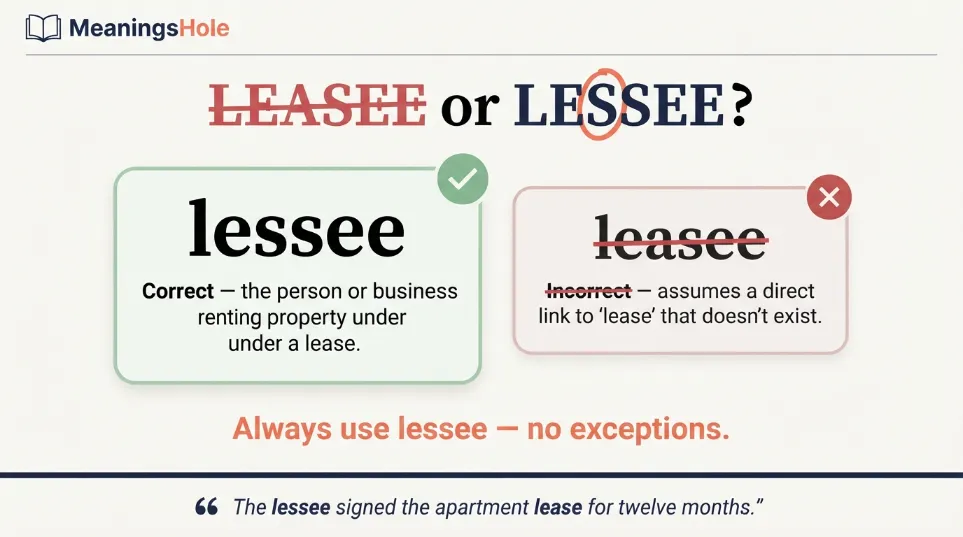
Quick Answer: Lessee is the correct spelling for someone who holds a lease. Leasee is a common misspelling with no accepted meaning in standard English. Example: The lessee signed the apartment lease for twelve months.
A friend of mine works in property management, and she once drafted a lease agreement that read, “The leasee agrees to the terms below.” Her supervisor caught it during review and circled the word in red. She admitted she always assumed the spelling followed directly from “lease,” the way “employ” becomes “employee.”
That logic actually makes a lot of sense on the surface. Many similar legal terms do build directly off their base word. But lessee breaks that expected pattern, and once you understand why, the correct spelling becomes much easier to remember.
If leasee or lessee has ever left you second-guessing a contract or form, this guide will clear it up for good. We’ll walk through the correct spelling, the reasoning behind it, and plenty of real examples, so you never have to guess again.
Leasee or Lessee: Quick Answer
Lessee is the correct spelling.
Leasee is incorrect in standard English.
Always use lessee when referring to someone renting property.
Examples
- The lessee must pay rent by the first of each month.
- She became the lessee after signing the office lease.
Incorrect Example
- The leasee must pay rent by the first of each month.
What Does “Lessee” Mean?
Lessee refers to the person or business that rents property, equipment, or land from someone else under a lease agreement. It’s a legal term used constantly in real estate, business contracts, and rental agreements.
Examples
- The lessee agreed to a two-year commercial lease.
- As the lessee, she was responsible for minor repairs.
- The lessee returned the vehicle at the end of the term.
Whenever you’re describing the person doing the renting, lessee is the correct legal term.
Is “Leasee” a Real Word?
No. Leasee is simply a spelling mistake. It has no separate meaning and doesn’t appear as an accepted entry in standard dictionaries or legal documents. Even though it looks like a logical spelling based on the word “lease,” it never became the accepted standard.
Incorrect Examples
- ❌ The leasee signed the rental agreement yesterday.
- ❌ Please have the leasee initial each page.
Corrected Versions
- ✅ The lessee signed the rental agreement yesterday.
- ✅ Please have the lessee initial each page.
Why Is “Lessee” Spelled With Two “S”s Instead of “Lease”?
This one connects to a broader pattern in legal and business terminology, involving pairs of words ending in -or and -ee. These endings come from Old French legal language, where -or typically identifies the person granting something, and -ee identifies the person receiving it.
Lessee pairs directly with lessor, the person who owns the property and grants the lease. Both words build from the same root, related to “letting” or “releasing” property for use, rather than directly from the modern spelling of “lease.”
The Pattern
- lessor → the person granting the lease
- lessee → the person receiving the lease
The Incorrect Pattern
- lease + ee → leasee ❌
This version assumes a direct, modern spelling connection to “lease,” which doesn’t match the word’s actual legal history.
Leasee vs Lessee: Side-by-Side Comparison

| Word | Correct or Incorrect | Meaning |
| Lessee | Correct | The person or business renting property |
| Leasee | Incorrect | No accepted meaning |
Key Takeaway
There’s no situation where leasee is the right choice. Always write lessee.
The Spelling Rule, Explained Simply
Since this isn’t a modern suffix rule, the real skill here is recognizing the legal word pair this term belongs to.
Step-by-Step: Locking In the Correct Spelling
Step 1: Remember that lessee pairs with lessor, not directly with “lease.”
Step 2: Notice both words share the same less- beginning.
Step 3: Add -or for the person granting the lease.
Step 4: Add -ee for the person receiving the lease.
Step 5: Practice writing both words together until the pattern feels familiar.
Similar Legal Word Pairs
| Grantor Role (-or) | Recipient Role (-ee) |
| Lessor | Lessee |
| Employer | Employee |
| Grantor | Grantee |
| Trustor | Trustee |
Recognizing this shared pattern helps explain why lessee doesn’t follow “lease” directly.
Where Does the Word “Lessee” Come From?
Lessee traces back to Old French legal terminology, connected to the verb lesser, meaning “to let” or “to release,” referring to granting someone temporary use of property. That legal vocabulary entered English through medieval property law, where formal -or and -ee pairs became standard for identifying two sides of an agreement.
Interestingly, the modern word lease developed along a slightly different path, even though it shares that same distant root. That’s exactly why the spelling doesn’t align perfectly with what you might expect from “lease” alone.
Why Do People Misspell “Lessee” as “Leasee”?
This mistake happens for a few clear reasons, and it’s more common than most people realize.
The Word “Lease” Feels Like the Obvious Root
Most people naturally connect lessee to the everyday word lease.
That assumption leads directly to the incorrect spelling, leasee.
Similar Words Do Follow That Pattern
Words like employee build directly from employ plus -ee.
That familiar pattern makes leasee feel logical, even though it’s wrong here.
Legal Terminology Isn’t Widely Taught
Most people encounter this word only when signing a lease themselves.
Without legal training, the correct spelling isn’t always intuitive.
Also read: Devide or Divide: Meaning, Difference, Grammar Rules, Examples, and Correct Usage
How “Lessee” Shows Up in Real Life
This word appears constantly across real estate, business, and legal documents.
In Real Estate
- The lessee must provide thirty days’ notice before moving out.
- The property manager reviewed the lessee’s rental history.
In Business Contracts
- The lessee agreed to maintain the equipment properly.
- Under the agreement, the lessee covers all utility costs.
In Legal Writing
- The lessee’s obligations are outlined in section four.
- Both the lessor and lessee signed the finalized contract.
“Lessee” in Everyday Writing
Emails
- Please confirm the lessee’s move-in date for next week.
News Headlines
- Commercial lessees face rising costs amid market shifts.
Social Media Posts
- Finally became a lessee on my very first apartment! 🏡
Formal Contracts
- The lessee shall pay a security deposit upon signing.
Related Words Built From “Lessee”
Knowing related forms sharpens your understanding of the word family.
| Word | Meaning |
| Lessee | The person renting property |
| Lessor | The person granting the lease |
| Lease | An agreement to rent property for a set time |
| Sublease | A lease granted by a lessee to another party |
Example Sentences
- The lessor approved the lessee’s renovation request.
- She signed a three-year commercial lease.
- The lessee arranged a sublease while traveling abroad.
Common Mistakes People Make

Mistake 1: Building the Word Directly From “Lease”
- ❌ The leasee must renew the contract by June.
- ✅ The lessee must renew the contract by June.
Mistake 2: Confusing “Lessee” With “Lessor”
- ❌ The lessee approved the tenant’s application.
- ✅ The lessor approved the tenant’s application.
Mistake 3: Misspelling Both Legal Terms Together
- ❌ Both the leasor and leasee signed the agreement.
- ✅ Both the lessor and lessee signed the agreement.
Lessee vs Other Commonly Misspelled Legal Terms
This kind of root-word confusion shows up elsewhere too.
| Correct | Common Misspelling |
| Lessee | Leasee |
| Lessor | Leasor |
| Guarantor | Garantor |
| Trustee | Trustey |
Comparing these side by side can help train your eye for similar legal spelling patterns.
Easy Ways to Remember “Lessee”
Memory Trick 1
Pair it with lessor, since both words share that same less- beginning.
Memory Trick 2
Remember: the person receiving something usually gets the -ee ending, like employee or trustee.
Memory Trick 3
Avoid connecting it directly to “lease.” Think of it as its own legal term instead.
British English vs American English
Here’s some reassuring news. There’s no split at all.
Lessee is spelled identically in every major English-speaking region.
| Region | Correct Spelling |
| American English | lessee |
| British English | lessee |
| Canadian English | lessee |
| Australian English | lessee |
Leasee stays incorrect everywhere in standard English.
Why Correct Spelling Actually Matters
A single misspelled word can leave a bigger impression than most people expect, especially in a legal document.
In Professional Writing
Misspelling this word in a contract can look careless or unprofessional.
- ❌ The leasee agrees to the terms outlined above.
- ✅ The lessee agrees to the terms outlined above.
In Legal Writing
Precise terminology matters greatly, since contracts rely on clear, standardized language.
In Digital Communication
Clean, correct spelling helps build trust with clients and tenants quickly.
“Lessee” in Spoken English
Spoken conversations rarely expose this mistake, since the word sounds nearly identical either way when spoken aloud.
- The lessee agreed to renew the contract.
- She became the lessee after months of searching.
The error mostly appears in writing, contracts, and legal paperwork.
What the Usage Data Shows
Dictionaries and legal style guides consistently confirm one spelling.
Lessee appears as the only accepted spelling across every major English dictionary and legal reference.
Leasee shows up almost entirely as a spelling mistake.
Lawyers, property managers, and professional writers rely exclusively on lessee.
Common Phrases Using “Lessee”
Lessee’s Obligations
- The contract outlines the lessee’s obligations in detail.
Lessor and Lessee
- Both the lessor and lessee must sign the final agreement.
Prospective Lessee
- The property manager interviewed each prospective lessee carefully.
Lessee’s Rights
- Local laws protect certain lessee’s rights during disputes.
More Real-Life Example Sentences
- The lessee requested minor repairs before move-in.
- As the lessee, he was responsible for lawn maintenance.
- The lessor and lessee negotiated a lower monthly rate.
- The lessee’s lease term ends in early December.
- She reviewed the lessee’s credit history before approval.
- The lessee filed a complaint about the broken heater.
- Under the agreement, the lessee cannot sublet without approval.
- The commercial lessee expanded into the adjoining unit.
Practice Exercise 1: Fill in the Blank
Choose the correct spelling for each sentence.
- The ______ signed the twelve-month lease agreement. (Answer: lessee)
- Please confirm the ______’s move-in date. (Answer: lessee)
- Both the lessor and ______ reviewed the contract. (Answer: lessee)
Practice Exercise 2: Fix the Sentence
Rewrite each sentence with the correct spelling.
- The leasee must pay rent by the fifth of each month. (Answer: The lessee must pay rent by the fifth of each month.)
- Please have the leasee sign here. (Answer: Please have the lessee sign here.)
- The leasee requested an early lease termination. (Answer: The lessee requested an early lease termination.)
A Deeper Look at the Spelling

Why Doesn’t “Lessee” Match “Lease” Directly?
Legal terminology often preserves older spelling patterns, even after related everyday words evolve differently over time. Lease, lessor, and lessee all trace back to the same distant root, but only lessor and lessee kept the doubled s, forming a matched legal pair that doesn’t perfectly mirror the modern spelling of “lease.”
Compare the Patterns
| Word | Category | Correct Spelling |
| Lease | Everyday noun/verb | lease |
| Lessor | Legal term | lessor |
| Lessee | Legal term | lessee |
Recognizing these as a connected but distinct legal pair helps prevent the common mix-up.
Leasee or Lessee in Formal Writing
Formal and legal writing leave absolutely no room for the incorrect spelling.
Real Estate Contracts
- The lessee shall maintain the property in good condition.
Business Agreements
- The lessee agrees to insure all leased equipment.
Legal Filings
- The court reviewed the dispute between the lessor and lessee.
Using leasee in any formal or legal document will almost always be flagged as an error.
Words Related to Lessee
| Word | Meaning |
| Lessor | The person or entity granting the lease |
| Lease | An agreement to rent property for a set period |
| Tenant | A person who rents and occupies property |
| Landlord | A property owner who rents to others |
These related words all connect to the broader world of rental and property agreements.
Also Read: Bareable or Bearable: Meaning, Difference, Grammar Rules, Examples, and Correct Usage
Frequently Asked Questions
Is “leasee” ever an acceptable spelling?
No. It’s not accepted anywhere in standard English or legal terminology.
Why doesn’t “lessee” match the spelling of “lease”?
Because it pairs with lessor as part of an older legal term system, rather than deriving directly from modern “lease” spelling.
Is “lessee” spelled the same worldwide?
Yes. It’s identical across British and American English.
What’s an easy way to remember the spelling?
Pair it with lessor, remembering both share that same less- beginning.
Is a lessee the same as a tenant?
They’re very similar, though lessee is the more formal, legal term, often used in written contracts.
Why is this word misspelled so often?
People naturally assume it builds directly from “lease,” similar to how “employee” builds from “employ.”
Does autocorrect usually catch this mistake?
Not always, since “leasee” can sometimes slip past less thorough spellcheck tools.
Final Thoughts
The debate over leasee or lessee really comes down to one simple fact. Lessee is always correct, and leasee has no accepted meaning in standard English or legal writing at all.
This mistake happens because people naturally connect the word to “lease,” when it actually pairs with lessor as part of an older legal terminology system. Once you remember that connection, the correct spelling becomes much easier to lock in.
Whether you’re drafting a lease, reviewing a contract, or simply curious about the correct term, getting this word right adds up over time. Correct spelling makes your writing look sharper, more professional, and more legally sound.
Remember the shortcut: pair lessee with lessor in your memory, since both share that same less- beginning. Practice it a few times, and it will start feeling completely automatic.
Read more Topics on Meanings Hole
