


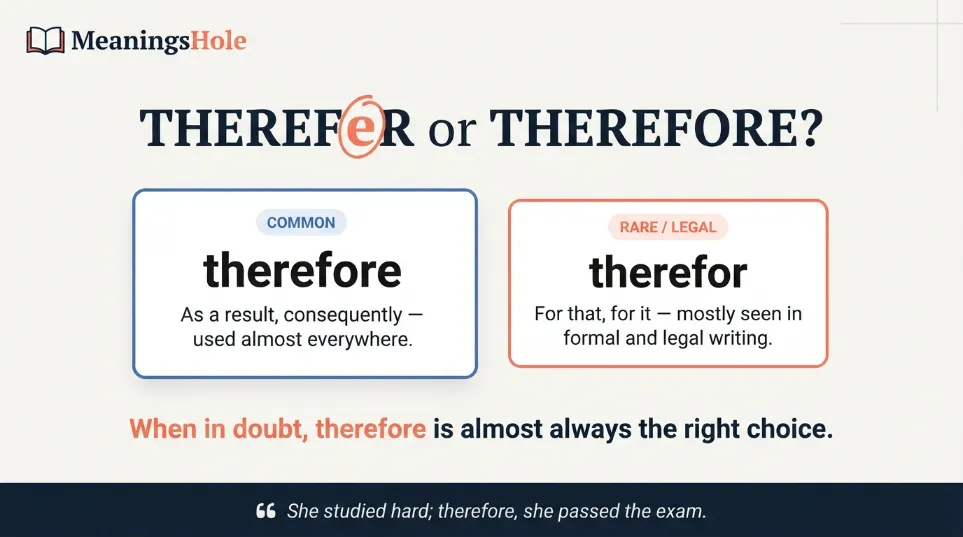
Quick Answer: Therefore means "as a result" or "consequently," and it's the word you'll use almost every time. Therefor is a rare, formal word meaning "for that" or "for it," mostly seen in legal writing. Example: She studied hard; therefore, she passed the exam.
A friend of mine works at a law firm, reviewing old contracts. One afternoon, she called me, confused. “There’s a word here I’ve never seen,” she said. “It says ‘therefor,’ not ‘therefore.’ Is that a typo?” I told her to look closer. It wasn’t a mistake at all. It was a completely different, much older word.
That moment surprised her. Like most people, she had never encountered therefor outside of legal documents. It turns out this tiny missing letter carries real meaning, even if almost nobody uses the word in everyday conversation anymore.
If therefor or therefore has ever caught your eye, this guide will clear it up for good. We’ll walk through the meanings, the reasoning, and plenty of real examples, so you always know which one belongs where.
Therefor or Therefore: Quick Answer
Therefore means “as a result” or “consequently.”
Therefor means “for that” or “for it,” used in formal or legal writing.
In everyday writing, always reach for therefore.
Examples
- He missed the deadline; therefore, he lost the bonus.
- The buyer paid the fee and received the deed therefor.
Incorrect Example (in casual writing)
- He missed the deadline; therefor, he lost the bonus.
What Does “Therefore” Mean?
Therefore is a common, everyday conjunctive adverb. It connects one idea to a result or conclusion that follows from it. You’ll see it constantly in essays, speeches, emails, and daily conversation.
Examples
- The road was icy; therefore, she drove slowly.
- He trained for months; therefore, he felt confident.
- The store was closed; therefore, we shopped online instead.
Whenever you’re explaining a cause and its effect, therefore is almost always the word you want.
What Does “Therefor” Mean?
Therefor looks like a typo at first glance, but it’s actually a real, distinct word. It means “for that,” “for it,” or “in exchange for that thing just mentioned.” It shows up almost exclusively in formal, legal, or old-fashioned writing.
Examples
- The tenant signed the lease and paid the deposit therefor.
- The applicant submitted the form and the fee therefor.
- The company issued shares and received payment therefor.
Notice how therefor always refers back to a specific thing mentioned earlier, rather than introducing a result or conclusion.
Why Are They Spelled Differently?
These two words split apart because they carry entirely different jobs in a sentence. It isn’t a spelling rule like adding “s” or swapping letters. Instead, it comes down to two separate words that happened to grow from similar roots.
Therefore combines “there” with “fore,” pointing toward what comes next, a result or conclusion.
Therefor combines “there” with “for,” pointing back toward something already mentioned, almost like a stand-in for “for that thing.”
Quick Way to Tell Them Apart
- Explaining a result or conclusion? Use therefore.
- Referring back to something specific, often in legal text? Use therefor.
Therefor vs Therefore: Side-by-Side Comparison

| Word | Part of Speech | Meaning |
| Therefore | Conjunctive adverb | As a result, consequently |
| Therefor | Adverb (formal/legal) | For that, for it |
Key Takeaway
Use therefore almost everywhere. Save therefor for very specific, formal situations.
The Usage Rule, Explained Simply
Since this pair isn’t governed by a typical spelling rule, the real skill is recognizing context and formality level. Once you understand when each word applies, the choice becomes automatic.
Step-by-Step: Choosing the Right Word
Step 1: Read the sentence and find what comes right before the word.
Step 2: Ask if the word introduces a conclusion or result.
Step 3: If yes, the word is therefore.
Step 4: If the word instead refers back to a specific object, payment, or action already named, it’s likely therefor.
Step 5: When unsure, default to therefore. It fits the vast majority of everyday writing.
Where Each Word Typically Appears
| Setting | Likely Word |
| Essays and articles | Therefore |
| Everyday conversation | Therefore |
| Legal contracts | Therefor (occasionally) |
| Business emails | Therefore |
| Formal government documents | Therefor (rarely) |
Where Do These Words Come From?
Both words trace back to Old and Middle English, built from combining “there” with a second small word. Therefore paired “there” with “fore,” an older way of pointing forward toward a following result. That structure survives today in words like “before” and “forecast.”
Therefor, on the other hand, paired “there” with “for,” creating a word that pointed back toward something already stated. Over the centuries, everyday English leaned heavily on therefore, while therefor slowly retreated into legal and formal writing, where precise, specific reference still matters.
Why Do People Confuse Therefor and Therefore?
This mix-up happens for a few clear reasons, and honestly, it makes sense once you break it down.
They Look Nearly Identical
The only difference is a single letter, e, at the end.
A quick glance can easily miss it entirely.
Therefor Is Rarely Taught in School
Most people never encounter therefor outside of legal documents.
So when it appears, it looks like a spelling mistake.
Autocorrect Sometimes “Fixes” It
Many writing tools automatically change therefor to therefore.
This makes the rarer word even less familiar over time.
How These Words Show Up in Real Life
These words aren’t confined to grammar textbooks. Therefore shows up constantly, while therefor stays mostly tucked inside formal paperwork.
In Everyday Writing
- The flight was delayed; therefore, we missed our connection.
- She practiced daily; therefore, her confidence grew.
In Legal Documents
- The parties exchanged goods and payment therefor.
- The grantee accepted the property and the deed therefor.
In Business Communication
- Sales dropped last quarter; therefore, we’re adjusting our budget.
- The client canceled; therefore, we rescheduled the meeting.
These Words in Everyday Writing
Emails
- The server crashed overnight; therefore, updates were delayed.
- Please review the attached invoice; therefore, we ask for prompt payment.
News Headlines
- Prices rose sharply; therefore, consumers are cutting back.
- The bridge closed for repairs; therefore, traffic shifted downtown.
Social Media Posts
- Studied all weekend; therefore, feeling ready for this exam!
- Rain canceled the game; therefore, we rescheduled for Sunday.
Formal Legal Writing
- The buyer received the goods and tendered payment therefor.
- The board approved the transfer and authorized funds therefor.
Every Form and Related Word
Knowing related forms sharpens your understanding of each word.
| Word | Type | Example |
| Therefore | Conjunctive adverb | It rained; therefore, we stayed inside. |
| Therefor | Formal adverb | He paid the fine and received a receipt therefor. |
| Thereof | Formal adverb | The terms and conditions thereof apply. |
| Thereby | Adverb | She finished early, thereby saving time. |
Example Sentences
- He studied hard; therefore, he earned top marks.
- The vendor delivered supplies and invoiced the company therefor.
- The contract includes terms and the obligations thereof.
- They merged the teams, thereby cutting costs significantly.
Common Mistakes People Make

Mistake 1: Using “Therefor” in Casual Writing
- ❌ It was raining; therefor, we stayed home.
- ✅ It was raining; therefore, we stayed home.
Mistake 2: “Correcting” Therefor in Legal Text
- ❌ The buyer paid the fee and received the deed therefore.
- ✅ The buyer paid the fee and received the deed therefor.
Mistake 3: Confusing Therefor With Thereof
- ❌ The company issued shares and payment thereof.
- ✅ The company issued shares and payment therefor.
Therefor vs Therefore: Which One Fits?
This trips up even confident, experienced writers sometimes.
| Word | Used For |
| Therefore | Introducing a result or conclusion |
| Therefor | Referring back to something specific, formally |
Examples
- Traffic was heavy; therefore, we left earlier.
- The applicant filed the request and the fee therefor.
- She trained hard; therefore, she qualified for finals.
- The tenant returned the keys and the deposit receipt therefor.
Similar Formal Word Pairs Worth Knowing
This kind of formal, legal-leaning vocabulary shows up elsewhere too.
| Word | Meaning |
| Thereof | Of that, or of it |
| Thereby | By that means |
| Herein | In this document |
| Hereinafter | From this point onward in a document |
Legal writing often keeps these older word forms alive, even as everyday English moves on.
Easy Ways to Remember Therefor and Therefore
Memory Trick 1
Therefore has an extra “e,” just like an extra step toward a conclusion.
Memory Trick 2
Therefor looks like “for” hiding at the end, a hint that it points back to something.
Memory Trick 3
If you’re not signing a legal document, you almost certainly want therefore.
British English vs American English
Here’s some reassuring news. There’s no meaningful split.
Both words carry the same meaning and formality level in either version of English.
| Region | Everyday Word | Rare Legal Word |
| American English | therefore | therefor |
| British English | therefore | therefor |
| Canadian English | therefore | therefor |
| Australian English | therefore | therefor |
Therefor stays rare and formal everywhere it’s used.
Why Correct Usage Actually Matters

A single missing letter can leave a bigger impression than most people expect. Readers often form quick judgments within the first few lines, sometimes without even realizing they’re doing it.
In Professional Writing
Using therefor by accident can look like a careless typo.
- ❌ Sales dropped last month; therefor, we adjusted pricing.
- ✅ Sales dropped last month; therefore, we adjusted pricing.
In Legal Writing
Using therefore instead of therefor can subtly shift the intended meaning.
In Academic Writing
Precise word choice signals stronger command of formal English.
Therefor and Therefore in Spoken English
Spoken conversations almost never use therefor at all.
- The weather turned bad; therefore, the game was postponed.
Since therefor lives almost entirely in written legal text, you’ll rarely, if ever, hear it spoken aloud in everyday life.
Also Read: Losses or Loses? Meaning, Difference & Correct Usage
What the Usage Data Shows
Search trends and dictionaries consistently confirm this distinction.
Therefore appears constantly across everyday writing and speech.
Therefor appears almost exclusively in legal and historical documents.
Editors, lawyers, and professional writers keep these two carefully separate.
Common Phrases Using These Words
Therefore, I Conclude
- The evidence was strong; therefore, I conclude he is responsible.
And Therefore
- The bridge was closed, and therefore, traffic backed up for miles.
Payment Therefor
- The buyer accepted the goods and payment therefor.
Receipt Therefor
- She returned the item and received a receipt therefor.
More Real-Life Example Sentences
- The test was postponed; therefore, students had extra study time.
- The client requested changes; therefore, the timeline shifted.
- He forgot his umbrella; therefore, he got soaked in the rain.
- The tenant vacated the unit and surrendered the keys therefor.
- The team lost their star player; therefore, morale dropped.
- The company issued a refund and confirmation therefor.
- She missed the bus; therefore, she arrived twenty minutes late.
- The board approved the merger and the funding therefor.
Practice Exercise 1: Fill in the Blank
Choose therefor or therefore for each sentence.
- The roads were flooded; ______, school was canceled. (Answer: therefore)
- The buyer paid the deposit and received a receipt ______. (Answer: therefor)
- She worked overtime all week; ______, she felt exhausted. (Answer: therefore)
Practice Exercise 2: Fix the Sentence
Rewrite each sentence correctly.
- It was late; therefor, we headed home. (Answer: It was late; therefore, we headed home.)
- The tenant returned the unit and the keys therefore. (Answer: The tenant returned the unit and the keys therefor.)
- He passed the exam; therefor, he celebrated. (Answer: He passed the exam; therefore, he celebrated.)
A Deeper Look at the Words
Why Does One Extra Letter Change So Much?
That single extra e in therefore signals a completely different grammatical job. It shifts the word from pointing backward at something specific, to pointing forward toward a conclusion or result.
Compare the Patterns
| Word | Points To | Example |
| Therefore | A result or conclusion | It rained; therefore, we stayed in. |
| Therefor | A specific item already mentioned | He paid the fine and receipt therefor. |
Recognizing which direction the word points makes the choice much clearer.
Therefor or Therefore in Formal Writing
Formal writing leaves almost no room for guessing on this point.
Legal Contracts
- The parties exchanged the property and consideration therefor.
Business Reports
- Revenue declined sharply; therefore, leadership revised its forecast.
Academic Papers
- The results were inconclusive; therefore, further research is recommended.
Mixing up therefor and therefore in a formal document can look careless, or in legal writing, can even shift meaning.
Words Related to Therefor and Therefore
| Word | Meaning |
| Thereof | Of that, or of it |
| Thereby | By that means |
| Wherefore | For what reason, mostly archaic |
| Hereby | By this present statement or action |
These related words all belong to the same older, formal family of English adverbs.
Also Read: Fair or Fare: Meaning, Difference & Correct Usage
Frequently Asked Questions
Is “therefor” a real word?
Yes. It’s a real but rare word, meaning “for that” or “for it,” mostly used in legal writing.
Should I ever use “therefor” in casual writing?
Almost never. Stick with therefore for everyday conclusions and results.
What’s the difference between “therefor” and “thereof”?
Therefor means “for that,” while thereof means “of that.” They point to slightly different relationships.
Is this distinction the same in British English?
Yes. It’s identical across British and American English.
Why does autocorrect keep changing “therefor” to “therefore”?
Because therefor is so rare, many spellcheck tools assume it’s a typo.
Is “therefore” ever used in legal writing?
Yes, when introducing a conclusion, but therefor appears when referring back to something specific.
Does the meaning really change if I use the wrong one?
In casual writing, it mostly just looks like a typo. In legal writing, it can genuinely shift meaning.
Final Thoughts
The debate over therefor or therefore really comes down to recognizing two related but distinct words. Therefore introduces a result or conclusion, and you’ll use it constantly in everyday writing. Therefor points back toward something already mentioned, and it stays mostly confined to formal, legal documents.
Since there’s no everyday spelling rule to lean on, context and formality level become your best guides. When in doubt, therefore almost always fits.
Whether you’re writing an essay, an email, or a contract, this small distinction adds up over time. Correct word choice makes your writing look sharper, clearer, and more precise.
Remember the shortcut: results and conclusions need therefore, while formal references back to something specific need therefor. Practice it a few times, and it will start feeling completely automatic.
Read more Topics on Meanings Hole
