


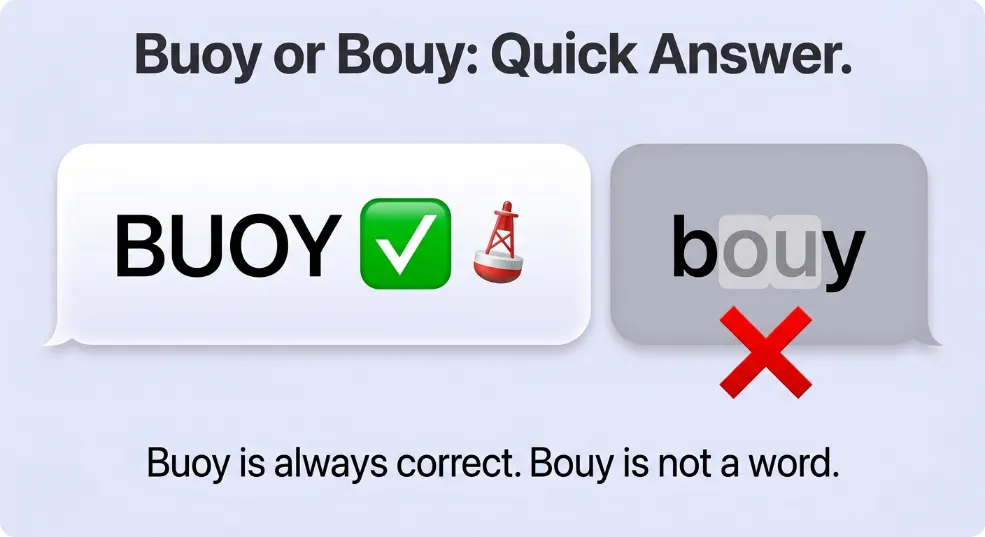
Quick Answer: Buoy is the correct spelling. Bouy is a common misspelling with no accepted meaning in standard English. Example: The sailboat steered carefully around the warning buoy.
A friend of mine works at a marina, and she once helped design a safety sign that read, “Stay clear of the bouy.” A visiting inspector pointed out the mistake during a routine check, and the sign had to be reprinted before it could go up along the dock. She laughed about it later, admitting she always mixes up the letter order in that word.
That kind of slip happens more than people expect, especially with words where the vowels don’t line up the way they sound. Buoy is a great example, since its spelling doesn’t match its pronunciation in an intuitive way at all.
If buoy or bouy has ever made you pause before typing, this guide will clear it up for good. We’ll walk through the correct spelling, the reasoning behind it, and plenty of real examples, so you never have to second-guess it again.
Buoy or Bouy: Quick Answer
Buoy is the correct spelling.
Bouy is incorrect in standard English.
Always use buoy, whether describing the object or the verb.
Examples
- The red buoy marked the edge of the channel.
- Good news helped buoy her spirits after a tough week.
Incorrect Example
- The red bouy marked the edge of the channel.
What Does “Buoy” Mean?
Buoy most commonly refers to a floating marker anchored in water, used to guide boats, mark hazards, or indicate specific locations. It also functions as a verb, meaning to keep something afloat, or figuratively, to support or lift someone’s spirits.
Examples
- The lifeguard swam out to check the buoy line.
- Sailors use buoys to navigate safely through the harbor.
- Encouraging words helped buoy his confidence before the interview.
Because buoy covers both a physical object and a figurative action, context always decides which meaning fits.
Is “Bouy” a Real Word?
No. Bouy is simply a spelling mistake. It has no separate meaning and doesn’t appear as an accepted entry in standard dictionaries. This particular error swaps the order of the middle vowels, u and o, without changing the intended meaning at all.
Incorrect Examples
- ❌ The boat passed close to the yellow bouy.
- ❌ Her promotion helped bouy team morale.
Corrected Versions
- ✅ The boat passed close to the yellow buoy.
- ✅ Her promotion helped buoy team morale.
Why Is “Buoy” Spelled With “Uo” Instead of “Ou”?
English spelling here traces directly back to French and Dutch origins, where the word’s structure placed u before o. Despite how the word is often pronounced today, closer to “boy” or “boo-ee” depending on dialect, the spelling has remained fixed in that original order for centuries.
The Pattern
- buoy → correct
- bouy → incorrect
There’s no phonetic shortcut here. It’s simply a matter of remembering the traditional letter order, regardless of how the word sounds when spoken.
Similar Words With Unusual Vowel Order
| Word | Note |
| Buoy | Vowels ordered “u” then “o” |
| Buoyant | Follows the same pattern as “buoy” |
| Guise | Vowels ordered “u” then “i” |
Seeing these together highlights just how often English vowel order doesn’t match intuitive pronunciation.
Buoy vs Bouy: Side-by-Side Comparison

| Word | Correct or Incorrect | Meaning |
| Buoy | Correct | A floating marker, or to keep afloat or support |
| Bouy | Incorrect | No accepted meaning |
Key Takeaway
There’s no situation where bouy is the right choice. Always write buoy.
The Spelling Rule, Explained Simply
Since this isn’t governed by a transformation rule, the real skill here is memorizing the correct vowel order directly.
Step-by-Step: Locking In the Correct Spelling
Step 1: Break the word into its core letters: b-u-o-y.
Step 2: Notice the u comes before the o, not after.
Step 3: Compare it to the related word buoyant, which follows the same pattern.
Step 4: Avoid relying on how the word sounds, since pronunciation doesn’t clearly indicate letter order here.
Step 5: Practice writing it a few times until the correct sequence feels automatic.
Related Words That Share the Same Vowel Order
| Word | Meaning |
| Buoy | A floating marker, or to support |
| Buoyant | Able to float, or cheerful and optimistic |
| Buoyancy | The ability to float |
Where Does the Word “Buoy” Come From?
Buoy likely traces back to Old French or Middle Dutch, both languages with strong maritime traditions, where a similar word described a floating object used to mark locations at sea. That nautical connection makes sense, given how essential buoys have always been for guiding ships safely.
The verb meaning, describing support or upliftment, developed later, drawing on the image of something buoyant keeping a person or object afloat, whether physically in water or emotionally during a difficult time.
Why Do People Misspell “Buoy” as “Bouy”?
This mistake happens for a few clear reasons, and it’s more common than most people realize.
The Word Doesn’t Sound the Way It’s Spelled
Many people pronounce buoy closer to “boy,” which doesn’t obviously suggest a u before the o.
That mismatch between sound and spelling creates a natural opportunity for error.
The Similar Word “You” Creates Confusion
The “ou” sound in words like “you” or “out” feels more intuitive to many writers.
That familiarity can nudge the spelling in the wrong direction.
Fast Typing Encourages Small Slips
Especially in quick notes or captions, letter order can flip without anyone noticing.
How “Buoy” Shows Up in Real Life
This word appears constantly across boating, safety, and even emotional or financial contexts.
In Boating and Navigation
- Sailors rely on buoys to mark safe channels.
- The rescue team spotted the missing swimmer near a buoy.
In Safety Equipment
- Life buoys are required on most commercial vessels.
- The pool area includes several rescue buoys along the edge.
As a Verb, Figuratively
- Positive feedback helped buoy her confidence.
- Strong sales figures buoyed the company’s stock price.
“Buoy” in Everyday Writing
Emails
- Please confirm the buoy inspection schedule for next week.
News Headlines
- Rescue crews credit the buoy system for saving lives.
Social Media Posts
- Spotted this bright orange buoy during our lake trip! 🛟
Formal Reports
- The safety audit reviewed buoy placement along the coastline.
Related Words Built From “Buoy”
Knowing related forms sharpens your understanding of the word family.
| Word | Meaning |
| Buoy | A floating marker, or to support |
| Buoyant | Able to float, or cheerful in mood |
| Buoyancy | The capacity to float |
| Buoying | Present participle, describing the ongoing act of supporting |
Example Sentences
- The life jacket kept him buoyant in the water.
- Her buoyancy helped the whole team stay optimistic.
- Good news kept buoying morale throughout the project.
Also Read: Opening or Openning: Meaning, Difference & Correct Spelling
Common Mistakes People Make

Mistake 1: Swapping the Vowel Order
- ❌ The bouy marked the edge of the swimming area.
- ✅ The buoy marked the edge of the swimming area.
Mistake 2: Misspelling Related Words the Same Way
- ❌ The raft felt surprisingly bouyant in the water.
- ✅ The raft felt surprisingly buoyant in the water.
Mistake 3: Assuming Pronunciation Reveals the Spelling
- ❌ Spelling the word based purely on how it sounds.
- ✅ Memorizing the correct letter order directly, regardless of pronunciation.
Buoy vs Other Commonly Misspelled Words
This kind of vowel-order confusion shows up elsewhere too.
| Correct | Common Misspelling |
| Buoy | Bouy |
| Buoyant | Bouyant |
| Guise | Giuse |
| Believe | Beleive |
Comparing these side by side can help train your eye for similar patterns.
Easy Ways to Remember “Buoy”
Memory Trick 1
Remember the phrase “U before O,” since that’s exactly the order buoy follows.
Memory Trick 2
Pair it with buoyant, since both words share that same tricky vowel sequence.
Memory Trick 3
Picture the letters “b-u-o-y” floating in that exact order, just like the object itself floats in water.
British English vs American English

Here’s some reassuring news. There’s no split at all.
Buoy is spelled identically in every major English-speaking region.
| Region | Correct Spelling |
| American English | buoy |
| British English | buoy |
| Canadian English | buoy |
| Australian English | buoy |
Bouy stays incorrect everywhere in standard English.
Why Correct Spelling Actually Matters
A single vowel swap can leave a bigger impression than most people expect, especially on safety signage or official documents.
In Professional Writing
Misspelling this word can quietly chip away at your credibility.
- ❌ The report reviewed bouy maintenance schedules.
- ✅ The report reviewed buoy maintenance schedules.
In Maritime and Safety Contexts
Accurate spelling matters for signage, safety manuals, and official navigation charts.
In Digital Communication
Clean, correct spelling helps build trust with readers quickly.
“Buoy” in Spoken English
Spoken conversations rarely expose this mistake, since the word’s spelling doesn’t clearly match its pronunciation either way.
- The buoy bobbed gently in the waves.
- Her encouragement helped buoy the team’s spirits.
The error mostly appears in writing, where the exact letter order actually matters.
What the Usage Data Shows
Dictionaries and style guides consistently confirm one spelling.
Buoy appears as the only accepted spelling across every major English dictionary.
Bouy shows up almost entirely as a typing or spelling mistake.
Sailors, safety officials, and professional writers rely exclusively on buoy.
Common Phrases Using “Buoy”
Buoy Someone’s Spirits
- Kind words can really buoy someone’s spirits.
Life Buoy
- The ship kept several life buoys near each railing.
Buoy the Market
- Strong earnings reports helped buoy the stock market.
Anchor Buoy
- The boat tied off to a nearby anchor buoy.
More Real-Life Example Sentences
- The lighthouse and buoy worked together to guide ships safely.
- His promotion helped buoy his overall confidence at work.
- The children pointed excitedly at the bright buoy near shore.
- Rescue teams use buoys to mark hazardous underwater areas.
- The good news helped buoy the entire family’s mood.
- Divers attached a marker buoy above the shipwreck site.
- The coach’s encouragement helped buoy the struggling team.
- A small buoy floated gently near the edge of the lake.
Practice Exercise 1: Fill in the Blank
Choose the correct spelling for each sentence.
- The boat steered carefully around the warning ______. (Answer: buoy)
- Positive feedback helped ______ her confidence. (Answer: buoy)
- Divers marked the wreck site with a ______. (Answer: buoy)
Practice Exercise 2: Fix the Sentence
Rewrite each sentence with the correct spelling.
- The swimmer held onto the rescue bouy. (Answer: The swimmer held onto the rescue buoy.)
- Good news helped bouy the team’s morale. (Answer: Good news helped buoy the team’s morale.)
- The bright orange bouy marked the swim area. (Answer: The bright orange buoy marked the swim area.)
A Deeper Look at the Spelling
Why Doesn’t “Buoy” Sound the Way It’s Spelled?
Buoy entered English through French and Dutch maritime vocabulary, and its spelling never fully aligned with typical English pronunciation patterns. This mismatch is common with borrowed words, where the original spelling gets preserved even as pronunciation shifts over time within the new language.
Compare the Patterns
| Word | Sounds Like | Correct Spelling |
| Buoy | Boy or boo-ee | Buoy |
| Buoyant | Boy-ant | Buoyant |
Recognizing this mismatch helps explain why memorization matters more than sounding the word out.
Buoy or Bouy in Formal Writing
Formal writing leaves absolutely no room for the incorrect spelling.
Maritime Documentation
- The chart marked each navigational buoy along the coast.
Safety Reports
- The inspection confirmed all buoys met current regulations.
Business and Financial Writing
- Strong exports helped buoy the national economy this quarter.
Using bouy in any formal document will almost always be flagged as an error.
Words Related to Buoy
| Word | Meaning |
| Buoyant | Able to float, or cheerful in mood |
| Buoyancy | The capacity of an object to float |
| Anchor | A heavy object used to keep a vessel in place |
| Float | An object designed to stay on the water’s surface |
These related words all connect to floating, support, or staying above water, literally or figuratively.
Also Read: Greyscale or Grayscale: Meaning, Difference & Correct Spelling
Frequently Asked Questions
Is “bouy” ever an acceptable spelling?
No. It’s not accepted anywhere in standard English.
Why doesn’t “buoy” sound the way it’s spelled?
Because it entered English through French and Dutch, and its original spelling never fully matched English pronunciation habits.
Is “buoy” spelled the same worldwide?
Yes. It’s identical across British and American English.
What’s an easy way to remember the spelling?
Remember “u before o,” and pair it with buoyant, which follows the same pattern.
Does “buoy” always refer to something in water?
No, it can also describe supporting or lifting someone’s mood or confidence.
Why is this word misspelled so often?
The mismatch between pronunciation and spelling makes phonetic guessing unreliable here.
Does autocorrect usually catch this mistake?
Yes, most spellcheck tools flag “bouy” immediately as incorrect.
Final Thoughts
The debate over buoy or bouy really comes down to one simple fact. Buoy is always correct, and bouy has no accepted meaning in standard English at all.
This mistake usually happens because the word’s pronunciation doesn’t clearly reveal its correct letter order, a common issue with words borrowed from other languages. Once you memorize the “u before o” pattern directly, the correct spelling becomes much easier to lock in.
Whether you’re writing about sailing, safety equipment, or someone’s rising spirits, getting this word right adds up over time. Correct spelling makes your writing look sharper, more careful, and more credible.
Remember the shortcut: pair buoy with buoyant, and always keep that u before the o. Practice it a few times, and it will start feeling completely automatic.
Read more Topics on Meanings Hole
