


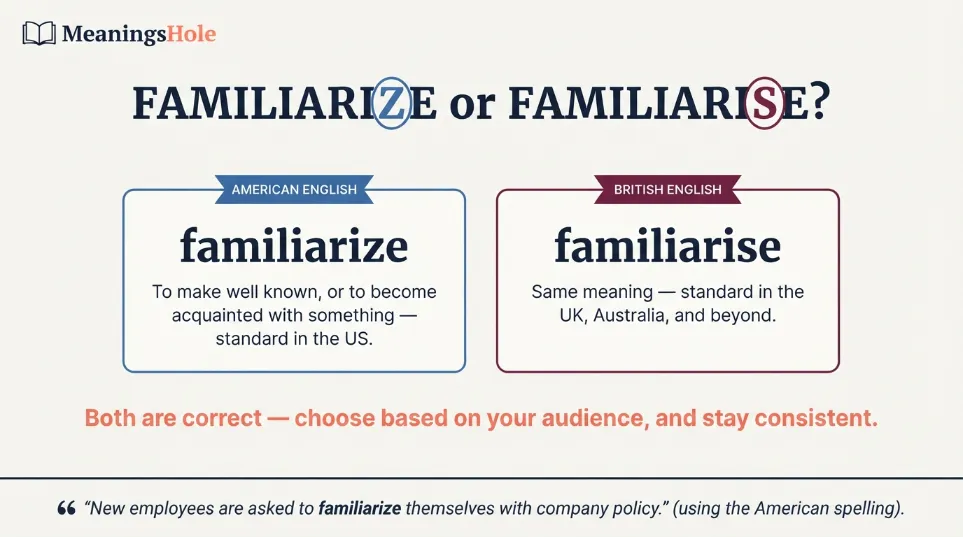
Quick Answer: Familiarize is the standard spelling in American English. Familiarise is the standard spelling in British English. Both are correct, depending on where you're writing. Example: New employees are asked to familiarize themselves with company policy.
A friend of mine moved from Toronto to Manchester for a new job, and her onboarding documents kept switching between “familiarize” and “familiarise” throughout the same packet. She assumed it was a typo at first, until her manager explained that the company simply hadn’t standardized which regional spelling to use across its global offices.
That kind of inconsistency is more common than people realize, especially inside international companies. Neither spelling is wrong on its own. They’re simply two accepted versions of the same word, shaped by where the writer learned English.
If familiarise or familiarize has ever left you unsure which one to type, this guide will clear it up for good. We’ll walk through the meaning, the reasoning, and plenty of real examples, so you always know which spelling fits your audience.
Familiarise or Familiarize: Quick Answer
Familiarize is standard in American English.
Familiarise is standard in British English.
Both spellings are correct, depending on your audience.
Examples
- Please familiarize yourself with the new software. (American)
- Please familiarise yourself with the new software. (British)
Consistency Matters
- Mixing both spellings within the same document looks inconsistent.
What Does “Familiarize” Mean?
Familiarize means to make someone or something well known, or to help someone become acquainted with a subject, place, or process. It’s the verb form of the adjective familiar.
Examples
- She familiarized herself with the city before moving.
- The manual helps users familiarize themselves with the app.
- He spent the weekend familiarizing his team with the new tools.
This spelling, with a z, is the standard form used throughout the United States and most of North America.
What Does “Familiarise” Mean?
Familiarise carries the exact same meaning as familiarize. The only difference lies in the spelling, specifically, the letter used before the -e ending. This version, with an s, is the standard form used throughout the United Kingdom, Australia, and many other English-speaking countries.
Examples
- She familiarised herself with the city before moving.
- The manual helps users familiarise themselves with the app.
- He spent the weekend familiarising his team with the new tools.
Notice the sentences carry identical meaning. Only the regional spelling convention changes.
Why Do These Two Spellings Exist?
This split isn’t about one version being right and the other wrong. It comes down to a much bigger pattern in English spelling history, involving many -ize and -ise word pairs.
American English generally settled on -ize endings, influenced heavily by dictionary reforms in the early 1800s. British English largely kept -ise endings, closer to earlier French spelling influences, though usage still varies somewhat within the UK itself.
The Pattern
- familiarize → correct in American English
- familiarise → correct in British English
This isn’t a spelling mistake pattern, like dropping a letter. It’s a genuine regional variation, accepted on both sides.
Familiarize vs Familiarise: Side-by-Side Comparison

| Word | Region | Meaning |
| Familiarize | American English (standard) | To become acquainted with something |
| Familiarise | British English (standard) | To become acquainted with something |
Key Takeaway
Choose the spelling that matches your audience, and stay consistent throughout your writing.
The Spelling Pattern, Explained Simply
Since this isn’t a right-or-wrong situation, the real skill is recognizing which regional convention applies to your writing.
Step-by-Step: Choosing the Right Spelling
Step 1: Identify your primary audience or publication style guide.
Step 2: If writing for an American audience, use familiarize.
Step 3: If writing for a British, Australian, or similar audience, use familiarise.
Step 4: Check whether your company or platform has an official style guide.
Step 5: Stay consistent throughout the entire document, never mixing both spellings.
Other Words Following This Same Pattern
| American English | British English |
| Organize | Organise |
| Realize | Realise |
| Recognize | Recognise |
| Emphasize | Emphasise |
Where Does the Word “Familiarize” Come From?
Familiarize, and its British counterpart familiarise, both trace back to the Latin word familiaris, meaning “belonging to a household” or “well-known.” That root also gives English words like family and familiar, all connected to closeness and shared understanding.
The verb form developed to describe the process of becoming comfortable or acquainted with something new, whether that meant a place, a task, or a piece of information. As American and British spelling conventions diverged, this word followed the same -ize versus -ise split seen across dozens of similar verbs.
Why Do People Get Confused Between the Two?
This mix-up happens for a few clear reasons, and it’s more understandable than most people realize.
Global Content Blurs Regional Lines
The internet mixes American and British writing constantly.
That constant exposure makes both spellings feel equally familiar.
Spellcheck Tools Often Default to One Region
Many writing tools are set to American English by default.
That can quietly “correct” a perfectly valid British spelling.
International Companies Don’t Always Standardize Spelling
Employees writing across global teams don’t always know which spelling applies.
Without clear guidance, inconsistency becomes common.
How These Words Show Up in Real Life
Both spellings appear constantly across workplaces, education, and everyday writing, depending on the audience.
In American Workplaces
- New hires familiarize themselves with the employee handbook.
- She familiarized her team with the updated procedures.
In British Workplaces
- New hires familiarise themselves with the employee handbook.
- She familiarised her team with the updated procedures.
In Education
- Students are encouraged to familiarize themselves with the syllabus. (American)
- Students are encouraged to familiarise themselves with the syllabus. (British)
These Words in Everyday Writing
Emails
- Please take time to familiarize yourself with the attached guide. (American)
- Please take time to familiarise yourself with the attached guide. (British)
News Headlines
- Officials urge residents to familiarize themselves with new regulations. (American)
- Officials urge residents to familiarise themselves with new regulations. (British)
Social Media Posts
- Spent the weekend familiarizing myself with my new city! (American)
- Spent the weekend familiarising myself with my new city! (British)
Formal Reports
- Staff must familiarize themselves with updated safety protocols. (American)
- Staff must familiarise themselves with updated safety protocols. (British)
Also Read: Leasee or Lessee: Meaning, Difference & Correct Spelling
Related Words and Forms
Knowing related forms sharpens your understanding of the entire word family.
| Word | Meaning |
| Familiar | Well known, or easily recognized |
| Familiarity | Close knowledge or understanding of something |
| Familiarized / Familiarised | Past tense of the verb |
| Unfamiliar | Not known or recognized |
Example Sentences
- The route felt familiar after a few visits.
- Her familiarity with the software impressed the interviewer.
- He familiarized himself with local customs. (American)
- He familiarised himself with local customs. (British)
Common Mistakes People Make

Mistake 1: Mixing Both Spellings in One Document
- ❌ We familiarised the team, then later familiarized new hires.
- ✅ We familiarised the team, then later familiarised new hires.
Mistake 2: Assuming One Spelling Is Simply Wrong
- ❌ “Familiarise” is a misspelling of “familiarize.”
- ✅ Both spellings are correct, depending on regional convention.
Mistake 3: Ignoring Style Guide Requirements
- ❌ Submitting American spelling to a British publication without checking guidelines.
- ✅ Always confirm which spelling convention your publication or company expects.
Familiarize vs Familiarise: Which One Fits?
This trips up even experienced writers, especially on international teams.
| Word | Used For |
| Familiarize | American English audiences and style guides |
| Familiarise | British, Australian, and similar style guides |
Examples
- The US-based company asked staff to familiarize with new tools.
- The UK-based company asked staff to familiarise with new tools.
- Both terms describe identical meaning and process.
Similar American vs British Word Pairs
This kind of -ize versus -ise pattern shows up across many related words.
| American English | British English |
| Organize | Organise |
| Realize | Realise |
| Recognize | Recognise |
| Emphasize | Emphasise |
Recognizing this broader pattern makes the familiarize pair much easier to remember.
Easy Ways to Remember Familiarize and Familiarise
Memory Trick 1
Z for the USA. Both letters feel bold and direct, matching American spelling.
Memory Trick 2
S for the UK, sharing that same letter with “Britain’s” spelling style overall.
Memory Trick 3
When unsure, check your document’s existing spelling of similar words, like “organize” or “organise,” for consistency.
British English vs American English
This is really the heart of the entire distinction.
| Region | Standard Spelling |
| American English | familiarize |
| British English | familiarise |
| Canadian English | familiarize (commonly, though both appear) |
| Australian English | familiarise |
Canadian English sometimes blends both conventions, so checking local style guides remains helpful there.
Why Correct Spelling Actually Matters
Choosing the right regional spelling can leave a stronger impression than most people expect.
In Professional Writing
Using the wrong regional spelling can feel slightly off to your target audience.
- If writing for a British client, “familiarise” signals attention to detail.
- If writing for an American client, “familiarize” does the same.
In Academic Writing
Universities and journals often specify which spelling convention to follow.
In Digital Communication
Matching your audience’s expected spelling builds trust and feels more natural to readers.
Familiarize and Familiarise in Spoken English
Spoken conversations rarely reveal this difference at all, since both words sound nearly identical.
- She wanted to familiarize herself with the new role.
- She wanted to familiarise herself with the new role.
The distinction matters almost entirely in writing, not speech.
What the Usage Data Shows
Dictionaries and style guides consistently confirm both spellings as valid.
Familiarize dominates in American publications, education, and business writing.
Familiarise dominates in British, Australian, and many international publications.
Editors typically choose one spelling and apply it consistently throughout a single piece of writing.
Common Phrases Using These Words
Familiarize Yourself With
- Please familiarize yourself with the updated schedule. (American)
Take Time to Familiarise
- Take time to familiarise yourself with the local customs. (British)
Familiarize the Team
- We spent the morning familiarizing the team with new software. (American)
Fully Familiarised
- She felt fully familiarised with the process by day two. (British)
More Real-Life Example Sentences
- New students familiarize themselves with campus resources. (American)
- New students familiarise themselves with campus resources. (British)
- The pilot familiarized herself with the aircraft’s controls. (American)
- The pilot familiarised herself with the aircraft’s controls. (British)
- Volunteers were asked to familiarize themselves with safety guidelines. (American)
- Volunteers were asked to familiarise themselves with safety guidelines. (British)
- He quickly familiarized himself with the neighborhood. (American)
- He quickly familiarised himself with the neighbourhood. (British)
Practice Exercise 1: Fill in the Blank
Choose the correct spelling based on the region noted.
- (American) Please ______ yourself with the manual. (Answer: familiarize)
- (British) Please ______ yourself with the manual. (Answer: familiarise)
- (American) She quickly ______ herself with the software. (Answer: familiarized)
Practice Exercise 2: Identify the Region
Read each sentence and identify which English convention it follows.
- “New staff familiarise themselves with the handbook.” (Answer: British English)
- “New staff familiarize themselves with the handbook.” (Answer: American English)
- “He familiarised himself with the city map.” (Answer: British English)
A Deeper Look at the Spelling Split

Why Did English Split Into Two Spelling Systems?
American English spelling reforms in the early 1800s, largely credited to lexicographer Noah Webster, intentionally simplified and standardized many word endings, including shifting -ise toward -ize. British English largely resisted these changes, keeping closer ties to earlier spelling traditions rooted in French.
Compare the Patterns
| Ending Type | American Example | British Example |
| -ize / -ise | Familiarize | Familiarise |
| -ized / -ised | Familiarized | Familiarised |
This historical split explains why so many related words follow the exact same dual-spelling pattern.
Familiarise or Familiarize in Formal Writing
Formal writing calls for extra attention to regional consistency.
American Business Writing
- New employees must familiarize themselves with company policy.
British Business Writing
- New employees must familiarise themselves with company policy.
International Publications
- Some global publications choose one spelling and apply it universally, regardless of the writer’s background.
Mixing spellings within a single formal document tends to look inconsistent and unpolished.
Words Related to Familiarize and Familiarise
| Word | Meaning |
| Familiar | Well known or easily recognized |
| Familiarity | Close knowledge or understanding of something |
| Acquaint | To make someone aware of or familiar with something |
| Orient | To help someone become adjusted to a new situation |
These related words all connect to the same underlying idea, becoming comfortable or knowledgeable about something new.
Also read: Devide or Divide: Meaning, Difference, Grammar Rules, Examples, and Correct Usage
Frequently Asked Questions
Is “familiarise” a misspelling of “familiarize”?
No. Both are correct, standard spellings, depending on regional English conventions.
Which spelling should I use for a global audience?
Check your company or platform’s style guide; many default to American spelling for international content.
Why do some British style guides also use “z,” like “organize”?
Certain British dictionaries, including some Oxford references, accept “-ize” endings too, though “-ise” remains more common overall.
Is Canadian English closer to American or British spelling?
It often blends both, though “familiarize” tends to appear more frequently in Canadian writing.
Does the noun “familiarity” change between regions?
No, “familiarity” stays the same in both American and British English.
Should I switch spellings depending on who I’m emailing?
Yes, adapting to your recipient’s regional convention is considered good etiquette.
Is it ever acceptable to mix both spellings in one document?
No. Consistency throughout a single piece of writing is always recommended.
Final Thoughts
The debate over familiarise or familiarize really comes down to regional spelling convention, not right versus wrong. Familiarize fits American English audiences, while familiarise fits British, Australian, and many international audiences.
This same -ize versus -ise pattern extends across many related words, like organize/organise and recognize/recognise. Recognizing that broader pattern makes choosing the right spelling much easier going forward.
Whether you’re writing an onboarding guide, a business report, or an email to an international client, matching your audience’s spelling convention adds up over time. Consistent, correctly matched spelling makes your writing look polished, professional, and audience-aware.
Remember the shortcut: Z for American English, S for British English. Practice it a few times, and choosing the right version will start feeling completely automatic.
Read more Topics on Meanings Hole
