


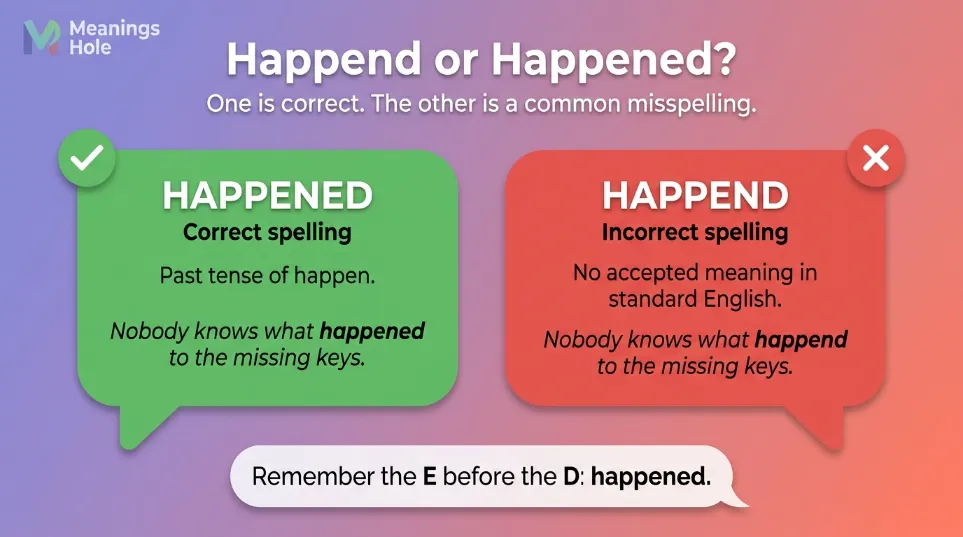
Quick Answer: Happened is the correct spelling. Happend is a common misspelling with no accepted meaning in standard English. Example: Nobody knows what happened to the missing keys.
“What happened?” might be the most repeated question in the English language. People ask it after a power cut, a surprise result, a missing sandwich, or a sudden silence in a group chat. It’s short, familiar, and used so often that you’d think nobody could get it wrong.
Yet in fast typing, a tiny letter near the end quietly disappears. The word still looks nearly complete. It still sounds exactly the same out loud. And that’s why the shortened version slips past so many readers, and so many writers too.
If happened or happend has ever made you pause before pressing send, here’s exactly why one version is correct, along with plenty of examples to help the spelling stay put.
Happend or Happened: Quick Answer
Happened is the correct spelling.
Happend is incorrect in standard English.
Always use happened when describing something that took place in the past.
Examples
- Something strange happened at the office today.
- She told us exactly what happened during the trip.
Incorrect Example
- Something strange happend at the office today.
What Does “Happened” Mean?
Happened is the past tense of the verb happen. It describes an event or situation that took place at some point before now, whether it was planned or unexpected.
Examples
- The accident happened late last night.
- Nothing much happened during the meeting.
- I wonder what happened to our old neighbors.
Whenever you’re describing something that already took place, happened is the correct word.
Is “Happend” a Real Word?
No. Happend is simply a spelling mistake. It has no separate meaning and doesn’t appear as an accepted entry in standard dictionaries. This particular error drops the letter e before the final d, without changing the intended meaning at all.
Incorrect Examples
- ❌ I don’t know what happend to the package.
- ❌ It all happend so quickly.
Corrected Versions
- ✅ I don’t know what happened to the package.
- ✅ It all happened so quickly.
Why Is “Happened” Spelled With “-ed” at the End?
English forms the past tense of most regular verbs by adding -ed to the base word. Happen is a regular verb, so it follows that same pattern. The e in -ed isn’t optional. It’s part of the ending that marks the past tense.
The Pattern
- happen + ed → happened
Because happen ends in n, the -ed simply attaches to the end with no other changes.
The Incorrect Pattern
- happen + d → happend ❌
This version treats the ending as a lone d, which only works for verbs that already end in e, like hope → hoped.
Happened vs Happend: Side-by-Side Comparison

| Word | Correct or Incorrect | Meaning |
| Happened | Correct | Past tense of happen, took place |
| Happend | Incorrect | No accepted meaning |
Key Takeaway
There’s no situation where happend is the right choice. Always write happened.
The Grammar Rule, Explained Simply
This connects to a basic spelling pattern for regular past-tense verbs.
Rule for Regular Past-Tense Verbs
Most regular verbs add -ed to the end of the base word to show past tense. If the base word already ends in e, add only -d.
Step-by-Step: Turning Happen Into Happened
Step 1: Start with the base verb happen.
Step 2: Check the last letter. It’s n, not e.
Step 3: Because it doesn’t end in e, add the full -ed ending.
Step 4: You land on happened.
Step 5: Notice that the n does not double, since the stress falls on the first syllable (HAP-pen).
Verbs That Follow the Same Pattern
| Base Verb | Correct Past Tense |
| Happen | Happened |
| Open | Opened |
| Listen | Listened |
| Visit | Visited |
Verbs That Only Add “-D”
| Base Verb | Correct Past Tense |
| Hope | Hoped |
| Move | Moved |
| Love | Loved |
Where Does the Word “Happen” Come From?
Happen traces back to Middle English, built from an older word, hap, meaning “chance” or “luck.” That same root shows up in words like happy, perhaps, and mishap, all connected to the idea of events falling into place by chance.
Over time, happen settled into its modern meaning of “to take place.” Because it’s a regular verb, it follows the standard -ed pattern for the past tense, leaving us with happened.
Why Do People Misspell “Happened” as “Happend”?
This mistake happens for a few clear reasons, and it’s more common than most people realize.
The “E” Is Silent in Speech
Say “happened” out loud, and you hear a soft “d” sound at the end. The e isn’t pronounced.
That makes it easy to leave the letter out while typing.
Some Verbs Really Do Only Add “-D”
Verbs like hoped and moved add just a d.
That familiar pattern can mistakenly carry over to verbs like happen.
Fast Typing Encourages Small Slips
Especially in texts and quick comments, a small vowel can slip out unnoticed.
How “Happened” Shows Up in Real Life
This word appears constantly across news, storytelling, and everyday conversation.
In Storytelling
- Let me tell you what happened on my first day.
- Nobody believed what happened next.
In News and Reporting
- Police are investigating what happened at the scene.
- Witnesses described what happened before the storm hit.
In Everyday Conversation
- What happened to your phone screen?
- That happened to me last year, too.
“Happened” in Everyday Writing
Emails
- I wanted to explain what happened during yesterday’s call.
News Headlines
- Officials explain what happened before the power outage.
Social Media Posts
- You won’t believe what happened at the grocery store today! 😂
Formal Reports
- The report summarizes what happened during the incident.
Related Words Built From “Happen”
Knowing related forms sharpens your understanding of the word family.
| Word | Meaning |
| Happen | To take place |
| Happened | Past tense of happen |
| Happening | Present participle, or an event taking place |
| Happenstance | A chance event or coincidence |
Example Sentences
- Whatever happens, we’ll figure it out together.
- Something exciting is happening downtown tonight.
- Meeting her was pure happenstance.
Also Read: Fryed or Fried: Meaning, Difference, Grammar Rules, Examples, and Correct Usage
Common Mistakes People Make

Mistake 1: Dropping the “E” Before the “D”
- ❌ I’m not sure what happend yesterday.
- ✅ I’m not sure what happened yesterday.
Mistake 2: Doubling the “N” by Mistake
- ❌ The accident happenned near the bridge.
- ✅ The accident happened near the bridge.
Mistake 3: Using the Wrong Tense
- ❌ Yesterday, something strange happens at work.
- ✅ Yesterday, something strange happened at work.
Happened vs Other Commonly Misspelled Past-Tense Words
This kind of dropped-letter confusion shows up elsewhere too.
| Correct | Common Misspelling |
| Happened | Happend |
| Opened | Opend |
| Listened | Listend |
| Occurred | Occured |
Comparing these side by side can help train your eye for similar patterns.
Easy Ways to Remember “Happened”
Memory Trick 1
Pair it with opened and listened, since all three add the full -ed ending.
Memory Trick 2
Remember: only verbs that already end in e add just a d.
Memory Trick 3
Say the word slowly, “hap-pened,” and picture all three letters at the end: e, then d.
British English vs American English

Here’s some reassuring news. There’s no split at all.
Happened is spelled identically in every major English-speaking region.
| Region | Correct Spelling |
| American English | happened |
| British English | happened |
| Canadian English | happened |
| Australian English | happened |
Happend stays incorrect everywhere in standard English.
Why Correct Spelling Actually Matters
A single missing letter can leave a bigger impression than most people expect.
In Professional Writing
Misspelling this word can quietly chip away at your credibility.
- ❌ Please explain what happend during the meeting.
- ✅ Please explain what happened during the meeting.
In Academic Writing
Spelling accuracy often shapes how essays and reports get graded.
In Digital Communication
Clean, correct spelling helps build trust with readers quickly.
“Happened” in Spoken English
Spoken conversations never expose this mistake at all, since the word sounds the same either way when spoken aloud.
- Tell me exactly what happened.
- It happened faster than anyone expected.
The error only appears in writing, where the missing letter becomes visible.
What the Usage Data Shows
Dictionaries and style guides consistently confirm one spelling.
Happened appears as the only accepted spelling across every major English dictionary.
Happend shows up almost entirely as a typing or spelling mistake.
Editors, reporters, and professional writers rely exclusively on happened.
Common Phrases Using “Happened”
What Happened
- Can someone explain what happened here?
As It Happened
- The reporter described the event as it happened.
It Just Happened
- We didn’t plan it, it just happened.
Whatever Happened To
- Whatever happened to that old music shop downtown?
More Real-Life Example Sentences
- The accident happened just after sunrise.
- She asked me what happened during the game.
- Nothing unusual happened during the entire trip.
- It all happened so fast that nobody could react.
- I still remember exactly what happened that day.
- The story happened long before I was born.
- Tell me what happened after you left the party.
- Something funny happened on the way to the store.
Practice Exercise 1: Fill in the Blank
Choose the correct spelling for each sentence.
- Nobody knows what ______ to the missing book. (Answer: happened)
- The accident ______ late last night. (Answer: happened)
- It all ______ so quickly. (Answer: happened)
Practice Exercise 2: Fix the Sentence
Rewrite each sentence with the correct spelling.
- I don’t know what happend yesterday. (Answer: I don’t know what happened yesterday.)
- It happend right in front of us. (Answer: It happened right in front of us.)
- Tell me what happend at the meeting. (Answer: Tell me what happened at the meeting.)
A Deeper Look at the Grammar Rule
Why Doesn’t “Happen” Double Its Final “N”?
English doubles a final consonant before -ed only when the stress falls on the last syllable. Happen places its stress on the first syllable (HAP-pen), so the n stays single. That’s why the correct past tense is happened, not happenned.
Compare the Patterns
| Word | Stress Location | Doubles Before “-ed”? |
| Happen | First syllable | No → happened |
| Admit | Second syllable | Yes → admitted |
| Open | First syllable | No → opened |
| Prefer | Second syllable | Yes → preferred |
Recognizing this stress-based pattern explains why happened has just one n.
Happend or Happened in Formal Writing
Formal writing leaves absolutely no room for the incorrect spelling.
Business Writing
- The report explains what happened during the system outage.
Academic Writing
- The paper reviews what happened during the historical event.
Journalism
- The article describes what happened at the community meeting.
Using happend in any formal document will almost always be flagged as an error.
Words Related to Happened
| Word | Meaning |
| Occurred | Took place, often in a more formal tone |
| Took place | Happened, often used for planned events |
| Transpired | Happened, often used in formal writing |
| Unfolded | Developed or happened gradually |
These related words all connect to the idea of something taking place in the past.
Also Read: Instable or Unstable: Meaning, Difference & Correct Usage
Frequently Asked Questions
Is “happend” ever an acceptable spelling?
No. It’s not accepted anywhere in standard English.
Why does “happened” end in “-ed”?
Because happen is a regular verb, and regular verbs form the past tense by adding -ed.
Is “happened” spelled the same worldwide?
Yes. It’s identical across British and American English.
What’s an easy way to remember the spelling?
Pair it with opened and listened, since all three add the full -ed ending.
Does “happened” have one N or two?
One. The stress falls on the first syllable, so the n doesn’t double.
Why is this word misspelled so often?
The e isn’t pronounced, and some verbs only add a d, so the rule can blur.
Does autocorrect usually catch this mistake?
Yes, most spellcheck tools flag “happend” immediately as incorrect.
Final Thoughts
The debate over happend or happened really comes down to one simple fact. Happened is always correct, and happend has no accepted meaning in standard English at all.
This mistake usually happens because the e in the ending is silent when spoken, and because some verbs only add a d. Once you connect happened to words like opened and listened, the correct ending becomes much easier to lock in.
Whether you’re telling a story, writing an email, or reporting on an event, getting this word right adds up over time. Correct spelling makes your writing look sharper, more careful, and more credible.
Remember the shortcut: pair happened with opened and listened, since all three take the full -ed ending. Practice it a few times, and it will start feeling completely automatic.
