


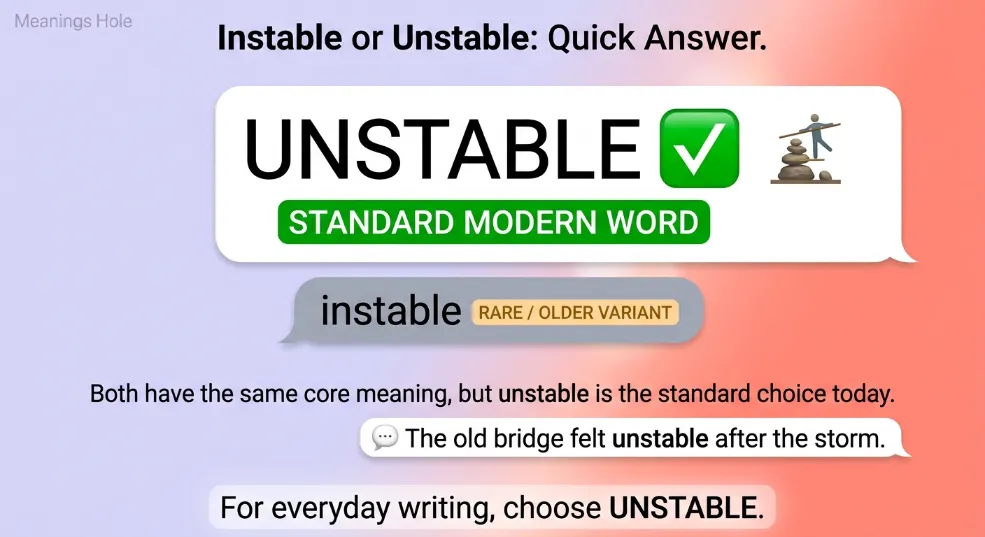
Quick Answer: Unstable is the standard, everyday word for something not firm, steady, or secure. Instable is a rare, older variant with the same meaning, but it rarely appears in modern writing. Example: The old bridge felt unstable after the storm.
Spell-check rarely flags instable. Open a dictionary, and you’ll actually find it listed as a real word. So why does it feel so wrong the moment you type it? The answer isn’t about correctness at all. It’s about how English quietly picked a favorite between two nearly identical words, centuries ago, and never looked back.
This is one of those rare cases where the “incorrect-sounding” option isn’t actually incorrect. It’s just old-fashioned, tucked into a small corner of the language that most people never encounter. Understanding why helps explain a whole category of similar English word pairs.
If instable or unstable has ever made you double-check a sentence, this guide breaks down exactly what’s going on, with plenty of examples to make the distinction stick.
Instable or Unstable: Quick Answer
Unstable is the standard, modern word.
Instable is a rare, older variant with the same meaning.
For everyday writing, always use unstable.
Examples
- The chemical compound became unstable at high temperatures.
- He felt emotionally unstable after the difficult news.
Rare, Older Example
- The patient’s condition was described as instable.
What Does “Unstable” Mean?
Unstable describes something that lacks firmness, steadiness, or balance. It applies to physical structures, emotional states, chemical compounds, political situations, and countless other contexts where something isn’t holding steady.
Examples
- The old ladder felt unstable on the uneven ground.
- Her mood had been unstable since the stressful week began.
- The region’s political situation remains highly unstable.
Whenever you’re describing something lacking balance or steadiness, unstable is the word nearly everyone reaches for.
What Does “Instable” Mean?
Instable carries the exact same core meaning as unstable, describing something unsteady or lacking firmness. It exists in dictionaries as a legitimate word, though it’s labeled as rare or archaic in most modern references.
Examples
- Historical texts sometimes describe conditions as instable.
- Older medical literature occasionally used instable rather than unstable.
- Some scientific writing from earlier centuries favored instable.
Notice that instable isn’t wrong, exactly. It’s simply fallen out of everyday use, replaced almost entirely by unstable.
Why Do Both Words Exist?
English often builds negative adjectives using either the prefix un- or in-, both roughly meaning “not.” Historically, both prefixes competed to attach to the word stable, and for a while, both unstable and instable appeared in written English.
Over time, unstable won out almost completely, becoming the standard form taught in schools and used across professional writing. Instable survived only in scattered historical texts, technical fields, and dictionaries that preserve older or rarer word forms.
The Pattern
- un- + stable → unstable (standard, modern)
- in- + stable → instable (rare, older)
Unstable vs Instable: Side-by-Side Comparison

| Word | Status | Meaning |
| Unstable | Standard, modern | Lacking firmness, steadiness, or balance |
| Instable | Rare, archaic | Lacking firmness, steadiness, or balance |
Key Takeaway
Use unstable in virtually all writing today. Save instable for historical or specialized references only.
The Usage Rule, Explained Simply
Since both words share the same meaning, the real skill here is recognizing which one fits modern, everyday communication.
Step-by-Step: Choosing the Right Word
Step 1: Ask whether you’re writing for a modern, general audience.
Step 2: If yes, always choose unstable.
Step 3: Ask if you’re quoting, translating, or referencing a historical text.
Step 4: If yes, instable may appear as written in the original source.
Step 5: When in doubt, unstable is almost always the safer, clearer choice.
Where Each Word Typically Appears
| Setting | Likely Word |
| Everyday conversation | Unstable |
| Modern scientific writing | Unstable |
| Historical or archival texts | Instable (occasionally) |
| Certain older medical literature | Instable (rarely) |
Where Do These Words Come From?
Both words trace back to Latin, built from the root stabilis, meaning “firm” or “steady.” That root also gives English words like stability and establish, all connected to the idea of standing firmly in place.
The prefixes un- and in- both entered English through slightly different paths, one rooted more in Old English, the other borrowed more directly from Latin negation. Since both attached comfortably to stable, English speakers used both forms for a time, before usage patterns gradually settled almost entirely on unstable.
Why Do People Get Confused Between the Two?
This mix-up happens for a few clear reasons, and it’s more understandable than most people realize.
Both Prefixes Feel Equally Valid
English uses in- constantly, in words like inactive and incomplete.
That familiarity can make instable feel just as natural as unstable.
Instable Still Appears in Dictionaries
Since it’s technically a real word, some writers assume it’s simply an alternate spelling.
That assumption isn’t entirely wrong, but it overlooks how rarely the word actually gets used today.
Older or Translated Texts Sometimes Use It
Historical documents and certain translated scientific texts occasionally favor instable.
Readers encountering these sources may mistakenly assume it’s the more “proper” or formal choice.
How These Words Show Up in Real Life
Unstable shows up constantly across everyday writing, science, and conversation. Instable appears almost exclusively in older or specialized texts.
In Everyday Writing
- The shelf felt unstable after the earthquake.
- Their friendship became unstable after the argument.
In Science and Medicine
- The compound proved unstable at room temperature.
- Doctors described the patient’s vital signs as unstable.
In Historical or Archival Texts
- Nineteenth-century medical journals occasionally used instable.
- Older engineering reports sometimes favored instable over unstable.
These Words in Everyday Writing
Emails
- The server has been unstable since last night’s update.
News Headlines
- Economists warn of an increasingly unstable housing market.
Social Media Posts
- My internet connection has been so unstable today! 😩
Formal Reports
- The report identified several unstable variables in the model.
Related Words and Forms
Knowing related forms sharpens your understanding of each word.
| Word | Type | Example |
| Stable | Adjective | The structure remained stable during the storm. |
| Stability | Noun | Financial stability took years to achieve. |
| Unstable | Adjective | The chemical reaction became unstable quickly. |
| Instability | Noun | Political instability affected the region for years. |
Example Sentences
- The company achieved financial stability after years of effort.
- The region has faced ongoing political instability.
- Her mood swings made the relationship feel unstable.
Also Read: Fryed or Fried: Meaning, Difference, Grammar Rules, Examples, and Correct Usage
Common Mistakes People Make

Mistake 1: Using “Instable” in Everyday Writing
- ❌ The Wi-Fi connection has been instable all week.
- ✅ The Wi-Fi connection has been unstable all week.
Mistake 2: Assuming “Instable” Sounds More Formal
- ❌ Choosing “instable” over “unstable” to sound more academic.
- ✅ “Unstable” remains the correct, formal choice in nearly all writing.
Mistake 3: Mixing Both Words Within the Same Document
- ❌ The bridge was instable, though the tower remained unstable too.
- ✅ Staying consistent by using “unstable” throughout.
Unstable vs Instable: Which One Fits?
This trips up even careful writers occasionally, mostly out of unfamiliarity with instable.
| Word | Used For |
| Unstable | Virtually all modern writing and conversation |
| Instable | Rare, historical, or specialized references only |
Examples
- The ladder felt unstable on the uneven floor.
- The medication helped stabilize his previously unstable condition.
- Some older texts describe similar situations as instable.
Similar English Prefix Pairs Worth Knowing
This kind of overlapping prefix history shows up elsewhere too.
| Word Pair | Standard Modern Form |
| Inflammable / Flammable | Both technically mean “capable of burning” |
| Irregardless / Regardless | “Regardless” is standard; “irregardless” is nonstandard |
| Instable / Unstable | “Unstable” is standard; “instable” is rare |
Comparing pairs like these shows how English sometimes keeps two competing forms alive, even after one clearly becomes dominant.
Easy Ways to Remember Unstable and Instable
Memory Trick 1
Unstable starts like unsteady, another common “un-” word describing shakiness.
Memory Trick 2
If a word feels unfamiliar or old-fashioned, like instable, it’s probably the rarer choice.
Memory Trick 3
When unsure, default to unstable. It fits nearly every situation correctly.
British English vs American English

Here’s some reassuring news. There’s no meaningful split.
Unstable stays standard across every major English-speaking region.
| Region | Standard Word |
| American English | unstable |
| British English | unstable |
| Canadian English | unstable |
| Australian English | unstable |
Instable remains rare and largely historical everywhere it’s used.
Why Correct Usage Actually Matters
Choosing the standard word can leave a clearer, more polished impression than most people expect.
In Professional Writing
Using instable by accident can look like an unfamiliar or outdated choice to most readers.
- ❌ The market conditions remained instable throughout the quarter.
- ✅ The market conditions remained unstable throughout the quarter.
In Academic Writing
Standard word choice signals familiarity with current, widely accepted English usage.
In Scientific and Technical Writing
Clarity matters most, and unstable is instantly recognizable to modern readers.
Unstable and Instable in Spoken English
Spoken conversations almost never use instable at all.
- The chair felt unstable, so I moved to another seat.
Since instable lives almost entirely in written, historical, or specialized text, you’ll rarely, if ever, hear it spoken aloud in everyday life.
What the Usage Data Shows
Dictionaries and usage data consistently confirm this distinction.
Unstable appears constantly across modern writing, speech, and professional contexts.
Instable appears rarely, mostly within older texts or specific technical fields.
Editors and professional writers rely almost exclusively on unstable.
Common Phrases Using “Unstable”
Emotionally Unstable
- He’s been emotionally unstable since the breakup.
Politically Unstable
- The country remains politically unstable after the election.
Chemically Unstable
- The compound is chemically unstable and requires careful storage.
Financially Unstable
- The startup struggled through a financially unstable first year.
More Real-Life Example Sentences
- The old fence looked unstable after years of weather damage.
- Her blood pressure has been unstable since the surgery.
- The region’s economy remains unstable due to ongoing conflict.
- The experiment produced an unusually unstable compound.
- His unstable internet connection disrupted the video call.
- The scaffolding appeared unstable, so workers avoided it.
- Their friendship felt unstable after months of miscommunication.
- The software update caused unstable performance on older devices.
Practice Exercise 1: Fill in the Blank
Choose the correct word for modern, everyday writing.
- The bridge felt ______ after the earthquake. (Answer: unstable)
- His mood has been ______ all week. (Answer: unstable)
- The compound became ______ at high temperatures. (Answer: unstable)
Practice Exercise 2: Fix the Sentence
Rewrite each sentence using the standard modern word.
- The connection has been instable since this morning. (Answer: The connection has been unstable since this morning.)
- The patient’s condition was instable overnight. (Answer: The patient’s condition was unstable overnight.)
- The old ladder felt instable on the uneven ground. (Answer: The old ladder felt unstable on the uneven ground.)
A Deeper Look at the Words
Why Did “Unstable” Win Out Over “Instable”?
Language change often comes down to habit and repetition rather than logic. Once enough writers, editors, and dictionary makers favored unstable, that preference reinforced itself over generations, gradually pushing instable into rare, specialized corners of the language, even though both technically remained grammatically valid.
Compare the Patterns
| Word | Status Today | Typical Use |
| Unstable | Standard | All modern writing |
| Instable | Rare | Historical or specialized texts |
Recognizing this shift helps explain why one word feels instantly familiar, while the other feels unusual.
Instable or Unstable in Formal Writing
Formal writing overwhelmingly favors the standard, modern term.
Business Writing
- The report flagged several unstable revenue streams.
Scientific Writing
- The reaction produced an unstable intermediate compound.
Journalism
- The article described the region’s unstable political climate.
Using instable in most formal documents today will likely read as outdated or unfamiliar to readers.
Words Related to Unstable
| Word | Meaning |
| Stable | Firm, steady, or well-balanced |
| Instability | The state of being unstable |
| Volatile | Likely to change suddenly or unpredictably |
| Precarious | Not securely held or in danger of collapse |
These related words all connect to ideas of steadiness, balance, and reliability, or the lack thereof.
Also Read: Buoy or Bouy: Meaning, Difference & Correct Spelling
Frequently Asked Questions
Is “instable” a real word?
Yes, though it’s rare and mostly found in older or specialized texts. Unstable is the standard modern choice.
Should I ever use “instable” in everyday writing?
Generally, no. Stick with unstable for nearly all modern writing and speech.
Why do both “unstable” and “instable” exist?
Both un- and in- historically attached to “stable,” but unstable became the dominant, standardized form over time.
Is this distinction the same in British English?
Yes. British and American English both favor unstable.
Does “instable” ever appear in modern scientific writing?
Rarely, though some older or translated scientific texts occasionally use it.
Why does autocorrect sometimes accept “instable”?
Because it’s a legitimate, if rare, dictionary word, some spellcheck tools don’t flag it as an error.
Is “instable” considered incorrect grammar?
Not exactly incorrect, just extremely uncommon and outdated in modern usage.
Final Thoughts
The debate over instable or unstable really comes down to recognizing a rare survivor from an older stage of English. Unstable is the word nearly everyone uses and expects today, while instable lingers only in historical texts and specialized corners of writing.
Since both technically share the same meaning, there’s no real risk in defaulting to unstable every single time. It’s clear, familiar, and instantly understood by virtually any reader.
Whether you’re describing a shaky ladder, a volatile market, or an unpredictable mood, choosing unstable keeps your writing sounding natural and current. Correct, modern word choice makes your writing feel polished and easy to follow.
Remember the shortcut: when in doubt, unstable is almost always the right call. Practice reaching for it automatically, and the rare exception, instable, will stay exactly where it belongs, tucked into the history books.
Read more Topics on Meanings Hole
