


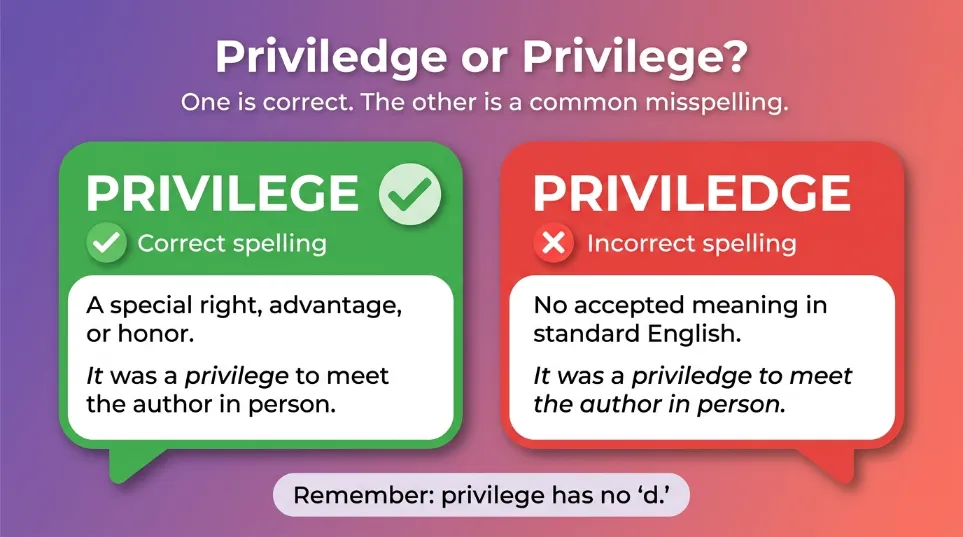
Quick Answer: Privilege is the correct spelling. Priviledge is a common misspelling with no accepted meaning in standard English. Example: It was a privilege to meet the author in person.
Wedding speeches, award ceremonies, and thank-you notes often share one tidy sentence: “It’s a privilege to be here.” It sounds warm, polished, and a little formal. That’s exactly why a misspelled version stings so much when it lands on a printed program or a slide behind the speaker.
The tricky part is that the wrong spelling looks believable. It has a familiar chunk at the end that shows up in other common words, and that chunk quietly pulls the spelling off course. Most people never notice until a red underline appears.
If privilege or priviledge has ever made you pause before writing a speech, a message, or a caption, here’s exactly why one version is correct, along with plenty of examples to help it stick.
Priviledge or Privilege: Quick Answer
Privilege is the correct spelling.
Priviledge is incorrect in standard English.
Always use privilege, whether as a noun or a verb.
Examples
- Having clean water is a privilege many people overlook.
- The club grants special privileges to its members.
Incorrect Example
- Having clean water is a priviledge many people overlook.
What Does “Privilege” Mean?
Privilege can work as a noun or a verb. As a noun, it describes a special right, advantage, or benefit given to a person or group. It can also describe a sense of honor, as in “it’s a privilege to help.” As a verb, it means to give someone an advantage or treat something as more important.
Examples
- Students earned library privileges after finishing the course.
- Many people take their daily comforts for granted, without noticing the privilege behind them.
- It was a privilege to work alongside such talented people.
Whenever you’re describing a special right, advantage, or honor, privilege is the correct word.
Is “Priviledge” a Real Word?
No. Priviledge is simply a spelling mistake. It has no separate meaning and doesn’t appear as an accepted entry in standard dictionaries. This particular error adds an extra d before the g, without changing the intended meaning at all.
Incorrect Examples
- ❌ Members enjoy priviledges at the club.
- ❌ It’s a priviledge to be part of this team.
Corrected Versions
- ✅ Members enjoy privileges at the club.
- ✅ It’s a privilege to be part of this team.
Why Is “Privilege” Spelled Without a “D”?
English spelling here traces back to Latin, where the word combined two parts: one meaning “private” and one meaning “law.” So the word originally described a “private law,” a rule that applied to one person or group. Neither part includes a d, and the spelling has stayed that way ever since.
The Pattern
- privilege → correct
- priviledge → incorrect
The word ends in -ege, not -edge. It’s simply a matter of remembering that the d doesn’t belong.
Words That Share the “-ege” Ending
| Word | Meaning |
| Privilege | A special right or advantage |
| Sacrilege | An act of disrespect toward something sacred |
| Sortilege | The practice of foretelling the future |
| College | A school for higher learning |
Seeing these together shows that -ege is a real ending in English.
Privilege vs Priviledge: Side-by-Side Comparison

| Word | Correct or Incorrect | Meaning |
| Privilege | Correct | A special right, advantage, or honor |
| Priviledge | Incorrect | No accepted meaning |
Key Takeaway
There’s no situation where priviledge is the right choice. Always write privilege.
The Spelling Rule, Explained Simply
Since this isn’t governed by a suffix rule, the real skill here is breaking the word into its smaller pieces.
Step-by-Step: Locking In the Correct Spelling
Step 1: Break the word into three parts: priv-i-lege.
Step 2: Notice the first part, priv-, looks like private.
Step 3: Notice the last part is -lege, with no d before it.
Step 4: Compare it to college, which also ends in -lege.
Step 5: Practice writing it a few times until the correct ending feels automatic.
Words That Take “-edge” vs “-ege”
| Word | Correct Ending |
| Privilege | -ege |
| College | -ege |
| Pledge | -edge |
| Knowledge | -edge |
Some words really do end in -edge, which is part of why the mix-up happens.
Where Does the Word “Privilege” Come From?
Privilege traces back to Latin, from a word combining privus, meaning “private” or “individual,” and lex, meaning “law.” Together, they described a law that applied to a single person or small group, rather than everyone.
Over time, the word moved through Old French and into English, keeping its meaning of a special right or advantage. That origin explains why the word feels formal and why the spelling includes pieces that link back to “private” and “law.”
Why Do People Misspell “Privilege” as “Priviledge”?
This mistake happens for a few clear reasons, and it’s more common than most people realize.
The Ending Sounds Like Other Words
Say “privilege” out loud, and the end sounds close to ledge or pledge.
That similarity nudges the spelling toward -ledge.
Many Common Words End in “-edge”
Words like knowledge, hedge, and bridge use a d before the g.
That familiar pattern can pull the spelling in the wrong direction.
Fast Typing Encourages Small Slips
Especially in speeches and quick notes, the extra letter can slip in unnoticed.
How “Privilege” Shows Up in Real Life
This word appears constantly across school, work, law, and everyday conversation.
In School and Work
- Seniors earn parking privileges after the first semester.
- Employees receive extra privileges after one year of service.
In Law and Politics
- Attorney-client privilege protects private conversations.
- Diplomats receive certain privileges while serving abroad.
In Everyday Conversation
- It was a privilege to meet her in person.
- Having a stable home is a privilege not everyone has.
“Privilege” in Everyday Writing
Emails
- It was a privilege to work with your team this quarter.
News Headlines
- Debate grows over membership privileges at local clubs.
Social Media Posts
- Feeling grateful for the privilege of doing work I love! 🙏
Formal Reports
- The report examines how access to resources reflects privilege.
Related Words Built From “Privilege”
Knowing related forms sharpens your understanding of the word family.
| Word | Meaning |
| Privilege | A special right, advantage, or honor |
| Privileged | Having special rights, advantages, or benefits |
| Underprivileged | Lacking the advantages many others have |
| Privileges | Plural form, more than one special right |
Example Sentences
- She felt privileged to attend the ceremony.
- The charity supports underprivileged children in the area.
- Visitors lose their privileges if they break the rules.
Also Read: Instable or Unstable: Meaning, Difference & Correct Usage
Common Mistakes People Make

Mistake 1: Adding an Extra “D”
- ❌ It’s a priviledge to speak with you today.
- ✅ It’s a privilege to speak with you today.
Mistake 2: Misspelling Related Words the Same Way
- ❌ The priviledged few had early access.
- ✅ The privileged few had early access.
Mistake 3: Misspelling the Plural
- ❌ Members lose their priviledges after three warnings.
- ✅ Members lose their privileges after three warnings.
Privilege vs Other Commonly Misspelled Words
This kind of extra-letter confusion shows up elsewhere too.
| Correct | Common Misspelling |
| Privilege | Priviledge |
| Knowledge | Knowlege |
| Separate | Seperate |
| Embarrass | Embarass |
Comparing these side by side can help train your eye for similar patterns.
Easy Ways to Remember “Privilege”
Memory Trick 1
Think of the phrase “private is a legend,” or just break it into priv-i-lege.
Memory Trick 2
Pair it with college, since both words end in -lege.
Memory Trick 3
Remember: privilege has no d. If you picture the word ledge, cross it out.
British English vs American English

Here’s some reassuring news. There’s no split at all.
Privilege is spelled identically in every major English-speaking region.
| Region | Correct Spelling |
| American English | privilege |
| British English | privilege |
| Canadian English | privilege |
| Australian English | privilege |
Priviledge stays incorrect everywhere in standard English.
Why Correct Spelling Actually Matters
A single extra letter can leave a bigger impression than most people expect.
In Professional Writing
Misspelling this word can quietly chip away at your credibility.
- ❌ Please review the access priviledges for each user.
- ✅ Please review the access privileges for each user.
In Legal and Official Writing
Terms like attorney-client privilege carry real weight, and spelling errors can look careless.
In Digital Communication
Clean, correct spelling helps build trust with readers quickly.
“Privilege” in Spoken English
Spoken conversations rarely expose this mistake, since the word sounds the same either way when spoken aloud.
- It’s a privilege to be here tonight.
- She worked hard to earn those privileges.
The error mostly appears in writing, where the extra letter becomes visible.
What the Usage Data Shows
Dictionaries and style guides consistently confirm one spelling.
Privilege appears as the only accepted spelling across every major English dictionary.
Priviledge shows up almost entirely as a typing or spelling mistake.
Editors, lawyers, and professional writers rely exclusively on privilege.
Common Phrases Using “Privilege”
It’s a Privilege
- It’s a privilege to serve this community.
Attorney-Client Privilege
- Attorney-client privilege protects private conversations.
Special Privileges
- Premium members receive special privileges.
Check Your Privilege
- The speaker asked everyone to reflect on their own privilege.
More Real-Life Example Sentences
- Students lose computer privileges if they ignore the rules.
- It was a privilege to learn from such a great teacher.
- The program offers extra privileges for early members.
- Many people don’t notice the privilege of reliable transportation.
- She felt privileged to have a seat at the table.
- Parking privileges are limited to staff and visitors.
- He enjoyed the privilege of working from home.
- The club revoked his privileges after repeated violations.
Practice Exercise 1: Fill in the Blank
Choose the correct spelling for each sentence.
- It’s a ______ to meet you today. (Answer: privilege)
- Members receive special ______ at the club. (Answer: privileges)
- She felt ______ to be part of the project. (Answer: privileged)
Practice Exercise 2: Fix the Sentence
Rewrite each sentence with the correct spelling.
- It was a priviledge to work with you. (Answer: It was a privilege to work with you.)
- Staff enjoy priviledges that visitors don’t have. (Answer: Staff enjoy privileges that visitors don’t have.)
- They felt priviledged to attend the event. (Answer: They felt privileged to attend the event.)
A Deeper Look at the Spelling
Why Does This Word Attract an Extra “D”?
English has many common words ending in -edge, such as knowledge, pledge, and ledge. Because privilege ends with a similar sound, the brain often fills in a d by habit. But privilege comes from different roots, and those roots never included that letter.
Compare the Patterns
| Word | Root Idea | Correct Ending |
| Privilege | Private law | -ege |
| Knowledge | Knowing | -edge |
| College | Group, community | -ege |
Recognizing that these words come from different roots helps explain why memorizing the spelling works better than guessing from sound.
Priviledge or Privilege in Formal Writing
Formal writing leaves absolutely no room for the incorrect spelling.
Business Writing
- Employees are reminded that access privileges can be changed at any time.
Legal Writing
- The court recognized the attorney-client privilege in this case.
Journalism
- The article explores how privilege shapes access to opportunity.
Using priviledge in any formal document will almost always be flagged as an error.
Words Related to Privilege
| Word | Meaning |
| Advantage | A condition that puts someone ahead |
| Benefit | A helpful or good result |
| Right | A legal or moral claim to something |
| Honor | A feeling of great respect or pride |
These related words all connect to special rights, advantages, or a sense of respect.
Also Read: Happened or Happend: Meaning, Difference & Correct Spelling
Frequently Asked Questions
Is “priviledge” ever an acceptable spelling?
No. It’s not accepted anywhere in standard English.
Why does “privilege” have no “d”?
Because it comes from Latin roots meaning “private” and “law,” and neither part includes a d.
Is “privilege” spelled the same worldwide?
Yes. It’s identical across British and American English.
What’s an easy way to remember the spelling?
Break it into priv-i-lege, and pair it with college, since both end in -lege.
Does “privilege” always mean an advantage?
Mostly, though it can also describe an honor, as in “it’s a privilege to be here.”
Why is this word misspelled so often?
The ending sounds like -ledge, and many common words end in -edge, which pulls the spelling off course.
Does autocorrect usually catch this mistake?
Yes, most spellcheck tools flag “priviledge” immediately as incorrect.
Final Thoughts
The debate over priviledge or privilege really comes down to one simple fact. Privilege is always correct, and priviledge has no accepted meaning in standard English at all.
This mistake usually happens because the ending sounds like -ledge, and many common words really do take a d before the g. Once you connect privilege to college and break it into priv-i-lege, the correct spelling becomes much easier to lock in.
Whether you’re writing a speech, a thank-you note, or a formal report, getting this word right adds up over time. Correct spelling makes your writing look sharper, more careful, and more credible.
Remember the shortcut: pair privilege with college, since both end in -lege, with no d in sight. Practice it a few times, and it will start feeling completely automatic.
Read more Topics on Meanings Hole
